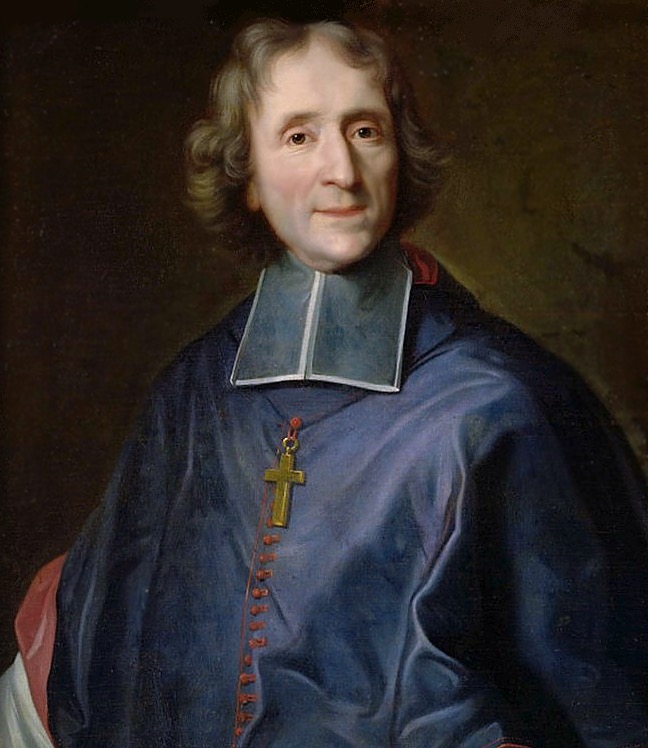
“Pure love resides only in the will. It is not a love of feeling, for the imagination has no part in it. It loves without feeling, just as faith believes without seeing.” — Fénelon, Spiritual Progress
Life
François de Salignac de la Mothe-Fénelon was born on August 6, 1651, in the château of Fénelon in Périgord, France, into a noble family (Encyclopaedia Britannica).
Around 1672 he entered the Seminary of Saint-Sulpice in Paris. He was ordained about 1675. Shortly afterward he was appointed director of the “New Catholics” (Nouvelles Catholiques), a school for young women who had converted from Protestantism, a ministry he carried on for about ten years. Out of this experience grew his Treatise on the Education of Girls (1687), in which he set out fresh ideas on the education of women (Encyclopaedia Britannica).
In 1685, when Louis XIV revoked the Edict of Nantes and outlawed Protestantism, Fénelon was sent to the region of Saintonge to work among the Huguenots. He urged the king to withdraw the dragoons and tried to win people by preaching rather than force (EBSCO Research).
In 1689, through the influence of Bishop Bossuet, Fénelon was appointed tutor to the king’s grandson, the Duke of Burgundy. For his royal pupil he wrote The Adventures of Telemachus, a kind of political parable in the form of a Greek tale. In 1693 he was elected to the Académie Française (Encyclopaedia Britannica).
The decisive spiritual turning came in October 1688 when he met Madame Jeanne Guyon. Fénelon, who had already defended the faith with his mind, now longed to know God inwardly. Through her teaching on silent prayer and the surrender of the will he found a path (Encyclopaedia Britannica).
In 1695 Fénelon was appointed archbishop of Cambrai. That same year the Conference of Issy examined Madame Guyon’s writings. Fénelon signed its thirty‑four articles. But in 1696, when Bossuet drafted a pastoral letter Instruction on the States of Prayer and sent it to Fénelon for his signature, Fénelon refused, convinced that it misquoted and misjudged Guyon’s works (Catholic Culture).
In 1697 he published Explanation of the Maxims of the Saints on the Interior Life (Explication des Maximes des Saints), a careful defence of the doctrine of pure love. Bossuet answered at once, and their controversy soon became a public storm. Louis XIV sided wholly with Bossuet, banished Fénelon from court, and confined him to his diocese in Cambrai (Encyclopaedia Britannica).
On March 12, 1699, Pope Innocent XII issued the brief Cum Alias, condemning twenty‑three propositions taken from the Maxims. Fénelon’s response astonished Europe: he submitted at once. He read the papal censure aloud in his cathedral, issued a pastoral letter withdrawing his book, and ordered all remaining copies to be recalled and destroyed (Early Modern France).
He never left Cambrai again. During the War of the Spanish Succession (1701–1714) his diocese became a battlefield. He gave his goods to relieve the wounded without asking which side they fought on. He continued to direct many souls by letter; these letters were later collected as Spiritual Letters. Fénelon died in Cambrai on January 7, 1715, aged sixty‑three (Encyclopaedia Britannica).
Timeline
- 1651 — Born August 6 at Fénelon in Périgord
- c. 1672 — Enters the Seminary of Saint-Sulpice in Paris
- c. 1675 — Ordained priest
- c. 1675–1686 — Director of the “New Catholics” school for converts
- 1685 — Sent to Saintonge as missionary to the Huguenots
- 1687 — Publishes Treatise on the Education of Girls
- 1688 — Meets Madame Guyon (October)
- 1689 — Appointed tutor to the Duke of Burgundy
- 1693 — Elected to the Académie Française
- 1695 — Appointed archbishop of Cambrai; Conference of Issy held
- 1697 — Publishes Explanation of the Maxims of the Saints; conflict with Bossuet becomes public
- 1699 — March 12: papal condemnation of the Maxims; Fénelon submits and withdraws the book
- 1699 — The Adventures of Telemachus published
- 1701–1714 — Ministers in war‑torn Cambrai during the War of the Spanish Succession
- 1715 — Dies January 7 in Cambrai
Teaching
Pure Love (Amour Pur)
Fénelon’s special contribution is his teaching on pure love. Pure love is a love for God unmixed with self‑interest — a love that does not seek heaven’s reward, fear hell’s punishment, or chase spiritual sweetness, but loves God simply because He is God.
“Pure love resides only in the will. It is not a love of feeling, for the imagination has no part in it. It loves without feeling, just as faith believes without seeing.” — Spiritual Progress
This cut against the grain of a religion built on “interested love” — loving God for benefit or safety. Fénelon did not say such motives are evil, but he insisted they are not the highest. True love does not calculate return.
In Maxims of the Saints he argued that pure love stands within Scripture and the tradition of the saints. When Paul cries in Romans 8:35–39 that nothing “will be able to separate us from the love of God, which is in Christ Jesus our Lord,” the goal is not to erase the self but to fill the will completely with love.
The Cross in Daily Circumstances
In his letters Fénelon often returns to how God works not only through great sufferings but through the small frictions and disappointments of daily life:
“The greatest of all crosses is self. If we die a little to self every day, we shall have but little to do on the last day.” — AZ Quotes
“The cross ceases to be a cross as soon as we do not take it as such.” — Spiritual Progress, ch. 28
Here “the cross” is not mainly outward persecution but the home, the workplace, the people close to us — the very events that expose our self‑love.
“Discouragement is simply the despair of wounded self‑love.” — AZ Quotes
Much of our spiritual gloom comes not because God has withdrawn but because self‑love has been bruised.
Spiritual Direction and Letters
Fénelon maintained a wide correspondence with Madame Guyon, the duchesse de Beauvilliers, and many others. In these letters he deals concretely with temptations, dryness, scruples, and consolation, always speaking plainly yet tenderly:
“God speaks to us all the time; but the noise of the world without, and of our passions within, confuses us and prevents us from hearing Him.” — AZ Quotes
“Tell God all that is in your heart, as one unloads one’s heart, its pleasures and its pains, to a dear friend.” — Pray for Revival
Christian Perfection
In Christian Perfection Fénelon teaches that perfection is not sinlessness but a perfection of love — the will wholly yielded to God’s will:
“There is but one way to love God: to take not one step without Him, and to follow with a brave heart wherever He may lead.” — Deeper Christian Quotes
“All our beautiful theories do not help to slay self. On the contrary, they nourish the hidden life of Adam in us, by the secret satisfaction and confidence which they inspire.” — Deeper Christian Quotes
This sentence cuts deep. We can even use spiritual knowledge to feed self — the more we talk of the cross, the deeper self hides. Fénelon saw this clearly.
Connection to the Lord’s Recovery
Watchman Nee and Fénelon
Brother Watchman Nee collected more than three thousand Christian classics. Brother Witness Lee recalls that among them were the writings of “Martin Luther, Madame Guyon, Father Fénelon, Count Zinzendorf, Darby, and many others” (Ministry Samples).
Nee oversaw the translation of Fénelon’s works into Chinese (Wikipedia – Watchman Nee), having found in his letters a deep resonance with his own teaching, especially on the subjective working of the cross in ordinary circumstances.
In The Breaking of the Outer Man and the Release of the Spirit, Nee teaches that the outer man — the self in the realm of soul with its own will, emotion, and thought — must be broken so that the spirit can be released (Watchman Nee – The Breaking of the Outer Man and the Release of the Spirit). This is very close to Fénelon’s line: “The greatest of all crosses is self.” Both see that God’s real target is not behaviour first but self‑love; and that God’s main tool is the environment He arranges day by day.
In The Spiritual Man Nee speaks of the dividing of soul and spirit and of learning to distinguish between the moving of the spirit and the activity of the soul. Fénelon likewise warns his correspondents not to live by feelings or let self‑love rule their spiritual judgments, but to quietly wait for the small inner voice. The routes differ, but the goal is the same: to be freed from the rule of the soul and to live in the spirit.
Witness Lee’s Evaluation
Witness Lee often mentions Fénelon when reviewing church history:
“They began the so‑called mystical way, yet never left the Roman Catholic Church. Among them were Madame Guyon, Father Fénelon, and Brother Lawrence.” — Witness Lee, The Speciality, Generality, and Practicality of the Church Life
“Another one was Father Fénelon, who at that time was a bishop. He was very willing to suffer for the Lord and worked together with Madame Guyon. Through these brothers and sisters the Lord released many spiritual messages.” — Watchman Nee, quoted in The Recovery of Truth from the Sixteenth to the Eighteenth Century
Lee comments that these mystics were “very good in life experience,” yet “not clear concerning the church” (Ministry Samples). This is typical of the Lord’s recovery: gladly receiving the spiritual heritage while also noting its limits. Fénelon and Guyon opened a deep inner‑life tradition, but the light concerning the church as the Body of Christ had to wait for later recovery.
Significance
On March 12, 1699, the papal condemnation of the Maxims reached Cambrai. Fénelon had strong reasons to protest; he believed his teaching stayed within the bounds of Scripture and the saints. Instead he chose submission. He mounted his pulpit, read the decree against his own book, wrote to his flock to withdraw it, and ordered that circulating copies be destroyed.
This act is itself the clearest commentary on his doctrine of pure love. If one loves God not for being right, or for reputation, or for spiritual standing, then one can accept being condemned.
For the next sixteen years he quietly pastored his war‑torn diocese. He spent his money feeding wounded soldiers, without regard to their side. He kept writing letters of spiritual direction. He lived hidden and lived what he taught.
For three centuries Fénelon’s letters have nourished those seeking the inner life. Brother Watchman Nee brought his works into Chinese. Brother Witness Lee counts him among the crucial figures in the Lord’s recovery’s inner‑life line. His speaking on pure love, on the cross in ordinary circumstances, and on the death of self‑love still helps believers see a central fact of the Christian life: God’s deepest work is not mainly in the great storms but in the quiet details of every day — in those small frictions and disappointments where the cross quietly does its work.