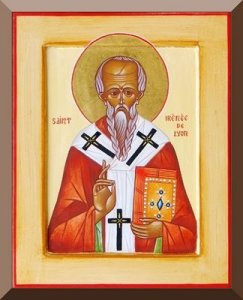
“The Word of God, our Lord Jesus Christ, who did, through His transcendent love, become what we are, that He might bring us to be even what He is Himself.” — Irenaeus, Against Heresies, Book V, Preface
Life
Irenaeus was born around 130 in Smyrna, Asia Minor (modern-day Izmir, Turkey). As a youth he personally heard Bishop Polycarp of Smyrna preach. Polycarp was a disciple of the apostle John — which means Irenaeus stood only two generations from the apostles of Christ. He later recalled in a letter to Florinus: “I can describe the very place in which the blessed Polycarp sat as he discoursed… how he spoke of his familiar intercourse with John, and with the rest of those who had seen the Lord.” (Catholic Encyclopedia)
Irenaeus later moved to Lyon in Gaul (modern France). In 177, under Emperor Marcus Aurelius, a severe persecution devastated the church at Lyon, and the aged Bishop Pothinus was martyred. During the persecution, the church sent Irenaeus to Rome carrying a letter about the Montanist controversy addressed to Pope Eleutherius. (Catholic Encyclopedia)
After returning from Rome, Irenaeus succeeded Pothinus as the second Bishop of Lyon. Around 180, he composed his monumental five-volume work Against Heresies — the most systematic and thorough refutation of Gnosticism in the history of the church. Around 190, he played the role of peacemaker in the Easter date controversy, persuading Pope Victor I not to excommunicate the churches of Asia. (Catholic Encyclopedia)
Irenaeus died around 200–202. Later tradition claims he was martyred, but the evidence is uncertain. (Catholic Encyclopedia)
Timeline
- c. 130 — Born in Smyrna, Asia Minor
- c. 140s–150s — Heard Bishop Polycarp preach as a youth
- c. 155 — Polycarp martyred at Smyrna
- c. 160s — Moved to Gaul; became a presbyter of the church at Lyon
- 177 — Persecution under Marcus Aurelius; Bishop Pothinus martyred; Irenaeus sent to Rome
- c. 178 — Returned to Lyon; succeeded Pothinus as second bishop
- c. 180 — Wrote the five volumes of Against Heresies
- c. 190 — Mediated in the Easter date controversy, urging Pope Victor not to excommunicate the Asian churches
- c. 190s — Wrote Demonstration of the Apostolic Preaching
- c. 200–202 — Died
Teaching
God’s Economy (Oikonomia)
Irenaeus was the first theologian to systematically use the Greek word oikonomia (economy, dispensation, arrangement) to describe God’s entire plan of salvation. For him, the economy was not an abstract concept but the totality of God’s action from creation through the incarnation to the final consummation.
“There is one Father God, and one Christ Jesus, who came by means of the whole economy related to Him, and gathered together all things in Himself.” — Against Heresies 3.16.6
Scholars call Irenaeus “the outstanding theologian of the economy.” In his usage, the economy encompasses the incarnation, the work of redemption, and the entire process by which humanity partakes of the divine nature through grace. (Conversant Faith)
Recapitulation (Recapitulatio / Anakephalaiosis)
This is Irenaeus’s most distinctive theological contribution. The Greek anakephalaiosasthai means “to sum up” or “to bring under one head.” Christ is the last Adam, who recapitulated the entire human race in Himself, reversing all the consequences of Adam’s fall.
“God recapitulated in Himself the ancient formation of man, that He might kill sin, deprive death of its power, and vivify man.” — Against Heresies 3.18.1
“The Word of God was made man… so that man, having been taken into the Word and receiving the adoption, might become the son of God.” — Against Heresies 3.19.1
Refutation of Gnosticism
Irenaeus’s Against Heresies is the most important early church work against Gnosticism. The Gnostics separated the creator from the supreme God, denied the goodness of the material world, and denied that Christ truly came in the flesh. Irenaeus devoted five volumes to the task — first fully exposing the Gnostic system (Book I), then refuting it through reason (Book II), apostolic tradition and Scripture (Book III), the Lord’s own words (Book IV), and the resurrection of the body (Book V). (Catholic Encyclopedia)
The Rule of Faith (Regula Fidei)
Irenaeus was one of the earliest fathers to clearly articulate the “rule of faith” — the core confession of faith received from the apostles at baptism and the key to interpreting Scripture:
“The Church, though dispersed throughout the whole world, even to the ends of the earth, has received from the apostles and their disciples this faith: in one God, the Father Almighty, Maker of heaven and earth and the sea and all things therein; and in one Christ Jesus, the Son of God, who became incarnate for our salvation; and in the Holy Spirit, who through the prophets proclaimed the economies of God.” — Against Heresies 1.10.1
Theosis
Over a century before Athanasius, Irenaeus expressed the exchange theme of “God became man that man might become God”:
“The Word of God, our Lord Jesus Christ, who did, through His transcendent love, become what we are, that He might bring us to be even what He is Himself.” — Against Heresies, Book V, Preface
This is one of the earliest classic formulations of the Christian doctrine of theosis. Athanasius later refined it into the more widely known form in On the Incarnation §54: “He became man that we might become god.” But the foundation was laid by Irenaeus. (IRR)
He also left a widely quoted statement:
“The glory of God is a living man, and the life of man consists in beholding God.” — Against Heresies 4.20.7
Connection to the Recovery
God’s Economy: From Irenaeus to Brother Lee
Brother Witness Lee made “God’s economy” (oikonomia) the central organizing concept of his entire ministry. In The Economy of God and other books he taught that the focus of the economy is God dispensing Himself into man. (Ministry Samples)
Irenaeus used the same word around 180 AD in a remarkably similar way — oikonomia was God’s entire plan of dispensing Himself to humanity through the incarnation and redemption. Both grounded their usage in Ephesians 1:10 and 1 Timothy 1:4. The line runs from Paul to Irenaeus, through the patristic tradition, to Brother Lee’s recovery in the 1960s. The Chinese Wikipedia notes: “In his later years, Witness Lee used the term ‘God’s economy,’ a theological term frequently used by the ancient church fathers, to construct the theological thought of the local churches.” (Chinese Wikipedia)
A 2025 scholarly article in the Journal of Theological Studies (Oxford) used “the divine oikonomia” as one of six analytical lenses to examine Brother Lee’s doctrine of the Trinity. (Oxford Academic)
Recapitulation and the Heading Up of All Things in Christ
Irenaeus’s doctrine of recapitulation — Christ “gathered together all things in Himself” — has a direct counterpart in Brother Lee’s teaching on Ephesians 1:10. Brother Lee likewise takes the heading up of all things in Christ as the goal of God’s economy in his teaching on the New Testament economy. (Ministry Samples)
Both understood this “heading up” as the goal of God’s economy, and both built on the same Pauline text.
God Became Man That Man Might Become God
Brother Lee explicitly taught this formulation, adding the qualifier “in life and nature but not in the Godhead.” He said: “God’s economy and plan is to make Himself man and to make us, the created beings, ‘God,’ so that He is ‘man-ized’ and we are ‘God-ized.’” (A God Man)
This theological line runs from Irenaeus (Against Heresies, Book V, Preface) to Athanasius (On the Incarnation §54), through the Cappadocian Fathers, Chrysostom, and Cyril of Alexandria, and finally to Brother Lee’s recovery and definition. (jdt365.net)
The Tripartite View of Man
Irenaeus taught:
“The complete man is the commingling and union of the soul receiving the Spirit of the Father, with that carnal nature.” — Against Heresies 5.6.1
Building on Brother Nee’s tripartite anthropology, Brother Lee developed the same theme: man is a being of three parts — spirit, soul, and body — with the spirit as the organ for receiving God. Both grounded their teaching in 1 Thessalonians 5:23.
Significance
Irenaeus stood at a critical crossroads. Behind him was the firsthand witness of the apostles — he had heard from Polycarp what John himself had said. Before him was Gnosticism’s wholesale rewriting of the gospel — denying the goodness of creation, denying Christ’s true incarnation, denying the resurrection of the body.
His response was not simply to pronounce the other side heretical. He spent five volumes first presenting his opponents’ system in full, then dismantling it from three directions: Scripture, reason, and apostolic tradition. The method itself is a testimony: truth does not fear examination; orthodox faith withstands the most rigorous testing.
What he left behind was not merely an anti-heretical treatise. He left the theological framework of “God’s economy” spanning the entire Bible — from Paul to Irenaeus, and seventeen centuries later rediscovered and unfolded by Brother Lee. He left the vision of “recapitulation” — Christ gathering all things into Himself. He left that sentence that shook the entire theological tradition: He became what we are, that we might become what He is.
In 2022, Pope Francis declared Irenaeus a Doctor of the Church, with the title Doctor Unitatis — “Doctor of Unity.” The title is fitting. Everything he did in his life was to hold fast to the one faith, the one God, and the one economy handed down from the apostles — and to contend for it to the end.