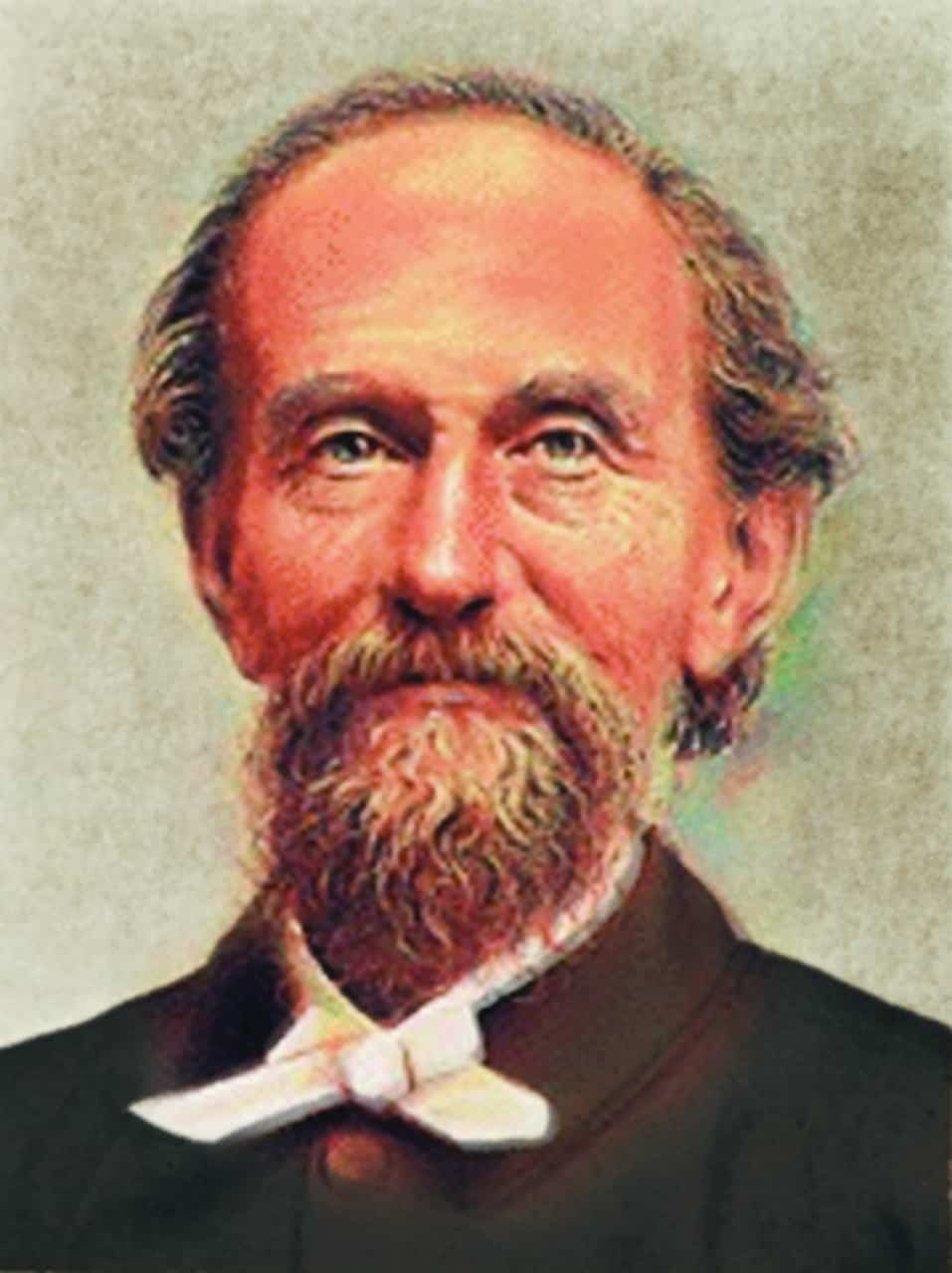
“Abiding in Jesus is nothing but the giving up of oneself to be ruled, taught, and led, and so rest in the arms of everlasting love.” — Andrew Murray, Abide in Christ
Life
Andrew Murray was born on May 9, 1828, in Graaff‑Reinet, South Africa. His father, Andrew Murray Sr., was a minister from Aberdeen, Scotland, who had been called to pastor in the Dutch Reformed Church in the Cape. His mother, Maria Stegman, was a member of the local Afrikaner community. Andrew grew up in a home where Scottish and Afrikaans cultures met (Boston University – Missionary Biography).
In 1838, at the age of ten, Andrew and his older brother John were sent to Aberdeen for schooling. He studied at Aberdeen Grammar School and then Aberdeen University, receiving his M.A. in 1845. Afterward the brothers moved to Utrecht in the Netherlands to study theology. There Andrew came under the influence of the “Réveil” (Awakening), a movement that pressed for living faith and personal conversion in contrast to dead state‑church formalism (Boston University – Missionary Biography).
In 1848 he was ordained in The Hague as a minister of the Dutch Reformed Church and returned to South Africa. He was sent to a vast field north of the Orange and Vaal rivers to pastor the Boer settlers — a region of roughly 100,000 square miles. These years of frontier ministry formed his character. In 1856 he married Emma Rutherfoord (Boston University – Missionary Biography).
In 1860, at thirty‑two, Murray became pastor of the Dutch Reformed congregation in Worcester. That same year a great revival broke out in South Africa. It began in Montagu, then spread to Worcester. On the farm of David Naudé some young people, together with an old servant named Saul Pieterse, had been praying for months. When the Spirit was poured out, the congregation began crying to God aloud all at once. Murray tried to restore order. Saul reportedly said to him, “Now, you go and stop the wind!” — meaning that no man can restrain the Spirit’s moving. This event deeply changed Murray’s view of the Spirit’s work (Vance Christie – South African Revival).
In 1864 he moved to pastor the Dutch Reformed church in Cape Town. In 1871 he accepted a call to Wellington, where he would serve for thirty‑five years until his retirement in 1906. In Wellington he founded a missionary training institute (1877), and helped form a ministers’ mission union, a Bible and prayer union, and a laymen’s missionary union. By 1900 South Africa stood fifth in the world in the number of missionaries sent; the Dutch Reformed Church alone had 304 missionaries at work in Africa with twelve mission stations (Boston University – Missionary Biography).
Murray wrote in both Dutch and English and published more than 240 books and booklets. In many South African homes, his books were the only volumes besides the Bible. In 1898 he received an honorary doctorate from Aberdeen University, and in 1907 an honorary degree from the University of the Cape of Good Hope (Boston University – Missionary Biography).
Andrew Murray fell asleep in Wellington on January 18, 1917, aged eighty‑eight.
Timeline
- 1828 — Born May 9 in Graaff‑Reinet, South Africa
- 1838 — Sent with his brother to Aberdeen for study
- 1845 — Receives M.A. from Aberdeen University; begins theology in Utrecht
- 1848 — Ordained in The Hague; returns to South Africa as Dutch Reformed minister
- 1849–1859 — Pastors Boer settlers north of the Orange and Vaal rivers
- 1856 — Marries Emma Rutherfoord
- 1857 — Publishes his first book
- 1860 — Becomes pastor in Worcester; South African revival breaks out
- 1864 — Moves to Cape Town as pastor
- 1871 — Moves to Wellington for a long pastorate
- 1877 — Founds the Wellington Missionary Training Institute
- 1882 — Publishes Abide in Christ
- 1885 — Publishes With Christ in the School of Prayer
- 1888 — Publishes The Spirit of Christ
- 1895 — Publishes Humility and Absolute Surrender
- 1898 — Receives honorary doctorate from Aberdeen University
- 1906 — Retires from the pastorate in Wellington
- 1907 — Receives honorary degree from the University of the Cape of Good Hope
- 1917 — Dies January 18 in Wellington
Teaching
Abiding in Christ
Murray’s central theme is union with Christ as set out in John 15 — “I am the vine; you are the branches. He who abides in Me and I in him, he bears much fruit” (John 15:5). This union is not first a matter of effort but of God’s own action:
“His union with the Lord is not the fruit of man’s wisdom, or power, or efforts, but the result of the work of God. Through His mighty power God has so united the soul to Christ that His life may flow into it.” — Abide in Christ
“He is the Holy Spirit, the bond of fellowship between Christ and His members, the sap of the heavenly Vine, through whom the vine and the branches are truly one.” — Abide in Christ
The Christian’s task is not to “do more” but to abide — to remain in Christ and let His life flow.
Absolute Surrender
Murray speaks of “absolute surrender” as the believer’s whole‑hearted yielding to God:
“Each of us is a temple of God, and God wants to dwell in us and work in us with mighty power; but there is one hindrance, and that is our absolute want of surrender.” — Absolute Surrender
“Christ demands that you should be absolutely surrendered to Him. He comes and says, ‘I have already given Myself absolutely to you; I have let Myself be united with you; I have given Myself altogether for you on the cross and by My life in you. And now I ask you to give yourself wholly to Me.’” — Absolute Surrender
Yet this surrender is not something we work up in our own strength; God Himself is ready to work it in us.
Prayer
In With Christ in the School of Prayer Murray calls prayer a two‑way speaking:
“Prayer is not a monologue, but dialogue; God’s voice in response to mine is its most essential part.” — With Christ in the School of Prayer
“Christ is our life; in heaven He lives and ever prays; in us He lives, and if we will trust Him, will also pray in us.” — With Christ in the School of Prayer
“We seek God’s gifts; God wants first to give us Himself.” — With Christ in the School of Prayer
Prayer, in this view, is Christ the Intercessor living and praying in His members.
Humility
In Humility Murray traces humility back into Christ’s own life. The first Adam fell through pride; the second Adam accomplished redemption through humility:
“This is the root and nature of redemption: it is the restoration of the lost humility and meekness to the soul.” — Humility
He writes that the highest honour of the creature lies in being an empty vessel:
“The highest glory of the creature is in being only a vessel, into which God can pour His fullness, and which can be filled with God and show forth His glory. It can do this only as it is willing to be nothing in itself that God may be all.” — Humility
The Work of the Spirit
The Spirit of Christ is one of Murray’s most theologically rich books. In chapter five he argues that the Spirit poured out at Pentecost is not merely “the Spirit of God” in the Old Testament sense, but the Spirit of the incarnate, crucified, and glorified Christ — a Spirit in whom the element of Christ’s humanity is present:
“When He came down at Pentecost, He came as the Spirit of the glorified Jesus—the Spirit of the God‑man—bringing down to us that which had been wrought out in the person of Christ, as the crucified and risen One.” — The Spirit of Christ, chap. 5
“Out of that nature, perfected and glorified in the resurrection and ascension, there comes the Spirit, the Spirit which is the Spirit of His human life—now made divine and one with God—to make us partakers of what He is and has.” — The Spirit of Christ, chap. 5
This view was unusual in his day. Many saw the Spirit only as the Spirit of God in a general way; Murray saw that after Christ’s incarnation and glorification, the Spirit is also the Spirit of the God‑man, carrying His history and humanity.
Connection to the Lord’s Recovery
Watchman Nee and Andrew Murray
Brother Watchman Nee read widely — about three thousand spiritual books. Among them, Andrew Murray’s writings held a special place. Brother Witness Lee recalls that Nee once said that if anyone would translate The Spirit of Christ into Chinese, he would gladly cover all the publishing costs (Ministry Samples – The Influence of the Inner Life Group).
Nee took up Murray’s central line of the inner life. Murray emphasised that abiding in Christ is the root of Christian living; Nee likewise again and again taught believers to “remain in the Lord,” not by outward work but by inward union. Murray’s teaching on absolute surrender — handing the whole person over to God — echoes strongly in Nee’s The Breaking of the Outer Man and the Release of the Spirit, where the outer man must be broken so that the inner life can flow freely.
Nee classed Murray with Madame Guyon, Fénelon, and Brother Lawrence as part of the “inner‑life” tradition that God used to help the Lord’s recovery (Ministry Samples – The Influence of the Inner Life Group).
Witness Lee’s Appreciation
Witness Lee’s appreciation focuses especially on chapter five of The Spirit of Christ. He testifies that when he read that chapter, he received a strong confirmation that the Spirit today includes the element of Christ’s humanity. Before this he had some inward hesitation about speaking in this way; after reading Murray, he was assured that this view had solid grounding (Ministry Samples – Confirmation by Andrew Murray).
Lee says:
“Andrew Murray further improved the writings of the mystics. In his writings the deep truths are expressed in plain words.” — Witness Lee, The Full Knowledge of the Word of God, ch. 4
“The inner‑life people and the Brethren have helped us very much.” — Witness Lee, The Full Knowledge of the Word of God
His way of evaluation is consistent: he gratefully receives the spiritual wealth and also notes the gaps. He sees that Murray went very deep in the experience of the inner life but did not have as much light on the church as the Body of Christ.
Significance
From a remote colonial field in South Africa, Andrew Murray’s ministry spread across the world. In many homes his books lay next to the Bible. His writing always returns to one centre: the Christian life does not rest on what we do outwardly, but on whom we dwell in inwardly. Absolute surrender, humility, and prayer are not separate practices but different faces of abiding in Christ.
His insight in The Spirit of Christ — that the Spirit poured out at Pentecost is the Spirit of the processed Christ, bearing His humanity as well as His deity — later fed directly into the Lord’s recovery’s teaching on “the Spirit.” Brother Watchman Nee and Brother Witness Lee received this as a key confirmation and development of what God had shown them.
Andrew Murray left not a system but a path: away from mere external religion and into living union with Christ. For believers today his call is still timely: turn inward, stay in Him. A branch apart from the vine cannot bear fruit.