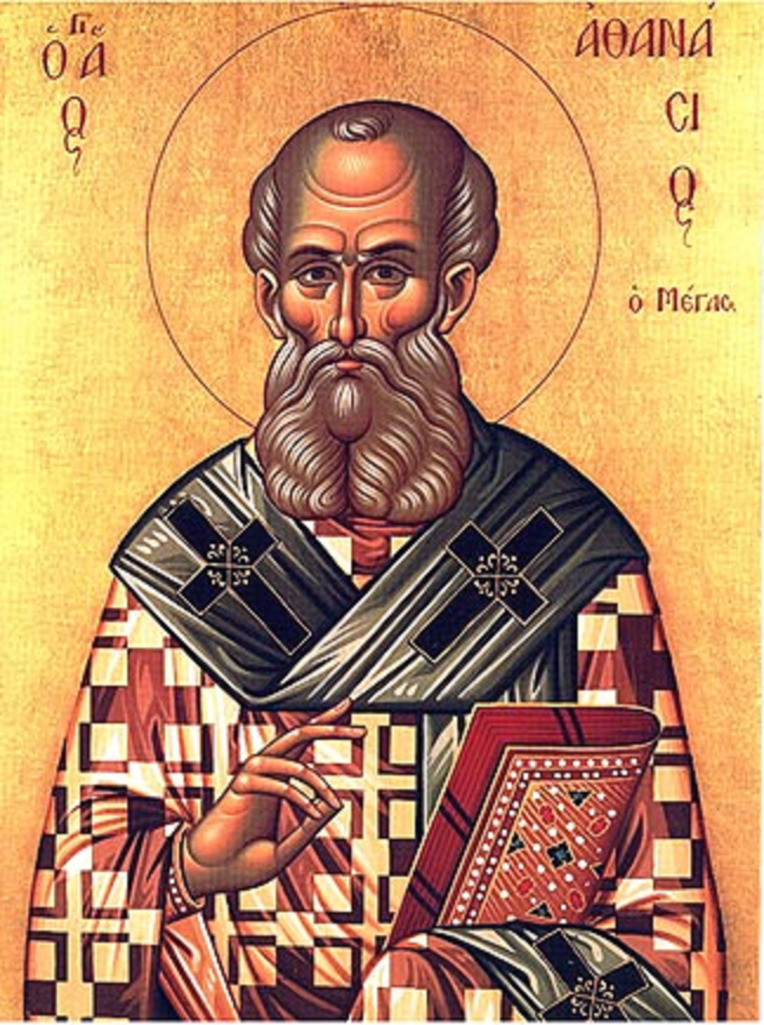
“He was made man that we might be made god. He manifested Himself by a body that we might receive the idea of the unseen Father. He endured the insolence of men that we might inherit immortality.” — Athanasius, On the Incarnation, §54
Life
Athanasius was born around 296 in Alexandria, Egypt. He was mentored from a young age by Bishop Alexander of Alexandria, becoming his secretary and theological advisor. In 325, at roughly twenty-seven years old, Athanasius attended the Council of Nicaea as a deacon, working behind the scenes to defend the homoousios (“of the same substance”) position against the heresy of Arius. (Catholic Encyclopedia)
In 328, Athanasius succeeded Alexander as Bishop of Alexandria. Over the next forty-five years, he was exiled five times under four different emperors, spending a total of more than seventeen years in banishment. His opponents included Arius himself, Eusebius of Nicomedia (the chief political maneuverer behind the anti-Athanasian campaigns), and the Arian-leaning Emperor Constantius II. His allies included Pope Julius I of Rome, Bishop Hosius of Cordova, and the Western Emperor Constans. (Catholic Encyclopedia; Britannica)
His third exile (356–362) was the longest and most productive — he lived in hiding among the monks of Upper Egypt, writing the Orations against the Arians, the History of the Arians, the Life of Antony, and the Letters to Serapion. In 367, in his thirty-ninth Festal Letter, he listed the twenty-seven books of the New Testament identical to the canon used today — the earliest known complete New Testament canon list. (Festal Letter 39)
Athanasius died peacefully in Alexandria on 2 May 373. Gregory of Nazianzus called him “the pillar of the church.” (Catholic Encyclopedia)
Timeline
- c. 296 — Born in Alexandria, Egypt
- c. 318–323 — Wrote Against the Heathen and On the Incarnation
- 325 — Attended the Council of Nicaea as a deacon
- 328 — Succeeded Alexander as Bishop of Alexandria
- 336–337 — First exile, banished to Trier, Germany
- 340–346 — Second exile, fled to Rome under the protection of Pope Julius I
- 356–362 — Third exile, hid among the monks of the Upper Egyptian desert; wrote Orations against the Arians, Life of Antony
- 362–363 — Fourth exile, ordered by the apostate Emperor Julian
- 364–366 — Fifth exile, ordered by the Arian Emperor Valens
- 367 — Listed the twenty-seven New Testament canonical books in the thirty-ninth Festal Letter
- 373 — Died peacefully in Alexandria on 2 May
- 381 — The Council of Constantinople definitively confirmed the Nicene orthodox faith, vindicating Athanasius’s lifelong struggle
Teaching
The Full Divinity of Christ
The core of Athanasius’s theology: the Son is homoousios with the Father — not a creature, not merely similar, but fully and eternally God.
“All that the Son is belongs to the substance of the Father, as the radiance from the light, and the stream from the fountain.” — Orations against the Arians, Book III, §3
“The Godhead of the Son is the Father’s Godhead; thus it is indivisible; and thus there is one God and none other.” — Orations against the Arians, Book III, §4
“The fullness of the Father’s Godhead is the being of the Son, and the Son is very God.” — Orations against the Arians, Book III, §6
His anti-Arian argument rested on soteriology: if Christ is not fully God, He cannot save. A creature cannot cause other creatures to partake of the divine nature. Only God Himself, entering creation through the incarnation, can grant immortality and incorruption. Homoousios was not an abstract philosophical concept — it was a truth on which salvation depended. (Orations against the Arians, Book I)
Theosis
Athanasius’s most famous theological statement comes from On the Incarnation, §54:
“He was made man that we might be made god (theopoiethomen).” — On the Incarnation, §54
This does not mean humans become God in essence. Through the incarnation, humans are enabled to partake of the divine nature — receiving immortality, incorruption, and restoration to the image of God.
“Who but the Image of the Father could restore the image in man — that is, our Savior Jesus Christ?” — On the Incarnation, §13
The Biblical Canon
In the thirty-ninth Festal Letter of 367, Athanasius wrote:
“These are fountains of salvation, that they who thirst may be satisfied with the living words they contain. In these alone is proclaimed the doctrine of godliness. Let no one add to them, neither let anyone take from them.” — Festal Letter 39
Connection to the Recovery
The Doctrine of Theosis: From Athanasius to Brother Lee
Athanasius’s statement “He became man that we might become god” was explicitly received and defined in the teaching of Brother Witness Lee, who refined the formulation to:
“God became man that man might become God in life and nature but not in the Godhead.”
A scholarly paper presented at the Evangelical Theological Society (ETS, 2015) noted: “In these few words, Witness Lee both clarified and elevated Athanasius’s memorable statement.” The addition of “in life and nature but not in the Godhead” made explicit the boundary the church fathers had assumed — theosis does not mean humans acquire God’s incommunicable attributes (omniscience, omnipotence, etc.). (An Open Letter: ETS 2015)
In the later years of his ministry, Brother Lee called “God became man that man might become God in life and nature but not in the Godhead” the “high peak of the divine revelation.” This was his distillation of the patristic theosis tradition rooted in Athanasius. (MDPI Religions: “Becoming God in Life and Nature”)
The Incarnation and “Mingling”
Brother Lee taught that the incarnation involved a “mingling” of divinity and humanity — not producing a third nature, but a union in which the two natures remain distinguishable. He used the analogy of grafting: “When a branch of one tree is grafted into another tree, they are mingled together. In the same way, God mingled Himself with man in the incarnation.” He clarified this does not produce a “third nature,” using “mingling” in its ordinary sense: “combining different elements so that the elements remain distinguishable in the combination.” The foundation of this teaching traces back to Athanasius’s writings on the incarnation — only the Word of God Himself, the Image of the Father, could restore the image of God in man. (An Open Letter: ETS 2015)
Brother Nee
No record has been found in the available sources of Brother Watchman Nee directly quoting Athanasius. However, scholarly research notes that Nee’s soteriology integrated justification, sanctification, and glorification into an organic, progressive pattern of union with God — a framework compatible with the Athanasian theosis tradition. (MDPI Religions: “Becoming God in Life and Nature”)
Significance
“Athanasius against the world” (Athanasius contra mundum) — the phrase describes his courage in standing alone for the Nicene orthodox faith when the entire Roman Empire seemed to have turned Arian. Five exiles. Four emperors. More than seventeen years of banishment. He never recanted. (Catholic Answers)
When he died in 373, victory was not yet visible. But his writings continued to do their work. Just eight years later, the Council of Constantinople in 381 decisively confirmed the Nicene orthodox faith.
What he established was not just a doctrine. He established a principle: truth is not determined by majority vote. When orthodoxy is suppressed by power, when holding the truth means losing position, freedom, even life — a person can still stand. For believers today who bear pressure in their faith, Athanasius’s witness issues the same call: not to win an argument, but because the full divinity of Christ — and our full salvation in Him — is worth everything it costs to hold.