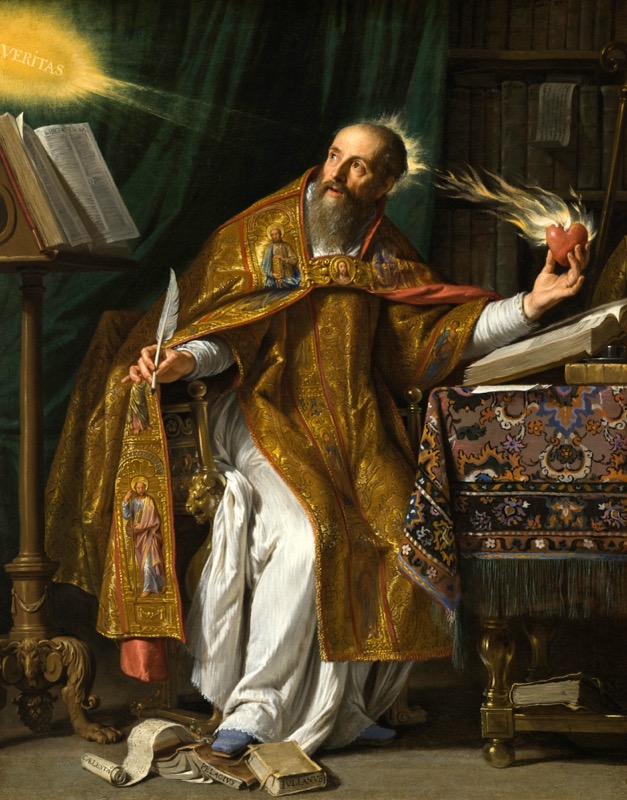
“You have made us for Yourself, and our heart is restless until it rests in You.” — Confessions 1.1
Life
Augustine was born on 13 November 354 in Thagaste, Numidia, North Africa (modern Souk Ahras, Algeria). His father Patricius was a pagan who was baptized on his deathbed; his mother Monica was a devout Christian who prayed for her son’s conversion for nearly seventeen years. (Wikipedia)
At eleven he was sent to school at Madaura, then to Carthage to study rhetoric. There he was drawn to Manichaeism and followed it for nine years. From 373 he taught grammar in Thagaste, then opened a school of rhetoric in Carthage. (Wikipedia)
In 383, troubled by unruly students in Carthage, he moved to Rome. At the end of 384 he obtained the chair of rhetoric in Milan. In Milan he met Bishop Ambrose — Ambrose’s preaching opened his eyes to understand Scripture, and Neoplatonism gave him a philosophical framework for thinking about God. (Wikipedia)
Conversion in the Garden
In the summer of 386 Augustine was in intense inner struggle — he desired God but could not break free from his old bonds. In a garden in Milan he threw himself under a fig tree, weeping. He heard a child’s voice from a neighboring house repeating: “Take up and read, take up and read” (Tolle lege, tolle lege). He took it as a divine command, picked up Paul’s epistles, opened at random, and his eyes fell on Romans 13:13–14 (Confessions 8):
“Not in rioting and drunkenness, not in chambering and wantonness, not in strife and envying. But put on the Lord Jesus Christ.”
He later wrote:
“No further would I read; nor needed I: for instantly at the end of this sentence, by a light as it were of serenity infused into my heart, all the darkness of doubt vanished away.” — Confessions 8.12
On the night before Easter, 24–25 April 387, Ambrose baptized Augustine in the cathedral at Milan (Midwest Augustinians). Monica at last saw the answer to her years of prayer. She said: “I had one wish left for this life — to see you a Catholic Christian before I died. God has given me more than I asked.” Soon after, Monica died at Ostia, the port of Rome. (Wikipedia: Monica)
After returning to North Africa, Augustine was ordained presbyter at Hippo in 391 and became bishop of Hippo in 396, remaining until his death. On 28 August 430, in the third month of the Vandal siege, Augustine died at Hippo, aged seventy-five. (Wikipedia)
Timeline
- 354 — Born in Thagaste (modern Algeria)
- 365 — Sent to school at Madaura
- 370 — To Carthage to study rhetoric; encountered Manichaeism
- 373 — Taught grammar in Thagaste
- 383 — Moved to Rome, opened school of rhetoric
- 384 — Obtained chair of rhetoric in Milan; met Bishop Ambrose
- 386 — Conversion in the Milan garden (“Take up and read”)
- 387 — Baptized on Easter Eve; mother Monica died
- 391 — Ordained presbyter at Hippo
- 396 — Became Bishop of Hippo
- 397–400 — Wrote Confessions
- 399–419 — Wrote On the Trinity
- 412–426 — Wrote City of God
- 412–430 — Controversy with Pelagianism
- 430 — Died 28 August at Hippo during the Vandal siege
Teaching
Sin and Grace
Augustine’s controversy with Pelagius defined the Western church’s understanding of sin and grace. Pelagius denied original sin, holding that Adam’s sin was only a bad example and that man could fully obey God’s will by his own power. Augustine’s response was rooted in his own experience and in Scripture — the human will is corrupted by sin; only grace can free the will to love and obey God. (The Gospel Coalition)
His famous line — “They are not chosen because they believed, but they are chosen so that they might believe” — was embedded in Calvin’s later doctrine of predestination. (Wikipedia: Augustinian soteriology)
The Trinity
On the Trinity, in fifteen books, was Augustine’s great work, to which he devoted sixteen years. He taught that Father, Son, and Holy Spirit are not different in essence but are an eternal, unchanging relation within one essence. The Spirit is the love between Father and Son. He used the mind’s memory, understanding, and will as an analogy for the Trinity — man is made in God’s image (Gen 1:26–27), and the human mind itself reflects the image of the Triune God. (New Advent)
The Inner Life
Some of Augustine’s most moving words come from Confessions book 10:
“Too late I loved You, O Beauty so ancient and so new; too late I loved You! You were within, and I was without; I was seeking You out there. You called, You cried, You broke through my deafness. You shone, You gleamed, You drove away my blindness. You sent forth Your fragrance; I drew breath and I pant after You. I tasted, and I hunger and thirst. You touched me, and I burn for Your peace.” — Confessions 10.27
This is not theological discourse; it is the cry of a man touched by God.
Connection to the Lord’s Recovery
Brother Witness Lee cited Augustine’s illustration of the Trinity — Augustine said that trying to fully understand the Trinity is like using a small spoon to measure the ocean — to show that spiritual truth is too deep for human reason to exhaust. (Ministry Samples)
Brother Lee also noted that Augustine — “a leader in teaching the divine Trinity” — was sometimes accused of modalism and sometimes of tritheism, much like Brother Lee’s own experience. He used this to show that faithfully speaking of the mystery of the Trinity often draws misunderstanding from both directions. (An Open Letter)
In a broader vein, Augustine’s emphasis on the inner life — “Do not go outside yourself; return into yourself; truth dwells in the inner man” — resonates deeply with Brother Watchman Nee’s teaching on breaking the outer man and releasing the spirit within. Both insisted that spiritual reality is not in outward religious activity but in inward contact with God.
Augustine’s absolute emphasis on grace — the will cannot save itself; only God’s grace can save — also aligns with the recovery’s central message of “no longer I, but Christ” (Gal 2:20).
Significance
Augustine’s influence crosses the boundary between Catholic and Protestant. Catholicism honors him as a Doctor of the Church; Luther was an Augustinian friar; Calvin cited Augustine about a hundred and fifty times in the Institutes. (Graham Joseph Hill) Some have called the entire Reformation “the Augustinianization of Christianity” — on the principle of grace alone, Luther, Calvin, and Zwingli were fully in line with Augustine. (Graham Joseph Hill)
The historian Diarmaid MacCulloch said: “Augustine’s influence on Western Christian thought can hardly be overstated; only Paul, whom he loved, was more influential, and Westerners have generally seen Paul through Augustine’s eyes.” (Stanford Encyclopedia of Philosophy)
But what moves us most about Augustine is not his theological system but his honesty. The Confessions is a sinner stripped bare before God. He does not hide his weakness, his lust, or his struggle. That is why his testimony remains alive across sixteen centuries — because everyone who has struggled in sin and been saved by grace can recognize themselves in his story.
“Too late I loved You.” That line belongs to everyone who has turned.