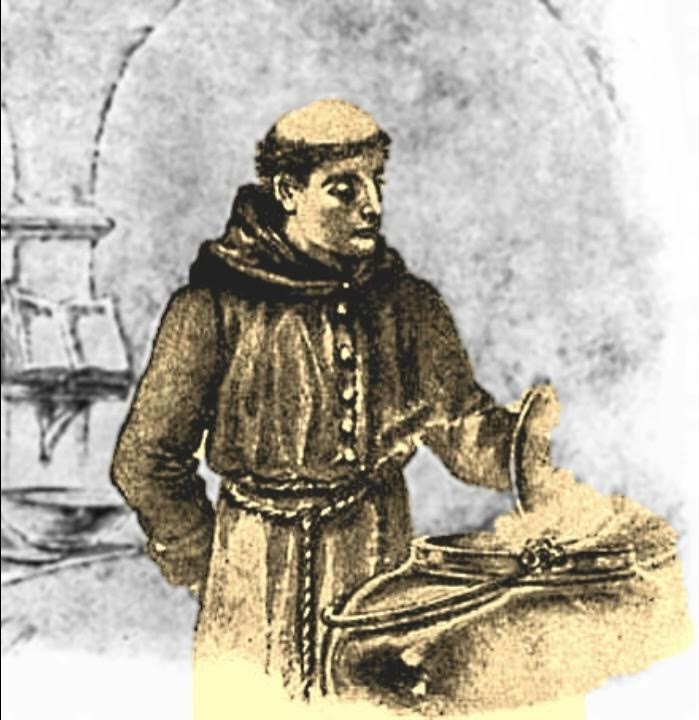
“In the noise and clatter of my kitchen, while several persons are at the same time calling for different things, I possess God in as great tranquility as if I were upon my knees at the blessed sacrament.” — Brother Lawrence, The Practice of the Presence of God
Life
Brother Lawrence was born Nicolas Herman around 1614 in Hériménil, Lorraine, France, into a devout Christian family. (Carmelite Spirit)
Around age eighteen, he saw a bare tree in winter and was struck by a sudden insight: this tree would again put forth leaves, flowers, and fruit. That vision gave him his first real glimpse of God’s providence, and the fire never went out. (Boston Carmel)
Not long after, he joined the Duke of Lorraine’s army and fought in the Thirty Years’ War. He was captured by German forces, suspected as a spy, and nearly hanged — but released because of his fearless bearing. Later he was badly wounded by Swedish soldiers at Rambervillers and walked with a limp for the rest of his life. (Boston Carmel)
After leaving the army he tried life as a hermit but found no rest. He went to Paris and served as a valet to a royal advisor. In June 1640, at twenty-six, he entered the Discalced Carmelite monastery on Rue de Vaugirard in Paris as a lay brother. He received his habit on 14 August, taking the name Laurent de la Résurrection (Lawrence of the Resurrection). He made his final vows on 14 August 1642. (Boston Carmel)
His work in the monastery was what he least desired — cooking. He served in the kitchen for about fifteen years, then because of severe gout and leg ulcers turned to mending sandals for over a hundred monks. He also traveled to Auvergne in 1665 and Burgundy in 1666 to purchase wine for the monastery. (Carmelite Spirit)
His first ten years in the monastery were marked by spiritual distress. But he finally gave himself wholly to the Lord, and from then on knew a deep, unshakable peace. (Carmelite Spirit)
Brother Lawrence fell asleep in Paris on 12 February 1691, around seventy-seven years old. He lived in obscurity — a cook, a cobbler. After his death, Abbé Joseph de Beaufort, vicar general to the Archbishop of Paris, gathered his four recorded conversations, sixteen letters, and spiritual maxims into a book titled The Practice of the Presence of God (1692). That slim volume — readable in twenty minutes — has never gone out of print in over three hundred years. (CCEL)
Timeline
- c. 1614 — Born in Hériménil, Lorraine, France, as Nicolas Herman
- c. 1632 — Age eighteen, winter vision of bare tree and deep sense of God’s providence
- c. 1633 — Joined Duke of Lorraine’s army, fought in Thirty Years’ War
- c. 1635 — Severely wounded by Swedish forces at Rambervillers; lifelong limp
- 1640 — Entered Paris Discalced Carmelite monastery in June; received habit 14 August
- 1642 — Final vows 14 August
- c. 1642–1657 — Served in kitchen about fifteen years
- 1665 — Traveled to Auvergne to purchase wine
- 1666 — Traveled to Burgundy to purchase wine; second conversation recorded 28 September
- 1691 — Fell asleep in Paris 12 February, around seventy-seven years old
- 1692 — Abbé de Beaufort published Maximes spirituelles
- 1694 — Moeurs et Entretiens (conduct and conversations) published
- 1937 — Yu Cheng-hua translated the book into Chinese in Shanghai as The Practice of the Presence of God
Teaching
Practicing God’s Presence in Every Activity
Brother Lawrence taught one thing above all: awareness of God should not be limited to prayer times but should permeate every moment.
“Think often on God, by day, by night, in your business and even in your diversions. He is always near you.” — Goodreads
“We should not grow weary of doing little things for the love of God, who regards not the greatness of the work, but the love with which it is performed.” — Goodreads
“To pick up a straw for the love of God is enough for me.” — Christian Transformation
No Special Method Required
Brother Lawrence said again and again: coming to God requires no art, no learning, only a resolute heart.
“It is not needful to have great things to do. I turn my little omelet in the pan for the love of God; when it is finished, if I have nothing to do, I prostrate myself on the ground and adore my God, who gave me this grace to make it.” — Goodreads
“He requires no great matters of us; a little remembrance of Him from time to time, a little adoration; sometimes to pray for His grace, sometimes to offer Him your sufferings, sometimes to thank Him for the graces, past and present, that He has given you… The least remembrance will always be acceptable to Him. You need not cry very loud; He is nearer to us than we think.” — Goodreads
Love Is the Purpose; Method Is Secondary
“Many do not advance in the Christian progress because they stick in penances and particular exercises, while they neglect the love of God, which is the end.” — Goodreads
“People invent means and methods of coming at God’s love… and yet it might be so much simpler — to do our common business entirely for the love of Him.” — Christian Transformation
Connection to the Recovery
Brother Lawrence’s link to Brother Watchman Nee is not indirect — it is direct and documented.
Brother Witness Lee wrote in Watchman Nee — A Seer of the Divine Revelation in the Present Age, chapter 8:
“It is clear that he received much help from Brother Lawrence’s The Practice of the Presence of God. In this matter he was also greatly helped by Hudson Taylor’s biography.” — bibleread.online
Brother Lee was describing how Brother Nee maintained unbroken communion with God — a practice that produced “life, light, power, and victory.” The Chinese translation of The Practice of the Presence of God came from Brother Nee’s closest co-worker. Yu Cheng-hua (1901–1956), an elder in the Shanghai church and one of Brother Nee’s intimate fellow workers, translated the book into Chinese in Shanghai in 1937 under the title 与神同在 (The Practice of the Presence of God). Yu also translated Madame Guyon’s autobiography 馨香的没药 (Scented Myrrh) in 1938. These translations were part of the systematic introduction of Western spiritual classics into Brother Nee’s circle. (Douban)
Brother Lawrence’s teaching lines up closely with the recovery:
| Brother Lawrence | Recovery Teaching |
|---|---|
| ”Practice of the presence of God” — awareness of God in all daily activity | ”Exercise the spirit” — using man’s spirit to contact the indwelling Lord in daily life |
| ”Turn the heart toward God” — a continual inward turning | ”Turn to the spirit” — constant turning from the mind to the spirit |
| No special method needed, only a turned heart | Not by ritual and regulation, but by walking according to the spirit |
| Same peace in the kitchen as before the sacrament | Not only in meetings — practice fellowship with the Lord in daily life |
| The reality of “unceasing prayer” (1 Thes 5:17) | “Unceasing prayer” — not ceremonial, but continual contact with the Lord in the spirit |
Significance
Brother Lawrence’s life was a paradox: he is among the most influential spiritual writers in Christian history, yet he wrote almost nothing himself. His “works” are the conversations and letters others recorded — the words of a cook and a cobbler.
A.W. Tozer called his writing “exceedingly simple, like a beautiful design wrought with priceless threads,” and said he “wrote little, but what he wrote has been found by generations of Christians to be so precious and beautiful that it deserves to be ranked among the greatest devotional classics of all time.” (Goodreads)
John Wesley included The Practice of the Presence of God in volume 23 of his Christian Library, which he compiled for Methodist believers. (Fred Sanders)
For believers coming out of controlled church environments, Brother Lawrence’s message brings a particular kind of release: he proved that the deepest communion with God does not depend on any particular system, method, organization, or movement. It needs one thing — a heart that keeps turning to God. In the kitchen, at the cobbler’s bench, wherever you are right now, God is closer than you think.