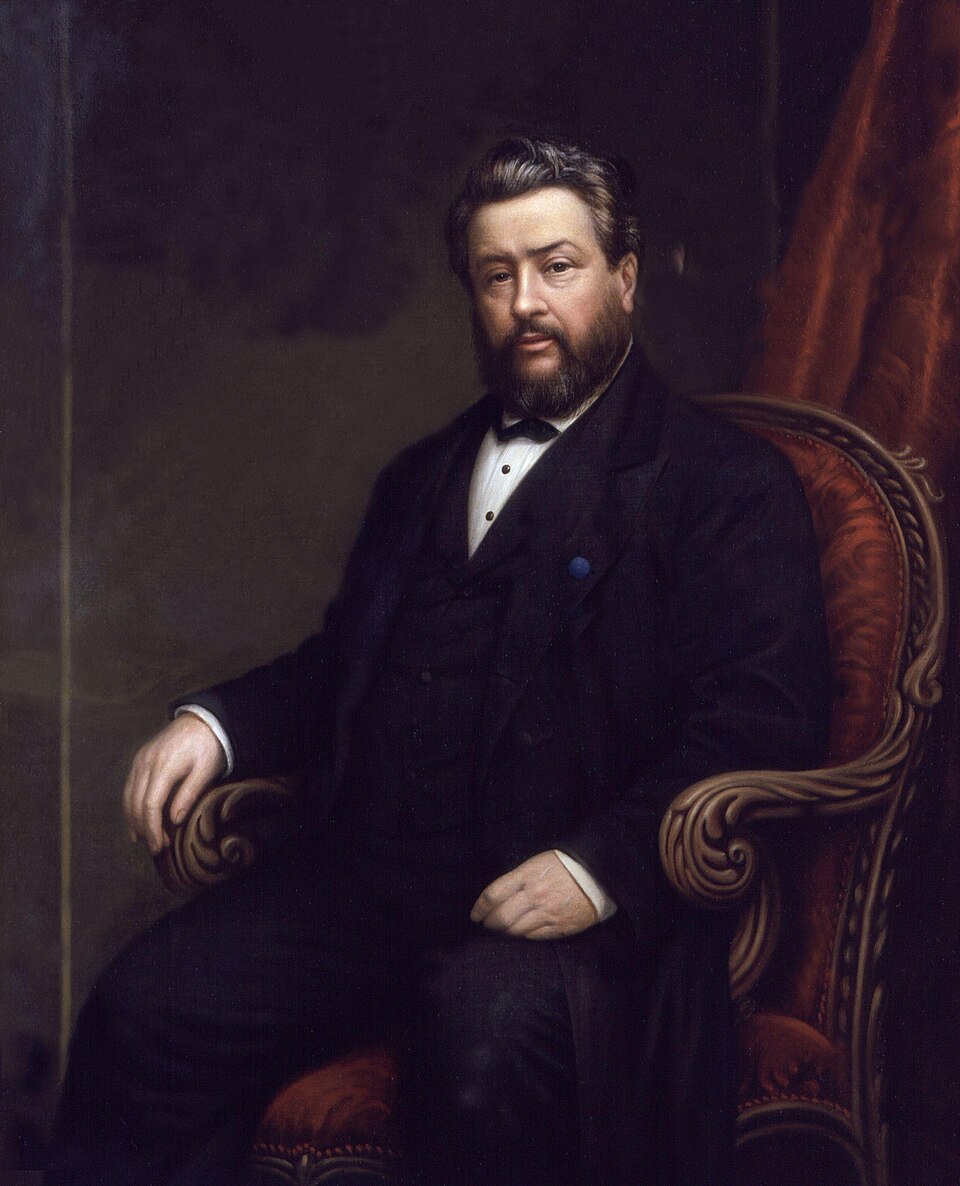
“Scripture is like a lion. Who ever heard of defending a lion? Just turn it loose; it will defend itself.” — Charles Spurgeon (AZ Quotes)
Life
Charles Haddon Spurgeon was born on 19 June 1834 in Kelvedon, Essex, the first of seventeen children. He was sent to live with his grandparents in Stambourne at age one. Both his grandfather and father were Independent ministers. (Wikipedia; Britannica)
On 6 January 1850 — the morning that changed everything. Fifteen-year-old Spurgeon, trapped by a blizzard, ducked into a Primitive Methodist chapel on Artillery Street in Colchester. The fill-in preacher — whom Spurgeon later described as “really stupid” — preached on Isaiah 45:22: “Look unto me, and be ye saved, all the ends of the earth.” The preacher looked at the young man and said directly: “Young man, you look very miserable. Look to Jesus Christ! Look! Look! Look! You have nothing to do but look and live.” Spurgeon looked, and was saved. (spurgeon.org)
In April 1854, at just nineteen, Spurgeon became pastor of London’s New Park Street Chapel. The congregation numbered roughly two hundred when he arrived. Within months the building could not hold the crowds. (spurgeon.org; Britannica)
In 1856 he married Susannah Thompson; twin sons Charles and Thomas were born the same year. That year he also founded the Pastors’ College — a free seminary for training preachers, still operational today. (Christianity Today)
In 1861, the Metropolitan Tabernacle opened — seating six thousand, completely debt-free. That same year Spurgeon preached to 23,654 people at the Crystal Palace. (spurgeon.org; Britannica)
He went on to found the Stockwell Orphanage (1867), a girls’ orphanage (1879), a colportage association (1866), and the monthly magazine The Sword and the Trowel (1865). In all, he founded sixty-six charitable organizations. (spurgeon.org)
The Downgrade Controversy. In 1887, Spurgeon published warnings in The Sword and the Trowel that theological liberalism was eroding Baptist doctrine. He wrote: “Our warfare is with men who are giving up the atoning sacrifice, denying the inspiration of Holy Scripture, and casting slurs upon justification by faith.” (GotQuestions; Christian History Institute)
On 28 October 1887, Spurgeon wrote to the Baptist Union announcing his withdrawal. In January 1888, the Union Council accepted his withdrawal and then voted to censure him — nearly a hundred to five. He stood almost alone for the authority of Scripture. He said: “I am quite willing to be eaten of dogs for the next fifty years; but the more distant future shall vindicate me.” (spurgeon.org)
On 7 June 1891, Spurgeon preached his last sermon at the Metropolitan Tabernacle. He died on 31 January 1892 in Mentone, France, aged fifty-seven. (Wikipedia)
Over his lifetime he preached some 3,500 sermons to an estimated ten million people. His sermons were translated into nearly forty languages and fill sixty-three volumes. He personally baptized fifteen thousand converts. (spurgeon.org)
Timeline
- 1834 — Born 19 June in Kelvedon, Essex
- 1850 — 6 January: converted in a Colchester chapel during a blizzard
- 1854 — Became pastor of New Park Street Chapel at age nineteen
- 1856 — Married Susannah Thompson; founded the Pastors’ College
- 1861 — Metropolitan Tabernacle opened (6,000 seats, debt-free)
- 1865 — Founded The Sword and the Trowel magazine
- 1867 — Founded the Stockwell Orphanage
- 1885 — Completed the seven-volume Treasury of David
- 1887 — The Downgrade Controversy; withdrew from the Baptist Union
- 1891 — Preached his last sermon, 7 June
- 1892 — Died 31 January in Mentone, France
Teaching
Scripture is self-authenticating. Spurgeon’s confidence in Scripture was absolute and simple: “Scripture is like a lion. Who ever heard of defending a lion? Just turn it loose; it will defend itself.” (AZ Quotes) And: “The Bible, the whole Bible, and nothing but the Bible is the religion of Christ’s church.” (AZ Quotes)
Preaching must be Christ-centered. “Never was man blamed in heaven for preaching Christ too much.” (spurgeon.org) “The Spirit of God bears no witness to Christless sermons.” (AZ Quotes) “Let this be to you the mark of true gospel preaching — where Christ is everything, and the creature is nothing.” (AZ Quotes)
Without the Spirit, no ministry. “Without the Spirit of God, we can do nothing. We are as ships without wind. We are useless.” (AZ Quotes) “Every growth of spiritual life, from the first tender shoot until now, has been the work of the Holy Spirit.” (AZ Quotes)
Prayer is the church’s lifeline. “I would rather teach one man to pray than ten men to preach.” (AZ Quotes) “Neglect of private prayer is the locust which devours the strength of the church.” (AZ Quotes)
Connection to the Recovery
Brother Witness Lee placed Spurgeon among the great evangelists the Lord raised up in the nineteenth century, alongside Moody, Finney, and Torrey. He wrote: “In England there were C. H. Spurgeon and Hudson Taylor, the founder of the China Inland Mission.” (Ministry Samples) Brother Witness Lee also cited Spurgeon’s era as a high point of British Christian output. (Ministry Samples)
Brother Watchman Nee cited Spurgeon’s endorsement of Robert Govett: “C.H. Spurgeon once said that Govett was a hundred years ahead of his time because his teachings were so profound.” Govett’s kingdom-reward teachings deeply influenced the recovery’s understanding of the overcomers. (Ministry Samples)
The Downgrade Controversy speaks directly to the recovery’s concern. When institutions tolerate drift on the authority of Scripture, the deity of Christ, and substitutionary atonement, the church degrades. Spurgeon stood nearly alone and was censured for it — a pattern that repeats whenever believers hold to biblical truth against institutional pressure.
Significance
Spurgeon is called the “Prince of Preachers.” He never attended seminary. He began pastoring at nineteen and continued for nearly forty years. He preached weekly to thousands, built a six-thousand-seat church (debt-free), founded a pastors’ college and sixty-six charities, and wrote devotional works that still circulate today.
But what stands out most may not be what he built but what he was willing to lose. When the Baptist Union compromised on the authority of Scripture, he walked out alone. Nearly a hundred men voted against him. Five stood with him. He said one sentence and waited for history:
“I am quite willing to be eaten of dogs for the next fifty years; but the more distant future shall vindicate me.”
A hundred and thirty years have passed. History vindicated him.