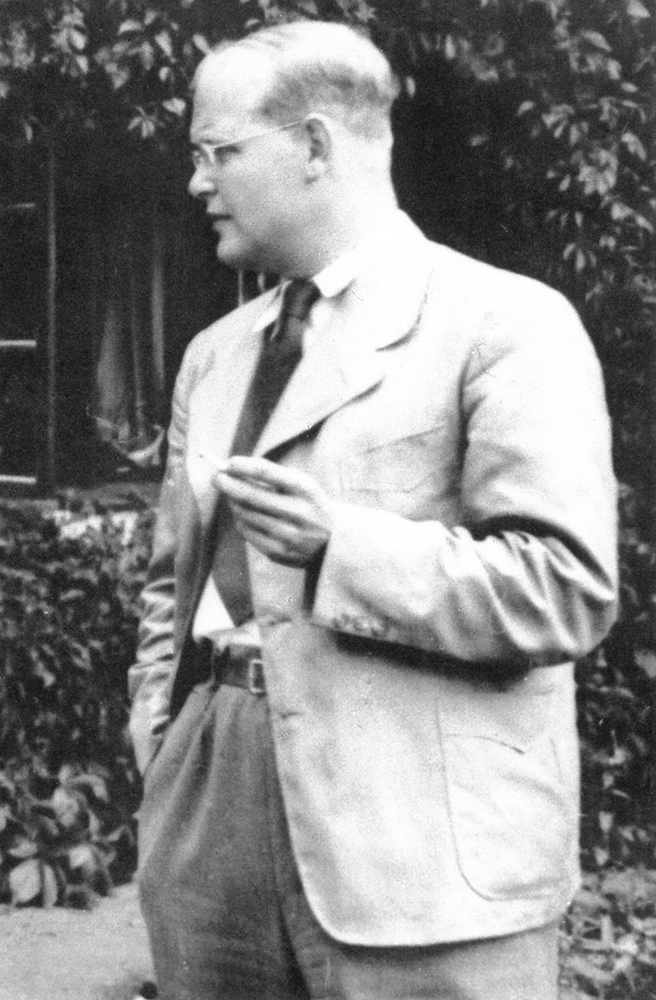
“When Christ calls a man, he bids him come and die.” — Bonhoeffer, The Cost of Discipleship
Life
Dietrich Bonhoeffer was born on February 4, 1906, in Breslau, Germany (now Wroclaw, Poland). His father, Karl Bonhoeffer, was a professor of psychiatry at the University of Berlin; his mother, Paula, came from a family of Protestant theologians and painters. He was the sixth of eight children, with a twin sister, Sabine. (Holocaust Encyclopedia — Dietrich Bonhoeffer)
In 1923, he began theological studies at the University of Tübingen, transferring to the University of Berlin the following year. In 1927, at just twenty-one, he completed his doctoral dissertation Sanctorum Communio, in which he proposed a definition that would accompany him for life: the church is “Christ existing as community” (Christus als Gemeinde existierend). Karl Barth called it “a theological miracle.” (Fortress Press — Sanctorum Communio; TGC — Christ Existing as Church-Community)
In 1928, he served as curate to a German-speaking congregation in Barcelona. From 1930 to 1931, he studied as a Sloane Fellow at Union Theological Seminary in New York, attending the Abyssinian Baptist Church in Harlem and witnessing American racism firsthand — an experience that shaped him deeply. (Samford University — Bonhoeffer Saw American Racism)
Hitler came to power in January 1933. That April, Bonhoeffer published “The Church and the Jewish Question,” one of the earliest Christian critiques of the Nazi regime. (Holocaust Encyclopedia)
In 1935, he returned to Germany to direct the Confessing Church’s underground seminary — first at Zingst, then at Finkenwalde. This semi-monastic communal life became the source of both The Cost of Discipleship and Life Together. In September 1937, the Gestapo shut Finkenwalde down. (Ligonier — An Underground Seminary)
In June 1939, he accepted an invitation to the United States, but after only two weeks decided to return to Germany. He wrote: “I shall have no right to participate in the reconstruction of Christian life in Germany after the war if I do not share the trials of this time with my people.” (International Bonhoeffer Society — Biography)
In October 1940, he joined the Abwehr (German military intelligence) as a civilian agent, using the cover for resistance activities. He participated in “Operation Seven” — a plan to smuggle Jews out of Germany by providing them papers as foreign agents. (Holocaust Encyclopedia)
On April 5, 1943, the Gestapo arrested Bonhoeffer. He was held at Tegel Prison in Berlin, where he continued to pastor fellow prisoners and wrote the theological letters and poems that became Letters and Papers from Prison. (Flossenbürg Memorial)
On April 8, 1945 — Easter Sunday morning — he led a final worship service for his fellow prisoners at Flossenbürg concentration camp, expounding Isaiah 53:5. The service had barely ended when the guards came. At dawn on April 9, after a summary court-martial, Bonhoeffer was hanged. He was thirty-nine years old.
The camp doctor, Fischer-Hüllstrung, recorded: “I saw Pastor Bonhoeffer… kneeling on the floor praying fervently to his God. I was most deeply moved by the way this lovable man prayed, so devout and so certain that God heard his prayer… At the place of execution, he again said a short prayer and then climbed the few steps to the gallows, brave and composed… I have hardly ever seen a man die so entirely submissive to the will of God.” (The Bonhoeffer Project — Last Days)
His last words, to fellow prisoner Payne Best, a British officer: “This is the end — for me, the beginning of life.” (HISTORY.com)
Timeline
- 1906 — Born February 4 in Breslau
- 1912 — Family moved to Berlin
- 1923 — Began theological studies at Tübingen
- 1927 — Completed doctoral dissertation Sanctorum Communio
- 1928 — Curate in Barcelona
- 1930–31 — Sloane Fellow at Union Theological Seminary, New York
- 1931 — Ordained; appointed lecturer at Berlin
- 1933 — Published “The Church and the Jewish Question”
- 1934 — Participated in drafting the Barmen Declaration
- 1935 — Directed the Finkenwalde underground seminary
- 1937 — Published The Cost of Discipleship; Finkenwalde closed by the Gestapo
- 1939 — Published Life Together; brief trip to America, then returned to Germany
- 1940 — Joined the Abwehr for resistance activities
- January 1943 — Engaged to Maria von Wedemeyer
- April 5, 1943 — Arrested by the Gestapo; held at Tegel Prison
- 1944 — Wrote theological letters and poems “Who Am I?” and “By Gracious Powers” from prison
- April 9, 1945 — Hanged at Flossenbürg concentration camp
Teaching
Costly Grace and Cheap Grace
Bonhoeffer’s most widely known distinction comes from The Cost of Discipleship:
“Cheap grace is the preaching of forgiveness without requiring repentance, baptism without church discipline, Communion without confession… Cheap grace is grace without discipleship, grace without the cross, grace without Jesus Christ, living and incarnate.”
“Costly grace is the treasure hidden in the field; for the sake of it a man will gladly go and sell all that he has… It is costly because it calls us to follow, and it is grace because it calls us to follow Jesus Christ. It is costly because it costs a man his life, and it is grace because it gives a man the only true life.”
(Goodreads — Cost of Discipleship Quotes)
The Church as “Christ Existing as Community”
This was the core insight of Bonhoeffer’s life. In Sanctorum Communio he wrote: “God does not desire a history of individual human beings, but the history of human community. However God does not want a community that absorbs the individual into itself but a community of human beings.” Later, in Letters and Papers from Prison, he went further: “The church is church only when it is there for others.” (TGC — Christ Existing as Church-Community)
Life Together
In Life Together, drawing on the Finkenwalde experience, Bonhoeffer wrote: “Christianity means community through Jesus Christ and in Jesus Christ… We belong to one another only through and in Jesus Christ.” “Christian brotherhood is not an ideal which we must realize; it is rather a reality created by God in Christ in which we may participate.” (Wikipedia — Life Together)
“Religionless Christianity”
On April 30, 1944, he wrote from prison to his closest friend Eberhard Bethge: “What is bothering me incessantly is the question what Christianity really is, or indeed who Christ really is, for us today.” He was not calling for a churchless Christianity but critiquing hollow religious institutions — true “religionless Christianity” meant a vibrant church-community centered on Christ’s living presence. (Richard Beck — Bonhoeffer’s Religionless Christianity)
Connection to the Recovery
Bonhoeffer (1906–1945) and Brother Watchman Nee (1903–1972) were near-exact contemporaries. They never met and left no record of referencing each other. Yet several deep parallels run between their lives and teachings.
Both paid the cost of faith under totalitarian regimes. Bonhoeffer was arrested and imprisoned in Nazi Germany, executed in 1945. Brother Watchman Nee was arrested and imprisoned in Communist China, held for twenty years, and died in confinement in 1972. Both remained faithful to Christ to the end. (Watchman Nee Life and Ministry)
Both saw the church as Christ’s corporate expression. Bonhoeffer said the church is “Christ existing as community.” Brother Watchman Nee taught that “the church as the Body of Christ was simply the enlargement, expansion, and expression of the resurrected Christ.” Independently — one within the German Lutheran tradition, the other within Chinese Christianity shaped by the Plymouth Brethren — they arrived at strikingly similar ecclesiologies. (Ministry Samples — Watchman Nee’s Ministry: Christ and the Church)
Both emphasized the cross and the cost of discipleship. Bonhoeffer: “When Christ calls a man, he bids him come and die.” Brother Watchman Nee likewise stressed bearing the cross and losing the soul-life to follow Christ — at the core of his revelation was “living a crucified life and a resurrected life for the church life.” (Watchman Nee Life and Ministry)
Both emphasized community as the environment for spiritual growth. Bonhoeffer wrote in Life Together about communal practices of prayer, meals, Scripture, and mutual service. Brother Watchman Nee taught that believers need to come together and be built together, leaving their individual rooms to practice the church life under one roof.
Where they diverge: Bonhoeffer’s ecclesiology was rooted in the Lutheran sacramental tradition, while Brother Watchman Nee developed a church practice based on the ground of locality. But on the core conviction — that the church is Christ’s living corporate expression — they were deeply aligned.
Significance
Bonhoeffer answered with his life the question he posed from prison: “Who is Christ really for us today?”
For him, Christ was not a system of doctrine, not a religious tradition, but a living Lord — who calls people to follow, whose following costs everything, and whose cost is grace itself.
His life speaks to believers today: when faith becomes cheap, when following becomes comfortable, when the church becomes a club — listen again to the voice that came from Finkenwalde and Tegel Prison:
“Above all, it is costly because it cost God the life of his Son.” — Bonhoeffer, The Cost of Discipleship