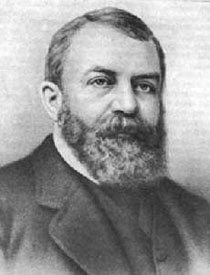
“I look upon this world as a wrecked vessel. God has given me a lifeboat and said, ‘Moody, save all you can.’” — D.L. Moody, Goodreads
Life
Dwight Lyman Moody was born on 5 February 1837 in Northfield, Massachusetts, the seventh of nine children. His father, a stonemason, died when Dwight was four, leaving the family in poverty. (Wikipedia)
At seventeen Moody moved to Boston to work in his uncle Samuel Holton’s shoe store. On 21 April 1855, his Sunday school teacher Edward Kimball visited him in the stockroom and spoke to him about Christ’s love. Moody was converted on the spot. He applied to Mount Vernon Congregational Church but was not received into membership until 4 May 1856, because the deacons found his theological knowledge so thin. (Christianity.com)
In 1856 he relocated to Chicago and entered the shoe business. In 1858 he started a Sunday school for poor children in a shanty in an area called “Little Hell.” By 1860 he left business entirely for full-time Christian work. In 1863 he organized the independent Illinois Street Church. In 1866 he became president of the Chicago YMCA. (BU Missiology)
On 8 October 1871 — the night of the Great Chicago Fire — Moody had preached on “What shall I do with Jesus which is called Christ?” and told the congregation to go home and think it over for a week. That night the fire broke out; some in the congregation died. The fire destroyed his church, his home, and the YMCA buildings. Moody resolved never again to give a congregation a week to decide — from then on he gave an invitation at every meeting. (Revival Library; Moody Church History)
Shortly after the fire, Moody traveled to New York to raise funds. Two women in his congregation — Sarah Anne Cooke and Mrs. Hawxhurst — had been praying that he would receive “the baptism of the Holy Ghost and fire.” While walking on Wall Street, an overwhelming sense of God’s presence came upon him. He went to a friend’s room and spent hours in prayer. In his own words: “God revealed Himself to me, and I had such an experience of His love that I had to ask Him to stay His hand.” He added: “The sermons were not different, I did not present any new truths; and yet hundreds were converted.” (Echoes of Inspiration)
In June 1873, Moody and singer Ira Sankey sailed for England. Over two years they held campaigns across Britain — in York, Edinburgh, Glasgow, Belfast, Dublin, Manchester, Birmingham, Liverpool, and London. In London alone, 285 meetings drew an estimated 2.5 million in aggregate attendance. (BU Missiology)
Returning to America, Moody conducted large urban campaigns and built institutions. In 1879 he founded the Northfield Seminary for girls; in 1881, the Mount Hermon School for boys. In 1880 he launched the Northfield Summer Conferences. In 1886, at a Northfield student conference, 100 young men pledged themselves to foreign missions — the “Mount Hermon Hundred” — giving birth to the Student Volunteer Movement, which sent over 20,000 missionaries abroad by the 1920s. In 1889 he founded the Chicago Bible Institute (renamed Moody Bible Institute after his death). (BU Missiology)
Moody preached his last sermon on 16 November 1899 in Kansas City. He fell ill, returned to Northfield by train, and died on 22 December 1899, aged sixty-two. (Britannica)
Timeline
- 1837 — Born 5 February in Northfield, Massachusetts
- 1855 — Converted 21 April in a Boston shoe store stockroom
- 1856 — Moved to Chicago
- 1858 — Started a Sunday school in the slums
- 1860 — Left business for full-time Christian work
- 1871 — October: Great Chicago Fire; shortly after, experienced the baptism of the Holy Spirit on Wall Street
- 1873–1875 — Moody-Sankey revivals across Britain
- 1879 — Founded Northfield Seminary
- 1880 — Launched Northfield Summer Conferences
- 1886 — “Mount Hermon Hundred”; Student Volunteer Movement born
- 1889 — Founded Chicago Bible Institute (now Moody Bible Institute)
- 1899 — Died 22 December in Northfield
Teaching
The power of the Holy Spirit. Moody’s most central message: without the Spirit’s power, all service is futile. He said:
“There is no use in running before you are sent; there is no use in attempting to do God’s work without God’s power. A man working without this unction, a man working without this anointing, a man working without the Holy Ghost upon him, is losing time after all.” — AZ Quotes
And: “The Bible without the Holy Spirit is a sundial by moonlight.” (AZ Quotes)
The authority of Scripture. “The Bible will keep you from sin, or sin will keep you from the Bible.” (Kevin Halloran) And: “Now we have to take the Word of God just as it is; and if we are going to take it, we have no authority to take out just what we like.” (Christianity.com)
Lay ministry. Moody was never ordained. He had barely any formal education. His life proved that God uses Spirit-filled ordinary people. His Bible Institute was designed not to train professional clergy but to equip laypeople for gospel work. (BU Missiology)
Interdenominational cooperation. His Chicago Avenue Church operated on the principle: “In essentials loyalty; in unessentials liberty; in all things charity.” He drew speakers and students from every Protestant tradition and refused to make denominational affiliation a test of fellowship. (TGC)
Connection to the Recovery
Brother Witness Lee placed Moody among the prominent evangelists the Lord raised up in the nineteenth century — alongside Finney, Spurgeon, and Torrey — as part of the evangelism line that God used alongside the inner-life line and the Brethren movement. (Ministry Samples — The Inner Life)
Brother Witness Lee quoted Moody directly: “D.L. Moody said that regeneration is the greatest miracle in the universe.” (Ministry Samples)
Brother Witness Lee also observed that Moody Bible Institute and Dallas Theological Seminary’s theologies “are basically those of the Brethren.” This places Moody’s institutional legacy within the same Brethren theological stream that deeply influenced Brother Watchman Nee. (Ministry Samples)
The indirect influence chain runs longer: Moody’s 1873–75 British campaigns prepared the soil for the Keswick Convention (founded 1875). He gave Keswick-style holiness teaching a major platform at his Northfield Conferences. The Keswick movement influenced Andrew Murray, Jessie Penn-Lewis, and F.B. Meyer — all of whom deeply shaped Brother Watchman Nee through the library of his mentor Margaret E. Barber. The chain: Moody’s British campaigns → Keswick Convention → inner-life writers → M.E. Barber → Brother Watchman Nee. (Wikipedia — Higher Life Movement)
Significance
Moody invented modern urban evangelism — adapting the rural camp meeting to the industrial city with organization, publicity, music, follow-up, and interdenominational cooperation. Every major evangelist after him, from Billy Sunday to Billy Graham, used his methods. He founded the Bible institute movement, training more missionaries than any other single American institution. He launched the Student Volunteer Movement, which sent 20,000 missionaries abroad. He demonstrated that Protestant Christians could cooperate across denominational lines without surrendering core convictions.
He was never ordained. His theological training was virtually nil. But R.A. Torrey summarized why God used Moody in seven points, none of them about credentials: complete surrender to God, a devoted prayer life, serious Bible study, genuine humility, freedom from materialism, a burning passion for lost souls, and clear empowerment by the Holy Spirit. (Wholesome Words)
Perhaps Moody’s most powerful sentence is his simplest:
“I firmly believe that the moment our hearts are emptied of pride and selfishness and ambition and self-seeking and everything that is contrary to God’s law, the Holy Ghost will come and fill every corner of our hearts.”
Not more knowledge. Not better methods. An emptied heart. That is Moody’s most enduring message.