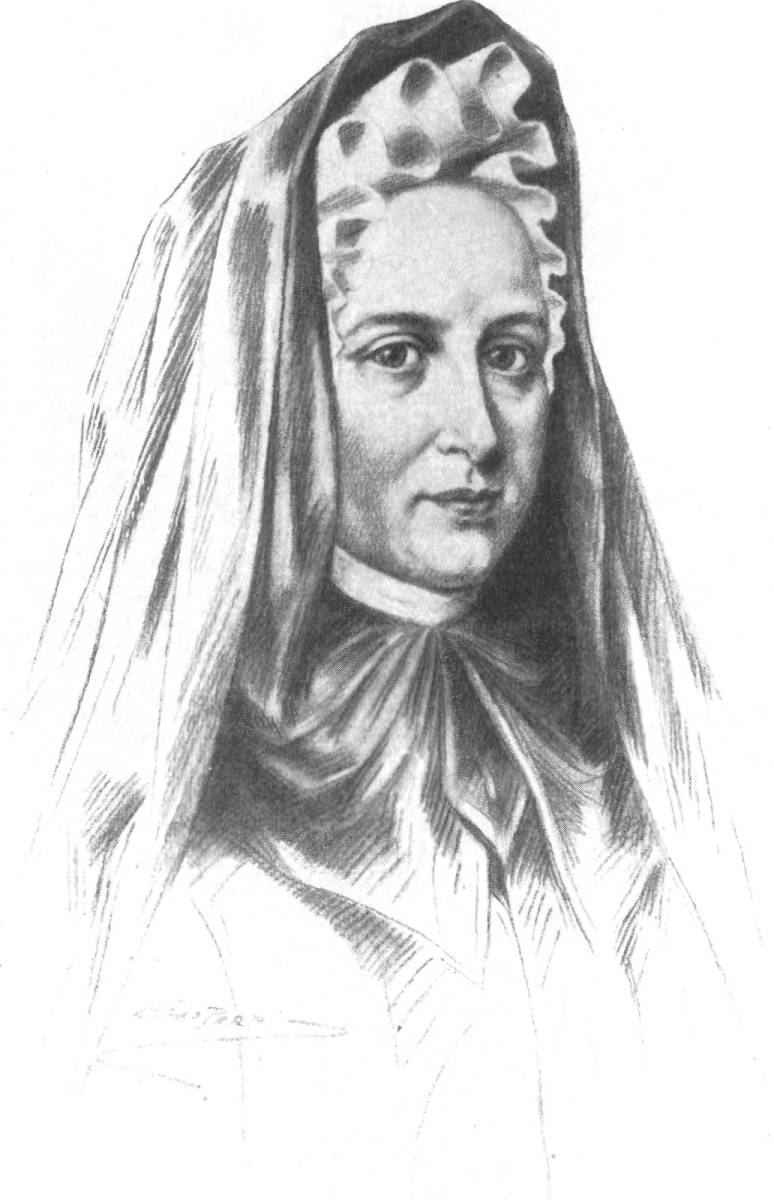
“Prayer is nothing else but turning the heart toward God, an inward exercise of love.” — Madame Guyon, A Short and Easy Method of Prayer
Life
Madame Guyon (Jeanne-Marie Bouvier de la Motte-Guyon) was born on 13 April 1648 in Montargis, France. As a child she was placed in an Ursuline convent. In 1664, at just fifteen years old, she was married to Jacques Guyon du Chesnoy, a man twenty-two years her senior. Married life was hard — her husband was sickly and her mother-in-law severe. (Britannica)
Around 1668, a Franciscan friar told her: “What you are seeking outside is actually within you. Learn to seek God in your heart.” This single sentence redirected her spiritual life. She abandoned her laborious methods of meditation and turned instead to quiet prayer in the depths of her heart. (Project Gutenberg: Autobiography)
After her husband’s death in 1676, she devoted herself entirely to spiritual pursuits. Beginning in 1681, under the guidance of the Franciscan friar François Lacombe, she traveled from Paris to Geneva, Turin, Grenoble, and elsewhere, preaching as she went. In 1685 she published A Short and Easy Method of Prayer, provoking intense controversy among church authorities. (Britannica)
She returned to Paris in 1687 and met François Fénelon, the Archbishop of Cambrai. The two developed a deep spiritual friendship and exchanged more than a hundred letters. However, Bishop Bossuet of Meaux regarded her teaching as heretical. The Conference of Issy in 1695 formally condemned her writings. (EBSCO Research)
She then endured eight years of imprisonment: first in the Château de Vincennes (1695–1696), then the Convent of Vaugirard (1696–1698), and finally the Bastille (1698–1703). In the Bastille she was held in solitary confinement, completely cut off from the outside world. She wrote from prison:
“In the Bastille I say to You, my God, that if You would make me a spectacle before men and angels, may Your will be done!” — Autobiography
She was released in 1703 at the age of fifty-four. She spent the remainder of her life quietly at her son-in-law’s home in Blois, until her death on 9 June 1717. (Encyclopedia.com)
Timeline
- 1648 — Born 13 April in Montargis, France
- c. 1655 — Placed in an Ursuline convent
- 1664 — Married Jacques Guyon at age fifteen
- c. 1668 — A Franciscan friar’s words transform her spiritual life
- 1676 — Husband dies; becomes a widow
- 1681 — Begins traveling with Friar Lacombe
- 1682 — Writes Spiritual Torrents
- 1685 — Publishes A Short and Easy Method of Prayer; controversy erupts
- 1687 — Returns to Paris; meets Archbishop Fénelon; Pope Innocent XI condemns Quietism
- 1688 — First confined in a convent; after release, teaches at the school of Saint-Cyr
- 1695 — Conference of Issy condemns her writings; imprisoned in the Château de Vincennes
- 1698 — Transferred to the Bastille
- 1703 — Released; retires to Blois
- 1717 — Dies 9 June in Blois, aged sixty-nine
Teaching
Prayer of the Heart
Madame Guyon taught that prayer is not an exercise of the mind but a turning of the heart toward God in love. She opened this path to everyone — including the uneducated:
“Come, all ye dull, ignorant, and illiterate — ye are called to pray! All are called, none excepted, because Jesus Christ has called all.” — A Short and Easy Method of Prayer
“If while reading you feel yourself recollected inwardly, lay the book aside and remain in quietness.” — A Short and Easy Method of Prayer
“Some have falsely supposed that the soul in silence is dull; actually it is operating more nobly than before — because God is the mover.” — A Short and Easy Method of Prayer
Abandonment of Self-Will
She taught believers to surrender their entire being to God, accepting all His arrangements — whether light or darkness, sweetness or bitterness:
“We should begin to abandon and surrender our whole being to God, because we strongly and certainly know that everything that happens each moment proceeds from His direct will and permission.” — A Short and Easy Method of Prayer
“We should receive equally all His dispensations: darkness, illumination, weakness, sweetness, temptation, suffering, and doubt.” — A Short and Easy Method of Prayer
The Death of Self
This is the deepest and most controversial part of Madame Guyon’s teaching. She used “death” to describe the complete cessation of self-will, so the soul no longer lives for itself:
“Death is called a departure, that is, a separation from self in order to pass into God; the total loss of the will of the creature, so that the soul no longer has anything of its own, but exists only in God.” — Spiritual Torrents
“Cease to struggle against death, and you shall live by death.” — Spiritual Torrents, Chapter 7
“He destroys only to build; for when He is about to rear His own divine temple in us, He first completely demolishes the vain and gaudy old structure.” — Autobiography
Union with God
In Spiritual Torrents, she used the image of a river flowing into the sea to describe the soul’s union with God:
“The river, losing itself in the sea, becomes one with the sea.” — Spiritual Torrents, Chapter 4
“The soul no longer has any separate interest, for by losing itself it has lost all self-interest; this blind abandonment becomes the soul’s permanent state.” — Spiritual Torrents
Connection to the Recovery
Brother Watchman Nee and Madame Guyon
Brother Watchman Nee first encountered Madame Guyon’s writings through his English missionary mentor, Margaret Barber. Brother Nee said that Madame Guyon’s biography, along with John Bunyan’s Pilgrim’s Progress, “helped him in the things of life.” (Ministry Samples; Thirdmill Biographical Study)
Under Brother Nee’s supervision, his co-worker Brother Yu Chenghua translated Madame Guyon’s autobiography into Chinese in 1938, published under the title Sweet Smelling Myrrh. Brother Yu also translated Brother Lawrence’s The Practice of the Presence of God. (BDCC: Yu Chenghua)
Madame Guyon’s teaching left clear marks in Brother Nee’s writings:
The Breaking of the Outer Man and the Release of the Spirit — Madame Guyon taught that self-will must die for God to work freely within. Brother Nee developed the same theme in The Release of the Spirit: the outer man (the soul’s self-will, emotion, and mind) must be broken so that the inner spirit can be released for service. The core is the same: the problem is not outward behavior but the inward self. (Watchman Nee, The Breaking of the Outer Man and the Release of the Spirit)
The Division of Spirit and Soul — In The Spiritual Man, Brother Nee cited Madame Guyon alongside Stockmayer, Jessie Penn-Lewis, and Evan Roberts, saying they “all testify of the division of the spirit and the soul,” and “because we have received the same commission, I freely cite their works.” (The Spiritual Man)
Brother Witness Lee’s Assessment
Brother Witness Lee positioned Madame Guyon as a representative figure of the inner-life tradition:
“In the history of the Lord’s recovery, there is one line known as the inner-life line. This line began about three hundred years ago with the mystics. Some of these were Madame Guyon, Fénelon, and Brother Lawrence. Although this group of seeking ones were within the Roman Catholic Church, they paid great attention to the inner life.” — Ministry Samples
“In the seventeenth century, among the Catholics there arose the mystics who pursued the inner life. The representative of this group was Madame Guyon. These people were very good in their life experience. But they were not clear about the church.” — Ministry Samples
Brother Lee also noted her limitation: “She still went to pray before an image of Mary.” (Ministry Books) This reflects Brother Lee’s consistent approach: acknowledging the genuine value of a spiritual heritage while honestly identifying its shortcomings. Madame Guyon went very deep in the experience of the inner life, but she had not yet been brought into the full light concerning the church.
Significance
Madame Guyon spent eight years in prison for teaching prayer — nearly five of those in the Bastille. The Roman Church declared her a heretic, the French king regarded her as a threat, and even Archbishop Fénelon, who defended her, was banished from the court. Her crime was not moral failure, not doctrinal deviation, but teaching ordinary people that they could meet God directly in the depths of their hearts — without elaborate ritual, without a priestly intermediary.
Her Short and Easy Method of Prayer, a small book of just twenty-four chapters, shook the entire French church. Because it implied a fact that those in power could not accept: if anyone can draw near to God in their own heart, what necessity remains for the vast religious apparatus?
Three hundred years later, Brother Watchman Nee rediscovered her writings in China, had her autobiography translated and published, and carried forward in his own teaching her vision of the death of self, the division of spirit and soul, and the inner life. Brother Witness Lee called her a “representative” of the inner-life line.
What Madame Guyon left us is not a theological system but a testimony: a person can experience the deepest rest in the deepest suffering, because what she sought was not outward freedom but inward union. For believers today who bear pressure in their faith, her life issues the same call — not to flee from suffering, but to turn within it toward the living God in the depths of the heart.