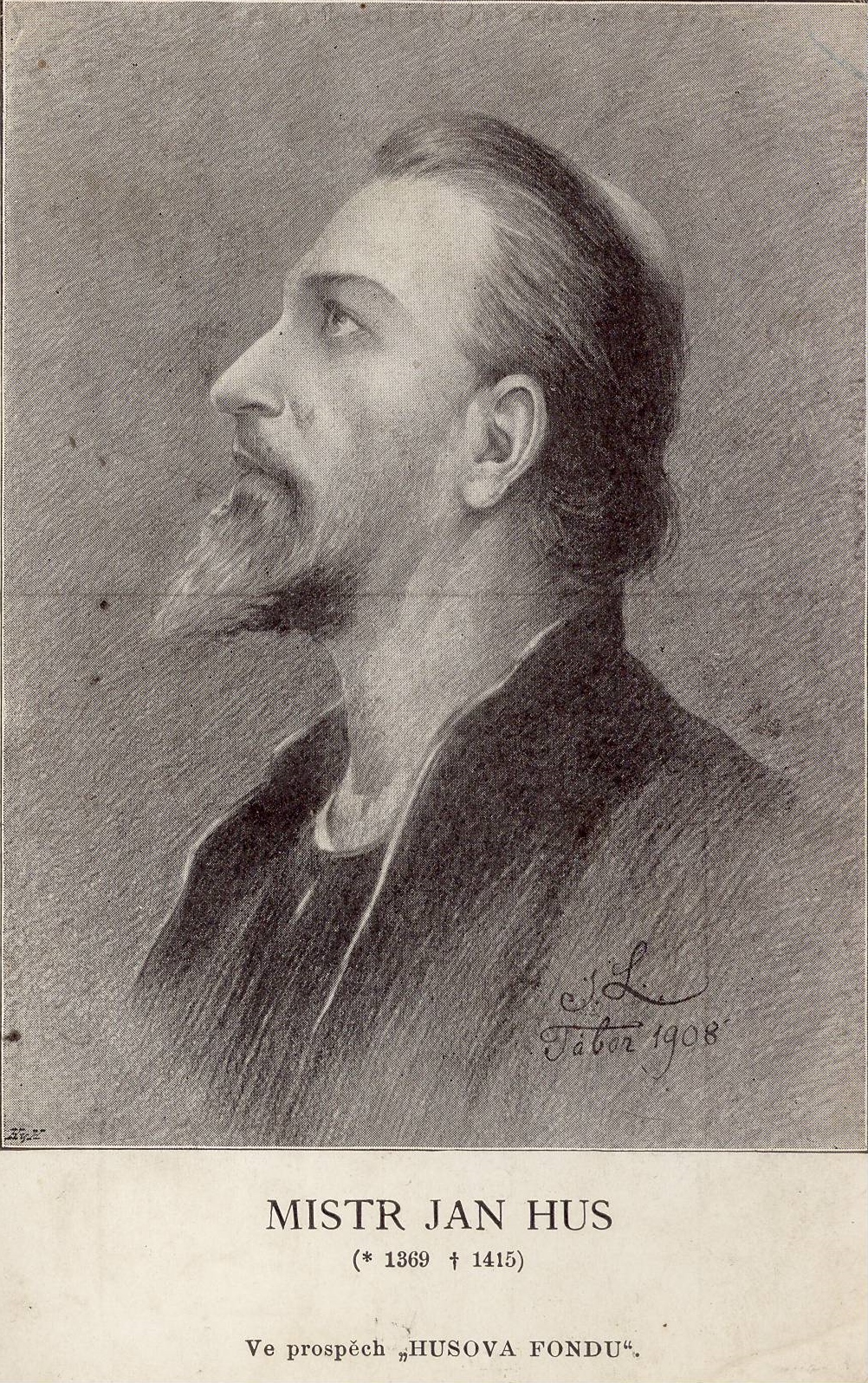
“Seek the truth, listen to the truth, learn the truth, love the truth, speak the truth, hold the truth, defend the truth — even to death.” — Jan Hus (AZ Quotes)
Life
Jan Hus (c. 1372–1415) was born in Husinec in Bohemia (in present-day Czechia). He entered the University of Prague around 1390, became dean of the faculty of philosophy in 1401, and in 1409 was elected rector. (Britannica)
In 1402 Hus was appointed to Bethlehem Chapel in Prague, the center of a Czech-language reform movement. He preached in Czech rather than Latin so ordinary people could hear God’s word. Under the influence of John Wycliffe, he began to challenge the sale of indulgences, the corruption of the papacy, and the pope’s absolute authority. (Britannica)
In 1412, after publicly opposing indulgences, Hus was excommunicated. To spare Prague from the burden of an interdict, he withdrew to southern Bohemia. There he wrote De Ecclesia (On the Church) and On Simony. (Britannica)
In 1414 the Council of Constance convened. Holy Roman Emperor Sigismund issued Hus a safe-conduct, promising personal security. Hus went to Constance hoping to defend his teaching, but he was arrested, tried, and pressed to recant.
On 6 July 1415 Hus refused to recant and was burned at the stake. According to one account, he said:
“God is my witness that I have never preached the things which are falsely charged against me. The principal intention of my preaching and all my other acts or writings was solely that I might turn men from sin.” — Wikipedia
His ashes were thrown into the Rhine. (Britannica)
Hus’s name in Czech means “goose.” A later tradition claims he spoke of a coming “swan” a hundred years after his death, which Martin Luther believed referred to the Reformation. (Ligonier)
Hus’s followers (the Hussites) later formed the Unitas Fratrum (the Bohemian Brethren). After centuries of persecution, their descendants included Moravian refugees who settled on Zinzendorf’s estate and founded Herrnhut.
Timeline
- c. 1372 — Born in Husinec, Bohemia
- c. 1390 — Entered the University of Prague
- 1402 — Appointed to Bethlehem Chapel; preached in Czech
- 1409 — Elected rector of the University of Prague
- 1412 — Opposed indulgences publicly; excommunicated; withdrew from Prague
- 1414 — Went to the Council of Constance under safe-conduct
- 1415 — 6 July: burned at the stake
Teaching
Scripture above pope and council. Following Wycliffe, Hus insisted that Scripture is the final authority and that pope and council must be judged by it.
Against indulgences and simony. The indulgence trade Hus opposed was the same evil Luther would challenge a century later.
The word of God in the people’s language. Hus preached in Czech so common people could hear and understand — the same line that runs through Wycliffe’s English Bible and Luther’s German Bible.
Connection to the Recovery
Hus occupies a key link in the recovery’s historical line through the Moravian movement. Brother Witness Lee, speaking of the Moravian Brethren, said:
“When the Moravian brothers came to Count Zinzendorf, they began to have the church life outside of Catholicism and altogether outside of the organized Protestant churches.” — Ministry Samples
Those Moravian Brethren were the spiritual heirs of the Hussites. The line is: Hus → Hussites → Unitas Fratrum → Moravian Brethren → Herrnhut under Zinzendorf → influence on Wesley → evangelical renewal. Hus watered a seed with martyr’s blood; centuries later it flowered in Herrnhut.
Significance
Hus stands between Wycliffe and Luther. He confessed, a century early, what reformers would later confess — and paid for it with his life. His followers survived persecution and became a root for one of the most consequential renewal movements in modern Christian history.
His words still cut clean:
“Seek the truth, listen to the truth, learn the truth, love the truth, speak the truth, hold the truth, defend the truth — even to death.”