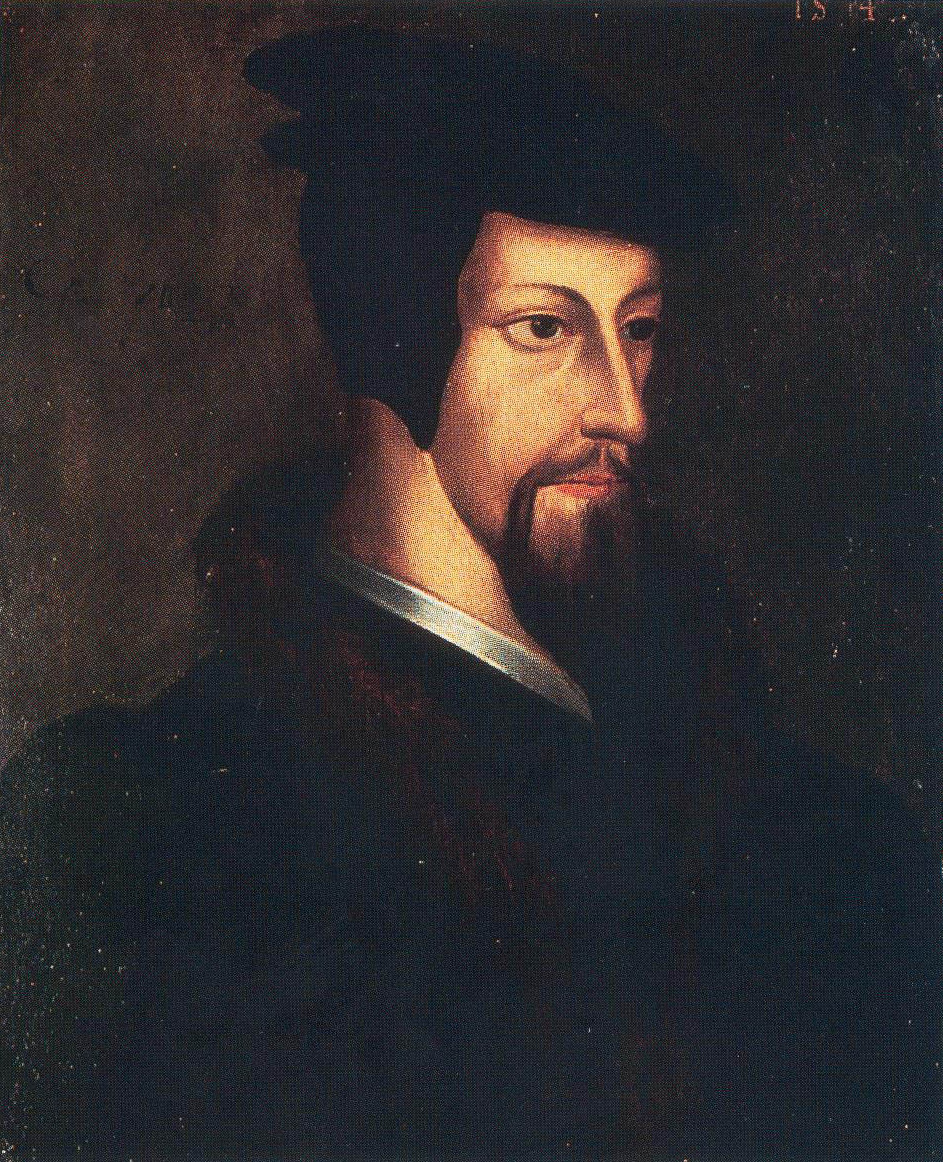
“The gospel is not a doctrine of the tongue, but of life. It cannot be grasped by reason and memory only, but it is fully understood when it possesses the whole soul and penetrates to the inner recesses of the heart.” — John Calvin, Institutes of the Christian Religion
Life
John Calvin (Jean Cauvin) was born on 10 July 1509 in Noyon, Picardy, in northern France. His father Gérard Cauvin served as a notary for the local cathedral chapter; his mother died when he was young. He later Latinized his surname to Calvinus, which became Calvin in French. (Calvin University)
In 1523, at just fourteen, Calvin was sent to Paris — first to the Collège de la Marche, then to the Collège de Montaigu. In 1528, his father redirected him from theology to law, and Calvin moved to Orléans and Bourges. He completed his law studies in 1532 and published his first work, a commentary on Seneca’s De Clementia. (Calvin University)
Around 1533, Calvin experienced spiritual conversion. He later described it as God subduing his heart by “a sudden conversion.” He fled Paris because of his contacts with those who opposed the Roman Catholic Church. (Calvin University)
In March 1536, at age twenty-six, he published the first edition of the Institutes of the Christian Religion in Basel (Latin, six chapters). That August, he made what he intended as a one-night stop in Geneva. William Farel detained him with a plea that carried the force of divine judgment: “If you refuse to help under the pretext of your studies, God will curse your peace!” Calvin stayed. (Calvin University)
In 1538, Calvin and Farel were banished from Geneva over theological conflicts with the city council. Calvin went to Strasbourg, where he pastored the French-speaking refugee congregation. In August 1540, he married Idelette de Bure, a widow of a converted Anabaptist. In 1542, their son Jacques was born prematurely and died two weeks later. The couple had no surviving children. (Calvin University; Wikipedia: Idelette Calvin)
In September 1541, the Geneva city council invited Calvin back. He accepted and served there for the rest of his life. On 29 March 1549, Idelette died. Calvin wrote to Farel: “I have lost the best companion of my life.” (Wikipedia: Idelette Calvin)
In 1559, the definitive edition of the Institutes was published (Latin, four books, eighty chapters), becoming the standard work of Reformed theology. On 6 February 1564, Calvin preached his last sermon at St. Pierre. He died on 27 May 1564, aged fifty-four. By his own request, his grave bore no marker — he did not want attention drawn to himself. (Calvin University; The Gospel Coalition)
Timeline
- 1509 — Born 10 July in Noyon, France
- 1523 — Sent to Paris (Collège de la Marche, then Collège de Montaigu)
- 1528 — Moved to Orléans to study law
- 1532 — Completed law studies; published commentary on Seneca’s De Clementia
- c. 1533 — Spiritual conversion; fled Paris
- 1536 — March: first edition of the Institutes published (Basel); August: arrived in Geneva and stayed
- 1538 — Banished from Geneva; went to Strasbourg to pastor a French-speaking congregation
- 1540 — Married Idelette de Bure
- 1541 — September: returned to Geneva at the city council’s invitation
- 1542 — Son Jacques born and died two weeks later
- 1549 — Idelette died
- 1559 — Definitive edition of the Institutes published (four books, eighty chapters)
- 1564 — Preached last sermon 6 February; died 27 May in Geneva
Teaching
The sovereignty of God. The cornerstone of Calvin’s theology is God’s absolute sovereignty over all things. He wrote: “All events whatsoever are governed by the secret counsel of God.” (Christian History Institute) This was not a cold doctrine for Calvin — it was the ground of the believer’s rest, because the one who governs our destiny is not blind fate but a wise, purposeful, loving Father.
Union with Christ. This stood at the center of Calvin’s entire soteriology. In Institutes 3.1.1 he wrote:
“First, we must understand that as long as Christ remains outside of us, and we are separated from him, all that he has suffered and done for the salvation of the human race remains useless and of no value for us.” — Institutes 3.1.1
He continued:
“That joining together of Head and members, that indwelling of Christ in our hearts — in short, that mystical union — are accorded by us the highest degree of importance, so that Christ, having been made ours, makes us sharers with him in the gifts with which he has been endowed.” — Institutes 3.11.10
Calvin compared the flesh of Christ to “a rich and inexhaustible fountain that pours into us the life springing forth from the Godhead” (Institutes 4.17.9, The Gospel Coalition).
The Holy Spirit as the bond of union. “The Holy Spirit is the bond by which Christ effectually unites us to himself.” (Institutes 3.1.1) Calvin insisted that without the Spirit’s inward work, everything Christ accomplished remains objective historical fact, never becoming the believer’s subjective experience.
The authority and sufficiency of Scripture. “For Scripture is the school of the Holy Spirit, in which, as nothing is omitted that is both necessary and useful to know, so nothing is taught but what is expedient to know.” (A-Z Quotes) And: “Those whom the Holy Spirit has inwardly taught truly rest upon Scripture, and that Scripture itself is self-authenticated.” (A-Z Quotes)
Christian liberty. In Institutes 3.19.7, Calvin taught that matters neither commanded nor forbidden by Scripture belong to the category of adiaphora (things indifferent), in which Christians have freedom. He warned: “The knowledge of this liberty is very necessary for us; where it is wanting our consciences will have no rest, there will be no end of superstition.” (Institutes 3.19.7, CCEL)
On the church. “Wherever we see the Word of God purely preached and heard, there a church of God exists, even if it swarms with many faults.” (A-Z Quotes) And: “The highest honor in the church is not government but service.” (A-Z Quotes)
Connection to the Recovery
Brother Watchman Nee placed Calvin in the lineage of the Lord’s recovery. He said: “After twelve years, in 1536 John Calvin was raised up by God. He was one of the greatest vessels of God in that age.” (Ministry Samples)
Calvin’s teaching on union with Christ — “as long as Christ remains outside of us… all that he has suffered and done for us remains useless” — resonates deeply with Brother Watchman Nee’s emphasis on “Christ as life.” Calvin described Christ’s flesh as “an inexhaustible fountain that pours into us the life springing forth from the Godhead” (Institutes 4.17.9). Brother Witness Lee’s teaching on the Triune God dispensing Himself into believers as life runs in a striking parallel with Calvin’s fountain imagery. (Ministry Samples: How to Take Christ as Life)
Calvin’s insistence that “the Holy Spirit is the bond” of union — not human reason or willpower, but the Spirit who applies all that Christ is to the believer — aligns with Brother Witness Lee’s teaching that the Spirit is the means by which the Triune God reaches and enters us.
There are also divergences. Calvin established presbyterian church governance — pastors, teachers, elders, and deacons organized in councils. Brother Watchman Nee later argued in The Normal Christian Church Life that the New Testament pattern is one church per city, governed by local elders, with no supra-local hierarchy. Calvin’s polity was a major recovery from papal hierarchy, but from the recovery’s perspective, it did not return fully to the New Testament ground of the church.
Brother Witness Lee also observed that while God used Calvin, the result was “Calvinism” and “Calvinites” — groups named after a human leader rather than gathered simply in the name of the Lord. (LSM Newsletter) This was not a rejection of Calvin’s theology, but a warning about the recurring pattern of recovered truths hardening into denominational labels.
Significance
Calvin’s legacy to the church is manifold. He integrated Luther’s justification by faith into a complete, Scripture-grounded systematic theology. He placed union with Christ at the center of soteriology — not merely a forensic declaration of righteousness, but a living, organic participation in Christ Himself. He established a model of church life built on the absolute standard of Scripture. His Institutes remains the standard reference for Reformed thought five centuries later.
His life itself bears witness. He published the first edition of the Institutes at twenty-six. Banished from Geneva, he bore no bitterness; recalled, he assumed no pride. He lost his wife and his only child. He never remarried. At his death he requested no gravestone — he did not want to be remembered; he wanted people to know the God he had served.
Perhaps Calvin’s most striking sentence is also his simplest:
“Wherever we see the Word of God purely preached and heard, there a church of God exists, even if it swarms with many faults.”
Not a perfect church. Not a faultless church. Just a place where the Word of God is purely preached and heard — and there is the church. Five hundred years on, this remains the clearest test.