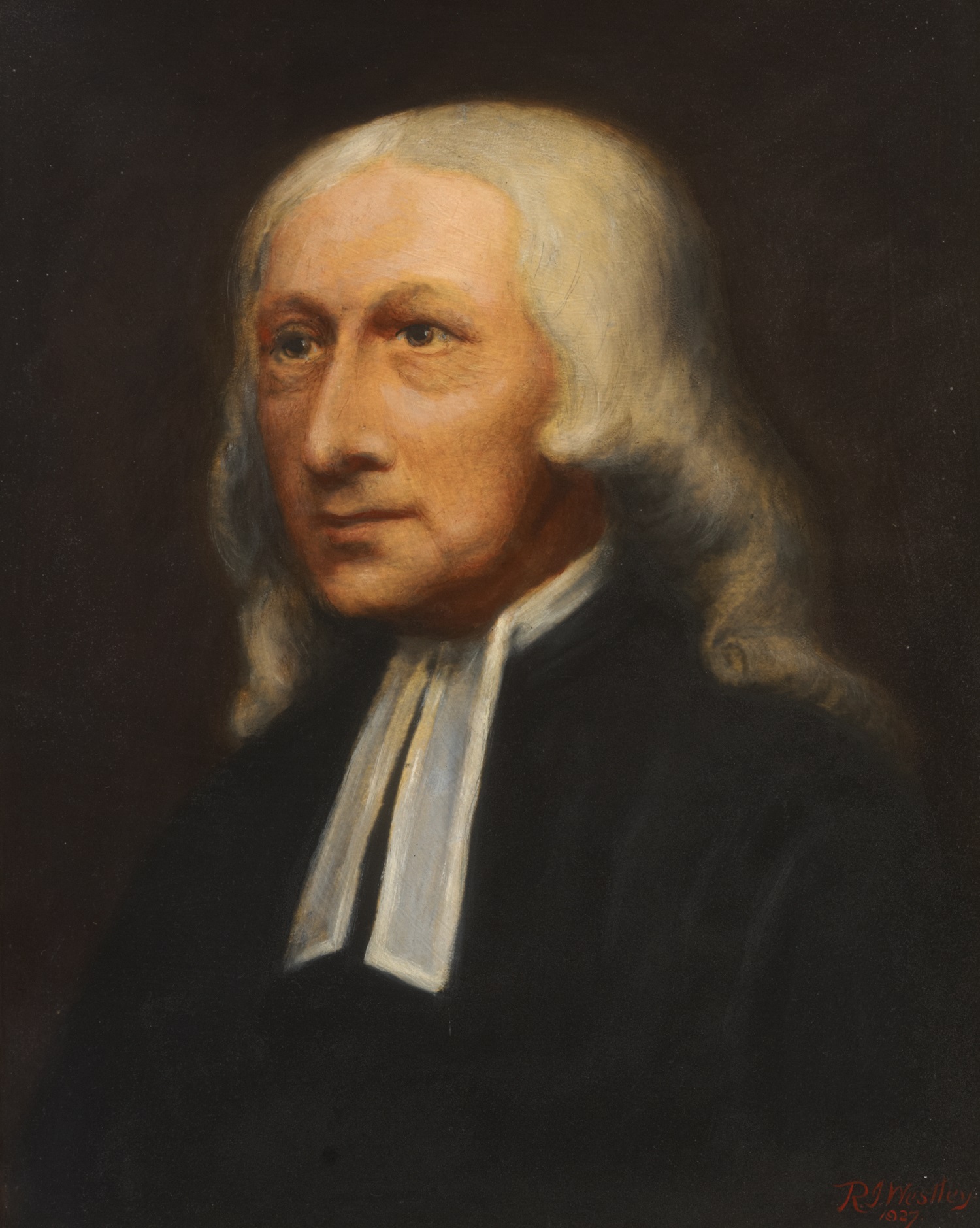
“About a quarter before nine, while he was describing the change which God works in the heart through faith in Christ, I felt my heart strangely warmed. I felt I did trust in Christ, Christ alone, for salvation; and an assurance was given me that He had taken away my sins, even mine, and saved me from the law of sin and death.” — John Wesley, Journal, 24 May 1738
Life
John Wesley was born on 17 June 1703 in Epworth, Lincolnshire, England, the fifteenth of nineteen children of Samuel Wesley, rector of Epworth, and Susanna Wesley. (Wikipedia)
On 9 February 1709, the Epworth rectory caught fire. Six-year-old John was trapped upstairs and rescued through a window moments before the roof collapsed. His mother Susanna called him “a brand plucked from the burning” (Zechariah 3:2), a phrase Wesley used of himself throughout his life. (UMC)
He entered Christ Church, Oxford in 1720. Elected fellow of Lincoln College in 1726. Ordained priest in the Church of England on 22 September 1728. (Britannica)
In November 1729, Wesley joined his brother Charles and several others at Oxford in a disciplined study group. Other students mocked them as “the Holy Club,” “Bible Moths,” and “Methodists.” Members included George Whitefield. (Wikipedia — Holy Club)
Around 1730, Wesley read William Law’s Christian Perfection and A Serious Call to a Devout and Holy Life. He wrote that these “convinced me more than ever of the absolute impossibility of being half a Christian.” (A Plain Account of Christian Perfection; Evangelical Arminians)
In 1735, Wesley sailed for the Georgia colony to serve as a missionary. He arrived in Savannah in February 1736. The mission failed, complicated by a legal scandal over his refusal of communion to a young woman. He left Savannah on 2 December 1737. (Georgia Encyclopedia)
On 24 May 1738 — the Aldersgate experience. At a Moravian meeting on Aldersgate Street, London, someone read Luther’s preface to the Epistle to the Romans. Wesley wrote: “I felt my heart strangely warmed. I felt I did trust in Christ, Christ alone, for salvation.” (CCEL — Wesley’s Journal)
On 2 April 1739, Wesley began open-air preaching near Bristol, speaking to about three thousand people. He wrote: “I submitted to be more vile, and proclaimed in the highways the glad tidings of salvation.” That same year he approved lay (unordained) preachers for the first time, breaking with Anglican convention. He declared: “I look upon all the world as my parish.” (Wesley Center; CCEL)
In February 1751, Wesley married Mary Vazeille, a London merchant’s widow. The marriage was deeply unhappy — Wesley’s constant travels and Mary’s jealousy produced lasting friction. (UMC)
Over roughly fifty years, Wesley travelled an estimated 250,000 miles on horseback (averaging about 4,500 miles per year), preaching some 40,000 sermons, often two or three per day. (Christianity Today)
Wesley died in London on 2 March 1791, aged eighty-seven. He sang Isaac Watts’ hymn shortly before the end. His last words: “The best of all is, God is with us.” He left behind 135,000 members and 541 itinerant preachers. (Wesley Center)
Timeline
- 1703 — Born 17 June in Epworth, Lincolnshire
- 1709 — Rescued from the rectory fire; “a brand plucked from the burning”
- 1720 — Entered Christ Church, Oxford
- 1728 — Ordained priest in the Church of England
- 1729 — Joined the “Holy Club” at Oxford
- c. 1730 — Read William Law’s Serious Call; deeply marked
- 1735 — Sailed for the Georgia colony as a missionary
- 1737 — Mission failed; returned to England
- 1738 — 24 May: Aldersgate experience — “heart strangely warmed”
- 1739 — Began open-air preaching; approved lay preachers
- 1751 — Married Mary Vazeille
- 1766 — Published definitive edition of A Plain Account of Christian Perfection
- 1791 — Died 2 March in London. Last words: “The best of all is, God is with us.”
Teaching
Heart religion and the Spirit’s inward witness. The core of the Aldersgate experience was not intellectual knowledge but heart experience. Wesley defined the Spirit’s witness in Sermon 10:
“The testimony of the Spirit is an inward impression on the soul, whereby the Spirit of God directly witnesses to my spirit, that I am a child of God; that Jesus Christ hath loved me, and given himself for me; and that all my sins are blotted out, and I, even I, am reconciled to God.” — Sermon 10, Wesley Center
Christian perfection (entire sanctification). Wesley’s most distinctive teaching. He defined it as “pure love reigning alone in the heart and life — this is the whole of scriptural perfection.” He insisted this was not sinless perfection, but love of God and neighbor filling the whole heart. (A Plain Account of Christian Perfection)
The authority of Scripture. Wesley said: “My ground is the Bible. Yea, I am a Bible-bigot. I follow it in all things, both great and small.” (Bob Kaylor) And: “In all cases, the Church is to be judged by the Scripture, not the Scripture by the Church.” (Thomas Jay Oord)
Social holiness and small-group pastoral care. Wesley declared: “‘Holy solitaries’ is a phrase no more consistent with the gospel than holy adulterers. The gospel of Christ knows of no religion, but social; no holiness but social holiness.” (Goodreads) He built a three-tier system: societies (large gatherings), class meetings (weekly groups of about twelve, answering “How goes it with your soul?”), and bands (intimate groups of three or four for confession and accountability). (Seedbed)
Connection to the Recovery
Brother Witness Lee placed Wesley within the stream of the Lord’s recovery:
“At the beginning of the eighteenth century, a great revival broke out in England. In 1729 the two Wesley brothers were raised up by God. They were called the Methodists. Through them, God brought in a great tide of revival… The main subject of John Wesley’s messages was the doctrine of sanctification.” — Ministry Samples
Brother Witness Lee also noted Wesley’s connection to Madame Guyon:
“John Wesley once said that he wished every believer would read the messages of Madame Guyon and that he owed much grace to her.” — Ministry Samples
Wesley’s teaching that “the Spirit of God directly witnesses to my spirit” resonates deeply with Brother Watchman Nee’s emphasis in The Spiritual Man on the human spirit as the organ for contacting God. Both insisted that faith cannot remain in the mind — it must enter the spirit and become living experience.
Wesley’s class meetings — twelve people gathering weekly, sharing the state of their souls, with no clergy barrier — bear a resemblance in spirit to the practice of mutual fellowship and speaking in the church life that Brother Watchman Nee and Brother Witness Lee practiced.
On sanctification, there is divergence. Wesley taught a form of “entire sanctification” attainable in this life. The Brethren later corrected this, stressing that biblical holiness centers on separation unto God rather than sinless perfection. Brother Witness Lee followed the Brethren on this point while still honoring Wesley’s contribution. (Ministry Samples)
Wesley also stands as the key link between William Law — already profiled on this site — and the broader evangelical revival. It was Law’s Serious Call that lit the fire in Wesley, and Wesley who carried that fire across Britain and the world.
Significance
Wesley’s legacy extends far beyond Methodism. What he recovered at Aldersgate — not a new doctrine, but an ancient experience: a heart warmed by Christ’s love — became the starting point of the entire evangelical movement. His sanctification teaching gave rise to the Holiness movement, the Church of the Nazarene, and the Salvation Army. His emphasis on the experiential work of the Spirit became a theological root of Pentecostalism. His class meetings anticipated the small-group church movement by two centuries.
At his death he left 135,000 members and 541 itinerant preachers. Today the Methodist tradition numbers some 75 million Christians worldwide. (Wikipedia)
But what endures most may not be the numbers. It is his last words:
“The best of all is, God is with us.”
Eighty-seven years, 250,000 miles, 40,000 sermons — and at the end, one sentence. Not what he had done, but that God was there. That may be Wesley’s finest lesson.