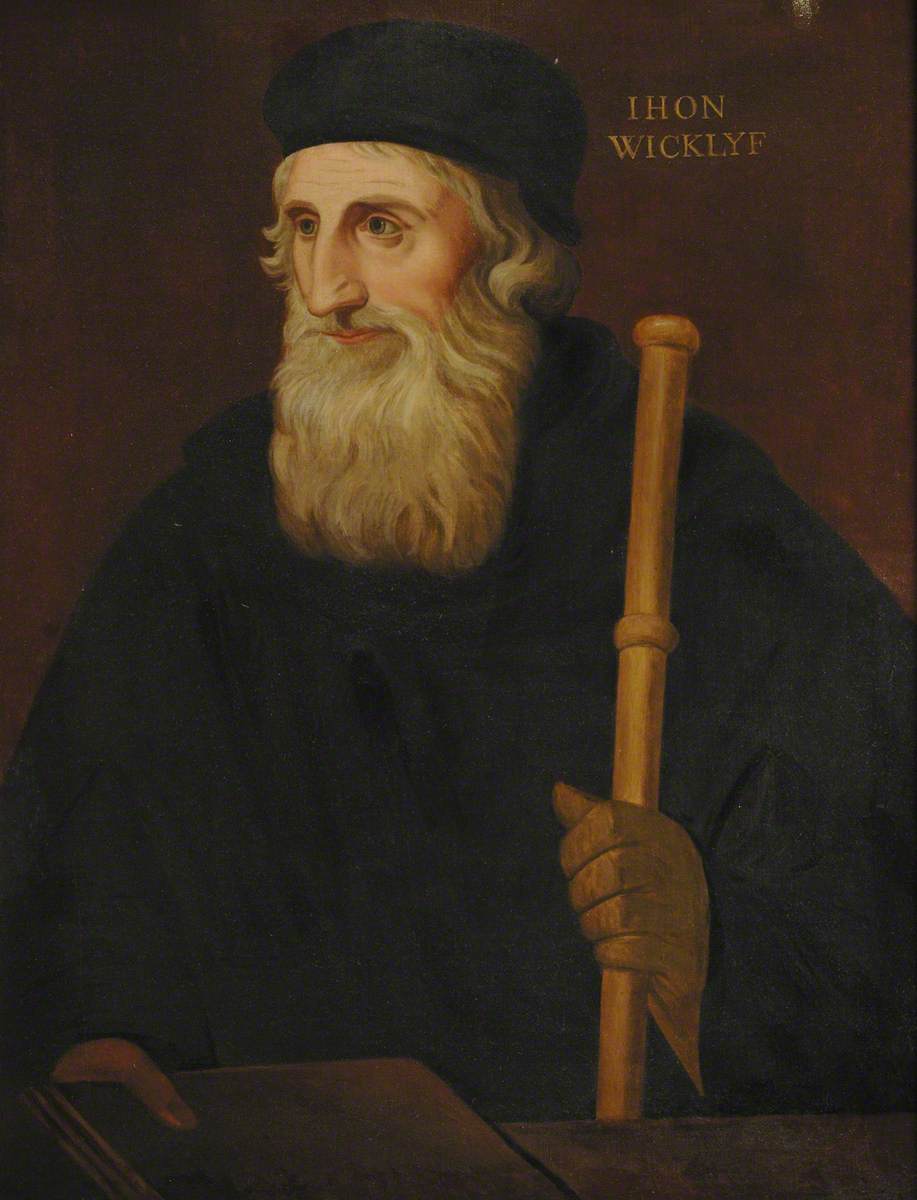
“I believe that in the end the truth will conquer.” — John Wycliffe (1381), to the Duke of Lancaster (Wikiquote)
Life
John Wycliffe (c. 1330–1384) was born in Yorkshire, England. Educated at Oxford, he taught at Merton and Balliol, earned his doctorate in theology in 1372, and in 1374 was appointed rector of Lutterworth. He was also sent to Bruges as part of negotiations with papal representatives. (Britannica)
From his Oxford pulpit Wycliffe began to challenge the Roman church. He rejected transubstantiation, opposed indulgences, questioned the pope’s temporal power, and argued that Scripture is the final authority in matters of faith — positions strikingly close to those Luther would press roughly 150 years later. In May 1377 Pope Gregory XI issued five bulls condemning Wycliffe. (Britannica)
Between c. 1382 and 1384 Wycliffe oversaw the translation of the Bible from the Latin Vulgate into English — the first complete English Bible (“Wycliffe’s Bible”). He argued that it is best for English people to learn Christ’s law in English, just as Moses heard God’s law in his own tongue and the apostles spoke in theirs. (AZ Quotes)
In 1382 Wycliffe suffered a stroke. He died at Lutterworth on 31 December 1384. His followers, known as the Lollards, continued to spread his teaching throughout England. (Wikipedia)
On 4 May 1415 the Council of Constance posthumously condemned Wycliffe as a heretic and ordered his works suppressed. In 1428 his bones were exhumed and burned, and the ashes were thrown into the River Swift. A later historian, Thomas Fuller, pictured the ashes flowing into larger rivers and then into the sea — a parable of Wycliffe’s teaching spreading through the world. (Wikipedia)
Timeline
- c. 1330 — Born in Yorkshire, England
- 1356 — Fellow of Merton College, Oxford
- 1372 — Earned doctorate in theology
- 1374 — Appointed rector of Lutterworth
- 1377 — Condemned by five papal bulls under Gregory XI
- c. 1382–1384 — Oversaw the first complete English Bible translation
- 1384 — Died 31 December at Lutterworth
- 1415 — Condemned posthumously as a heretic by the Council of Constance
- 1428 — Bones exhumed and burned; ashes thrown into the River Swift
Teaching
The supremacy of Scripture. Wycliffe insisted that Scripture stands above pope, council, and tradition. He wrote: “Trust wholly in Christ; rely altogether on His sufferings; beware of seeking to be justified in any other way than by His righteousness.” (AZ Quotes)
Scripture belongs to the people. By overseeing an English Bible translation, Wycliffe broke Latin’s monopoly and pressed the word of God toward ordinary readers.
Against papal corruption and coercion. He opposed indulgences, denied transubstantiation, and argued that Christ — not the pope — is the Head of the church. These themes became core to the later Reformation.
Connection to the Recovery
Wycliffe stands as a bridge between late medieval darkness and Reformation dawn. His teaching influenced Hus; Hus’s heirs fed the Moravian Brethren; the Moravian movement reached Herrnhut under Zinzendorf — a line that the recovery often traces when discussing the continuity of the church’s inner life and practice through the centuries.
Wycliffe’s insistence on Scripture as final authority runs straight with the principle of sola scriptura. His English Bible stands in the same practical current as Luther’s German Bible: putting God’s word back into the hands of ordinary believers.
Significance
Wycliffe is often called “the Morning Star of the Reformation.” (Desiring God) He spoke, long before Luther, the core Reformation protest against indulgences, papal absolutism, and Scripture’s captivity. He was condemned in life and branded a heretic after death; even his bones were burned.
But the sea did not extinguish the ashes — and the fire did not extinguish the truth.
“I believe that in the end the truth will conquer.”