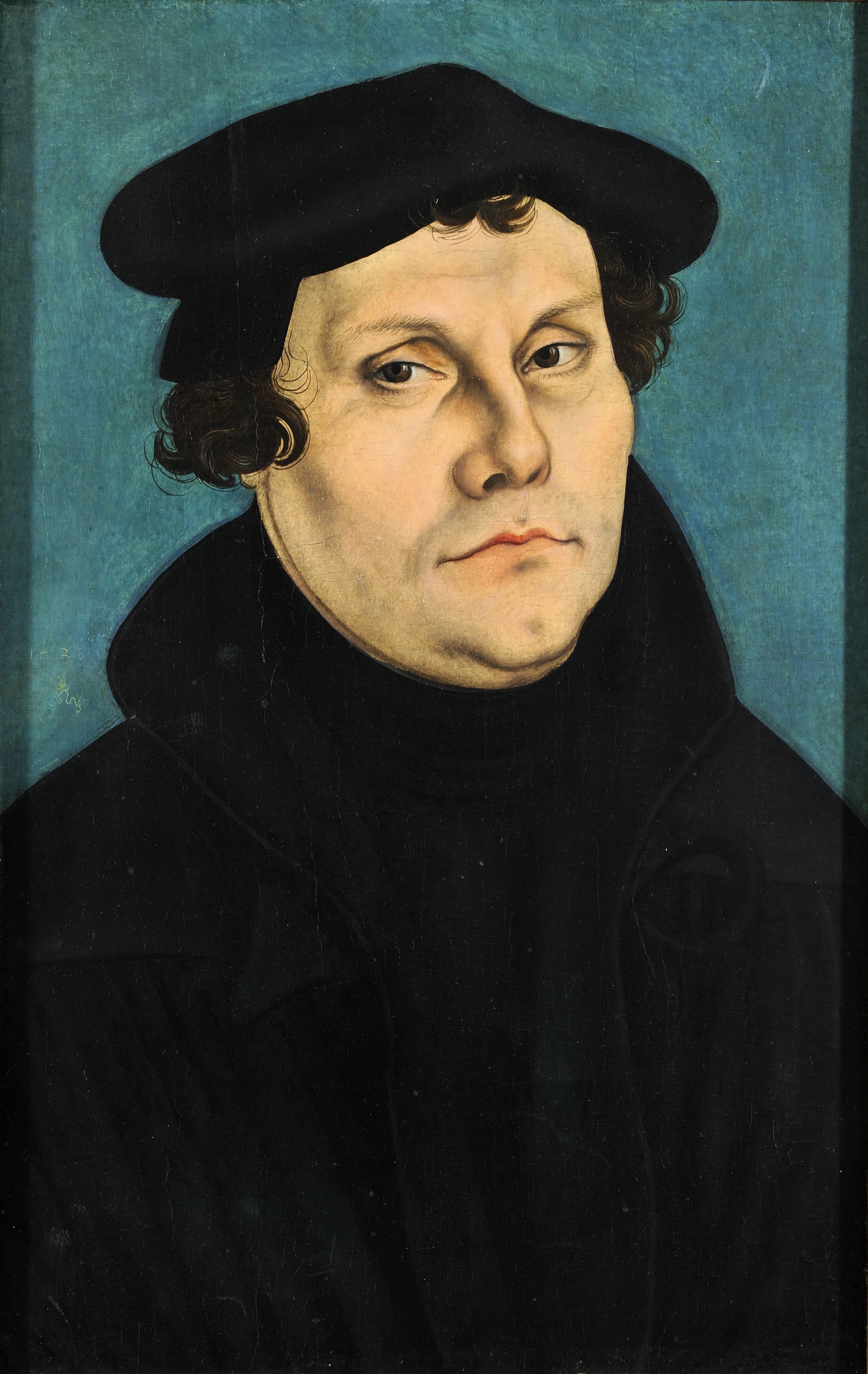
“Faith is a living, unshakeable confidence in God’s grace; it is so certain, that someone would die a thousand times for it. This kind of trust in and knowledge of God’s grace makes a person joyful, confident, and happy with regard to God and all creatures.” — Martin Luther, Preface to Romans (1522), CCEL
Life
Martin Luther was born on 10 November 1483 in Eisleben, County of Mansfeld, in the Holy Roman Empire. His father Hans Luder was a copper mine leaseholder. (Wikipedia)
He entered the University of Erfurt in 1501, earned his B.A. in 1502 and M.A. in 1505. That same year he began studying law — the path his father had chosen for him. (Christian History Institute)
On 2 July 1505, caught in a violent thunderstorm near Stotternheim, Luther vowed to St. Anne: “I will become a monk!” On 17 July he entered the Order of Augustinian Hermits in Erfurt. He was ordained in 1507 and celebrated his first Mass. In 1512 he earned his doctorate in theology and began lecturing on the Psalms and Romans at the University of Wittenberg. (Christian History Institute; Britannica)
The tower experience (Turmerlebnis). While studying Romans 1:17 in the tower of the Black Cloister at Wittenberg (scholars date this between 1514 and 1519), Luther broke through. In his 1545 preface to his Latin writings, he recalled:
“I hated the word ‘righteousness of God,’ because… God is righteous and punishes sinners.”
Then:
“The righteousness of God is a gift of God by which a righteous man lives, namely faith… the merciful God justifies us by faith.”
“Now I felt as though I had been reborn altogether and had entered Paradise.”
He called Romans 1:17 “the very gate to Paradise.” (Lutheran Reformation)
On 31 October 1517, Luther posted his Disputation on the Power and Efficacy of Indulgences (95 Theses) on the door of the Castle Church in Wittenberg. Thesis 1: “When our Lord and Master Jesus Christ said, ‘Repent,’ He willed the entire life of believers to be one of repentance.” Thesis 62: “The true treasure of the Church is the Holy Gospel of the glory and the grace of God.” (Wikipedia)
On 17–18 April 1521, Luther appeared before Emperor Charles V at the Diet of Worms and refused to recant:
“Unless I am convinced by the testimony of the Scriptures or by clear reason (for I do not trust either in the pope or in the councils alone, since it is well known that they have often erred and contradicted themselves), I am bound by the Scriptures I have quoted, and my conscience is captive to the Word of God. I cannot and I will not recant anything.” — World History Encyclopedia
From May 1521 to March 1522, Luther lived in hiding at Wartburg Castle under the pseudonym “Junker Jörg.” In approximately eleven weeks he translated the entire New Testament from Greek into German. It was published as the “September Bible” in 1522. The complete German Bible (Old Testament, Apocrypha, New Testament) followed in 1534. This translation not only gave the German people Scripture in their own tongue — it standardized the German language. (Lutheran Reformation; Wikipedia)
On 13 June 1525, Luther married Katharina von Bora, a former nun who had fled her convent. The couple had six children. Their marriage became the pattern for Protestant clerical marriage. (Wikipedia)
Luther died on 18 February 1546 in Eisleben — the city of his birth — aged sixty-two. (Wikipedia)
Timeline
- 1483 — Born 10 November in Eisleben
- 1501 — Entered the University of Erfurt
- 1505 — 2 July: vowed to become a monk in a thunderstorm; 17 July: entered Augustinian order
- 1507 — Ordained priest
- 1512 — Earned doctorate in theology; began lecturing at Wittenberg
- c. 1514–1519 — Tower experience — “the very gate to Paradise”
- 1517 — 31 October: posted the 95 Theses
- 1520 — Published three great Reformation treatises
- 1521 — April: Diet of Worms; May onward: hidden at Wartburg Castle, translated the New Testament
- 1522 — September Bible (German New Testament) published
- 1525 — Published The Bondage of the Will; married Katharina von Bora
- 1529 — Published the Small and Large Catechisms
- 1534 — Complete German Bible published
- 1546 — Died 18 February in Eisleben
Teaching
Justification by faith alone (sola fide). Luther called justification the article on which the church stands or falls. In the Heidelberg Disputation (1518), Thesis 25: “He is not righteous who does much, but he who, without work, believes much in Christ.” (Christian-History.org)
Scripture alone (sola scriptura). His declaration at Worms is the founding statement: “My conscience is captive to the Word of God.” Luther did not dismiss reason — he said that in matters of faith, Scripture stands above pope and councils. (World History Encyclopedia)
The priesthood of all believers. In Address to the Christian Nobility of the German Nation (1520): “For whoever comes out of the water of baptism can boast that he is already a consecrated priest, bishop, and pope.” He broke the wall between clergy and laity — every baptized Christian has the right to come directly before God. (Wikipedia)
Law and gospel. “Virtually the whole of the scriptures and the understanding of the whole of theology depends upon the true understanding of the law and the gospel.” Luther taught that the law condemns — it shows you how crooked you are; the gospel saves — grace comes and straightens you out. (Oxford Research Encyclopedia)
The theology of the cross (theologia crucis). God is not found in human glory and achievement but in apparent weakness, suffering, and the cross. This is a root challenge to every system that judges spiritual value by outward appearance. (Wikipedia)
Connection to the Recovery
Brother Witness Lee called Luther “a great servant of God” and identified two things the Lord accomplished through him: recovering “the truth concerning justification by faith” and making “the Bible open to the general public.” He added: “Justification by faith has been fully recovered. It will never be lost again.” (Ministry Samples)
Brother Watchman Nee cited Luther as precedent: “It was right for Martin Luther to rise up to speak for the basic principle of justification by faith. It is also right for us to leave the denominations to stand as the testimony of oneness in the local church.” (Local Church Discussions)
Both brothers also named Luther’s limitation. Brother Witness Lee said: “In the matter of justification, Martin Luther was bold. However, in the matter of the church, he was cowardly.” (Ministry Samples) And: “Luther came out of Babylon, but he did not return to Jerusalem yet.” (Ministry Samples) Luther recovered the truth of justification but aligned with secular government and established state churches. From the recovery’s perspective, the full recovery of the church required further steps through the Brethren movement and beyond.
Luther’s influence also runs through an indirect chain: on 24 May 1738, John Wesley attended a meeting on Aldersgate Street, London, where someone read Luther’s Preface to the Epistle to the Romans. Wesley wrote: “I felt my heart strangely warmed.” Luther’s recovery of justification by faith — transmitted through his preface to Romans — became the spark that lit Wesley’s fire. The chain: Luther → Wesley → the recovery tradition’s emphasis on the subjective experience of Christ.
Luther’s teaching on the priesthood of all believers — every baptized Christian is a priest — runs parallel to the recovery’s emphasis on every-member functioning. Luther broke the clergy-laity wall in principle; the recovery aims to break it in practice.
Significance
Luther’s legacy is incalculable. He recovered justification by faith — the individual standing before God by faith in Christ, without priestly mediation, indulgences, or works-righteousness. He freed Scripture from its Latin prison and put it in every German’s hands. He established the principle that conscience is bound to Scripture alone, not to any human authority. He sanctified domestic life through his own marriage. His hymn — A Mighty Fortress Is Our God — became the battle hymn of the Reformation.
His life had both courage and limitation. He did not flinch before imperial power at Worms, but he did not go far enough on the church. He came out of Babylon but did not reach Jerusalem. Later recoveries had to continue the road he began.
But that road began with him. It began with a monk reading Romans 1:17 in a tower, finally understanding that “the righteousness of God” is not a condemning judgment but a gift of grace freely given. It began with him walking to the door of the Castle Church and posting ninety-five theses. It began with him standing in the hall at Worms and saying:
“My conscience is captive to the Word of God. I cannot and I will not recant anything.”
Five centuries on, that sentence remains the firmest ground any believer can stand on when facing any human authority.