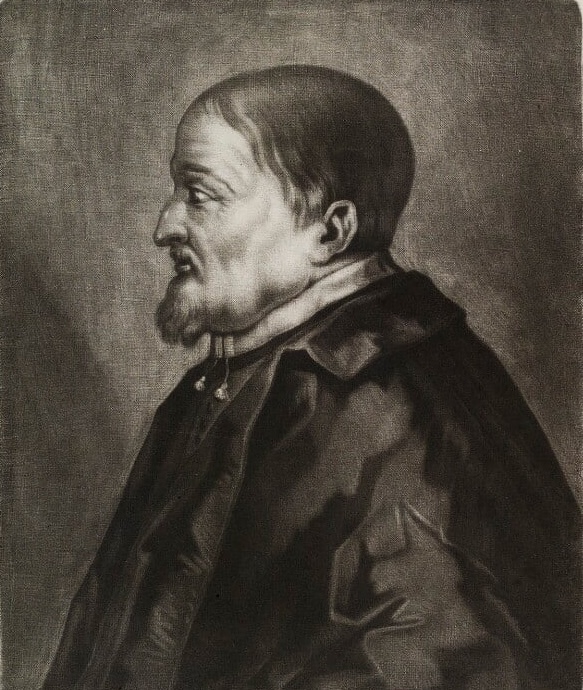
“Mystical knowledge does not come from the intellect but from experience; it is not invented but verified; not read but received.” — Without Limit
Life
Miguel de Molinos was baptized on 29 June 1628 in Muniesa, near Teruel, in Aragon, Spain. (Wikipedia) In his youth he moved to Valencia and was educated at the Jesuit College of St. Paul. He was ordained a priest in 1652 and received a doctorate. (Wikipedia)
In 1663 Molinos went to Rome as a procurator for a beatification case. The case failed, but he remained in Rome, settling at the church of St. Alfonso of the Spanish Discalced Augustinians. He gradually became one of Rome’s most sought-after spiritual directors. At his arrest, twelve thousand letters of consultation were seized from his possession, and over two hundred people in Rome were implicated. (Catholic Answers)
In 1675 the Italian edition of his major work The Spiritual Guide (Guía espiritual) was published in Rome; the Spanish edition appeared in Madrid in 1676. Within twelve years it went through twenty editions and was translated into Latin, French, English, and German. (Catholic Answers)
On 18 July 1685 Molinos was arrested by the papal guard. He was tried by the Inquisition in the spring of 1687; initially 263 suspect propositions were examined, later reduced to 68. Molinos acknowledged his errors. On 3 September of that year he was pronounced a “formal heretic” in the church of Santa Maria sopra Minerva and sentenced to life imprisonment. (Wikipedia)
Pope Innocent XI had initially been favorable to Molinos but ultimately approved the condemnation. On 20 November 1687 he issued the bull Coelestis Pastor, condemning all 68 propositions and prohibiting all of Molinos’s works. (EWTN)
Molinos died in the prison of the Roman Inquisition on 28 December 1696, aged about sixty-eight. (Wikipedia)
Timeline
- 1628 — Baptized 29 June in Muniesa, Spain
- c. 1640s — Educated at Jesuit college in Valencia
- 1652 — Ordained priest
- 1663 — Went to Rome and settled there
- 1675 — Italian edition of The Spiritual Guide published in Rome
- 1676 — Spanish edition published in Madrid
- 1685 — Arrested 18 July and imprisoned
- 1687 — Tried in spring; sentenced to life imprisonment 3 September
- 1687 — Pope issued Coelestis Pastor 20 November condemning 68 propositions
- 1696 — Died 28 December in Roman prison
Teaching
At the heart of Molinos’s teaching was the “inner way” — the soul reaches perfection not by active effort (meditation, reasoning, asceticism) but by passive contemplation: inner quiet, silence, and complete surrender to God.
He distinguished two paths to God: (1) meditation and reasoning, and (2) pure faith and contemplation. He held the second far above the first. (CCEL)
Three Kinds of Silence
Molinos taught three silences: silence of words, silence of desires, silence of thoughts — ultimately entering into mystical silence where “God speaks to the soul and communicates Himself to it.” (Wells of Grace)
Purification of the Soul
“Unless the mind is cleansed, the affections purified, the memory stripped, the understanding illumined, and the will denied and set on fire, the soul can never reach the intimate and affective union with God.” — The Spiritual Guide 16
Trust in Suffering
“You will never be closer to God than in trial; He allows it for the cleansing and beautifying of your soul.” — A-Z Quotes
“Do not fear the trials God sees fit to send. It is by the storm of trial that God separates the true wheat from the chaff on the threshing floor of the soul.” — A-Z Quotes
Condemned Propositions
The Inquisition condemned propositions including: human faculties should be reduced to nothing; active operations offend God; the soul should disregard reward, punishment, heaven, and hell; temptation need only be resisted passively. Whether these propositions fairly represented Molinos’s original intent remains disputed. (EWTN)
Connection to the Lord’s Recovery
Brother Watchman Nee explicitly mentioned Molinos in his teaching on church history:
“Molinos was born in 1640 and died in 1697. He wrote a book called The Spiritual Guide, which teaches the way of self-denial and dying with the Lord. This book influenced many people in his day.” — Brother Nee, The Recovery of Truth from the Sixteenth to the Eighteenth Century
In the same passage Brother Nee placed Molinos alongside Madame Guyon and Fénelon, noting that in this period “God released many spiritual messages” and that “those who knew the deepest experience of spiritual life were in Catholicism.” (Ministry Samples)
Brother Witness Lee often referred to this group — Madame Guyon, Fénelon, Brother Lawrence — when speaking of the inner-life tradition, but in available sources does not single out Molinos by name. (Ministry Samples)
Parallels in Teaching
Molinos’s emphasis on self-denial and dying with the Lord corresponds directly to Brother Nee’s teaching on “breaking the outer man.” Molinos’s three silences (of words, desires, and thoughts) also resonate with the practice, in Brother Nee’s tripartite anthropology (body, soul, spirit), of quieting the soul-life and releasing the spirit.
A Note of Caution
Some of the propositions for which Molinos was condemned involved extreme passivity — all active operation of the soul offends God. The recovery’s teaching distinguishes itself here: Brothers Nee and Lee stress not the soul’s pure passivity but the cooperation of man’s spirit with God’s Spirit — “He who is joined to the Lord is one spirit” (1 Cor 6:17). Exercising the spirit is active, but not by the soul’s power — it is cooperating with God in the spirit.
Significance
There was no direct personal contact between Molinos and Madame Guyon. Guyon herself claimed not to know Molinos’s teaching. But Molinos’s Quietism had reached France from the start and “prepared the soil” for Madame Guyon’s spiritual experience. (Catholic Culture)
The Quaker historian Howard Brinton noted: “The works of Madame Guyon, Fénelon, and Molinos — precious guides to the life of prayer — were once to be found in almost every Quaker library.” (Quaker Theology) Quietism also influenced the Pietist movement within Lutheranism. (Quaker Theology)
Though the Catholic condemnation has never been lifted, The Spiritual Guide has never gone out of print. It remains freely available today at CCEL.
Molinos’s life is both a warning and a comfort. Warning: when the pursuit of the inner life tilts toward extreme passivity, the biblical balance of man’s cooperation with God can be lost. Comfort: even when a man is condemned by the institution and dies in prison, the spiritual legacy he passed on can still bear fruit centuries later. Truth cannot be locked behind bars.