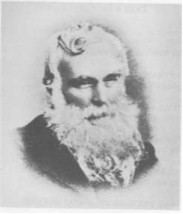
“Mr. Govett wrote a hundred years before his time, and the day will come when his works will be treasured as sifted gold.” — Charles Spurgeon, Who Was Robert Govett
Life
Robert Govett was born on 14 February 1813 in Staines, Middlesex. His father was vicar of Staines. His mother, Sarah Romaine, was the granddaughter of William Romaine (1714–1795), the eighteenth-century evangelical preacher. Of eight sons in the family, five were ordained in the Church of England. (Wikipedia)
In 1830, at seventeen, Govett matriculated at Worcester College, Oxford. He took his BA in 1834, won the Eaton Scholarship the same year, became a Fellow of Worcester College in 1835, and received his MA in 1837. (Wikipedia)
He was ordained deacon in 1836 and priest in 1837. His first curacy was at Bexley, Kent. In May 1841 he became curate of St Stephen’s Church, Norwich, where his clear, forceful preaching drew large congregations from across the city. (Wikipedia)
Around 1843, Govett’s conscience collided with Anglican practice. After witnessing an immersion baptism at St Mary’s Baptist Chapel in Norwich, he became convinced that believer’s baptism by immersion was scriptural and infant baptism was not. He was baptized there by William Brock. When he told the Bishop of Norwich he could no longer administer infant baptism in good conscience, his curate’s licence was revoked in 1844. (Wikipedia)
For nine years Govett held services at Victoria Hall on St Andrew’s Street, Norwich, seating 1,300, with growing attendance. In 1854 he opened Surrey Chapel — a large grey brick and split flint building on Chapel Loke between Ber Street and Surrey Road, seating 1,500. He paid nine-tenths of the building costs himself. He drew no ministerial salary, living at Surrey Lodge next to the chapel. (Who Was Robert Govett; Wikipedia)
Govett never married. He gave his life to exposition and writing — over 180 books and tracts. On 20 February 1901 he died in Norwich at eighty-eight. He had been preaching with full vigor at eighty-seven, just weeks before his final illness. He was buried in Rosary Cemetery, Norwich. By his last years, the congregation had visibly declined in numbers. (Who Was Robert Govett)
Timeline
- 1813 — Born 14 February in Staines, Middlesex
- 1830 — Matriculated at Worcester College, Oxford
- 1834 — BA and Eaton Scholarship
- 1835 — Elected Fellow of Worcester College
- 1836 — Ordained deacon in the Church of England
- 1837 — Ordained priest; MA
- 1841 — Curate of St Stephen’s, Norwich
- 1843 — Crisis of conscience over infant baptism; baptized by immersion
- 1844 — Curate’s licence revoked
- 1845 — Began independent services at Victoria Hall, Norwich
- 1846 — Published The Prophecy on Olivet
- 1852 — Published The Saints’ Rapture — a landmark of partial rapture teaching
- 1853 — Published Entrance into the Kingdom (first series)
- 1854 — Surrey Chapel completed, seating 1,500
- 1855 — Published Entrance into the Kingdom (second series)
- 1861–1865 — Published The Apocalypse: Expounded by Scripture (4 vols.) under the pen name “Mathetees”
- 1870 — Published The Kingdom of God Future
- 1878 — Formally left the Church of England
- 1881 — Published Exposition of the Gospel of St John
- 1884 — Published Christ Superior to Angels, Moses and Aaron: A Comment on the Epistle to the Hebrews
- 1889 — Published What is the Church? The Argument of Ephesians
- 1901 — Died 20 February in Norwich, aged eighty-eight
- 1901 — D.M. Panton succeeded him as pastor of Surrey Chapel
Teaching
Kingdom Reward versus Salvation
The central conviction of Govett’s life: salvation and the kingdom are not the same thing. Eternal life is God’s free gift to every believer through the finished work of Christ. But reigning with Christ in the millennial kingdom is a reward — granted to overcomers who submit to the Holy Spirit’s sanctifying work.
“Faith, connecting the sinner with the perfect work of Christ, brings present acceptance before God, and eternal life as its blessed issue.” — Govett, Entrance into the Kingdom (1853)
The kingdom invitation goes out to all saints. It is given only to the obedient. This distinction runs through nearly everything Govett wrote. Scholar David Seip, in his monograph on Govett, identifies him as the originator of the doctrine of millennial reward. (Grace Evangelical Society review)
Partial Rapture and Millennial Exclusion
Govett pioneered the modern partial rapture theory. In 1852 he published The Saints’ Rapture; in 1853, Entrance into the Kingdom. His argument: before the Great Tribulation there will be a selective rapture — only watchful, faithful believers (the “firstfruits”) will be caught up first. The rest remain on earth to face the tribulation.
From Philippians 3:10–11 he argued that Paul was striving for “a peculiar resurrection: the resurrection of reward, obtained by the just, while the wicked remain in their graves” — a select resurrection, distinct from the general one. (Walvoord.com) From Matthew 24:40–41 he pressed the Greek word paralambano (“take”), arguing it means “to take as a companion” with connotations of friendship — those “taken” are raptured; those “left” face the tribulation.
The sharper implication: unfaithful believers will miss the rapture, pass through the tribulation, and be excluded from the millennial kingdom — Christ’s thousand-year reign on earth. They do not lose eternal salvation. They lose the kingdom reward. This teaching runs through nearly all his writings. (Grace Evangelical Society review)
Futurist Interpretation of Prophecy
In Govett’s day, the Historicist school dominated English prophecy — reading Revelation as a map of history from Rome to the papacy. Govett rejected this outright. His four-volume magnum opus, The Apocalypse: Expounded by Scripture (1861–1865, published under the pen name “Mathetees” — Greek for “disciple”), argued that most of Revelation remains unfulfilled and points to the future. He interpreted Scripture by Scripture, using the types, shadows, and symbols of the Old Testament to illuminate the last book. (Wikipedia; Archive.org)
Dr. Wilbur M. Smith wrote of this work:
“One of the profoundest expositions of the book of Revelation that I know of is the work of Robert Govett. My own opinion is that he brings to his interpretation a more thorough knowledge of the Scriptures in their bearing on the last book of the Bible than any other writer of his generation.” — Wikipedia
The Twofoldness of Divine Truth
Govett authored a booklet titled The Twofoldness of Divine Truth, setting forth the principle that apparent contradictions in Scripture represent two complementary sides of truth rather than genuine logical conflicts. He wrote:
“But are they not contradictory? That cannot be, for they are both parts of the Word of God, and contradictions cannot both be true.” — Contending for the Faith
Brother Watchman Nee translated this booklet into Chinese and included it in his publication work. (Contending for the Faith)
Connection to the Recovery
From Govett to Panton
After Govett’s death, David Morrieson Panton (1870–1955) succeeded him as pastor of Surrey Chapel, serving until his own death in 1955. In 1924, Panton founded the bimonthly magazine The Dawn, carrying Govett’s prophetic teaching to a wider audience. Panton said of him:
“In all my life I have discovered no author so exactly aware of what God has said; and who is able to make it clear in plain and simple language.” — Who Was Robert Govett
From Panton to Brother Watchman Nee
The line runs through Margaret Barber (1866–1930), who had close ties to Surrey Chapel in Norwich. Barber later went to China as a missionary and became the spiritual mentor of Brother Watchman Nee. Through Barber’s library and personal influence, Brother Nee encountered the writings of Govett, Panton, G.H. Pember, and Jessie Penn-Lewis. (Wikipedia - Margaret E. Barber; Wikipedia - Robert Govett)
Brother Nee acknowledged that for his own exposition of Revelation (later published as Come, Lord Jesus), he drew on a Govett volume from Barber’s library — specifically The Apocalypse: Expounded by Scripture. (Ministry Samples)
The specific teachings Brother Nee received from the Govett–Panton–Lang stream include:
- Partial rapture — not all believers raptured simultaneously; matured overcomers caught up as firstfruits before the tribulation, with the majority raptured later
- Kingdom reward — the millennial kingdom as a reward for faithful believers, distinct from the free gift of eternal life
- The overcomer call — the call throughout Revelation 2–3 to overcome, with kingdom-related consequences
- Futurist interpretation of Revelation
Brother Witness Lee on Govett
In chapter 4 of Watchman Nee — A Seer of the Divine Revelation in the Present Age, Brother Witness Lee listed Govett among the Brethren writers on prophecy who were helpful to Brother Nee’s ministry, alongside Darby, Pember, and Panton. In the same book he recorded that Brother Nee translated Govett’s The Twofoldness of Divine Truth into Chinese. (Ministry Samples)
Significance
Govett spent his life outside the mainstream. He left the Anglican clergy system, gave up a minister’s salary, and built a chapel seating 1,500 at his own expense — preaching to a dwindling congregation while producing over 180 works, most of which found few readers in his lifetime.
His contribution was not a movement but a line of interpretation. He was the first to systematically argue for the distinction between kingdom reward and eternal salvation. He originated the partial rapture doctrine. His method — interpreting Scripture by Scripture — laid the groundwork for the prophetic studies that followed.
Spurgeon said he wrote “a hundred years before his time.” The words proved true. At his death Govett was nearly unknown. But through Panton, through Margaret Barber, through Brother Watchman Nee and Brother Witness Lee, his teaching entered the bloodstream of the Lord’s recovery — the overcomer call, the kingdom reward, the watchfulness for the Lord’s return. These truths still speak to every believer who seeks the Lord today.
Govett’s life says something simple: a man faithful to Scripture may not be recognized by his own generation, but his work will not be wasted. The Lord remembers everyone who stands quietly on the truth, seeks no one’s approval, and serves only by conscience.