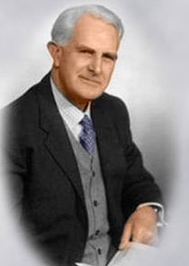
“Christianity is Christ. Christ is Christianity. That is where it all begins and it never departs from HIM.” — T. Austin-Sparks
Life
Theodore Austin-Sparks was born in 1888 in London’s Wandsworth district. His father was a theatre impresario; his mother, a devoted believer. Shortly after birth, he was sent to Scotland to be raised by his father’s relatives. (Lance Lambert biography)
At seventeen, he was arrested by an open-air preaching in the streets of Glasgow and “gave his life to the Lord — a committal from which he never withdrew.” He saw the truth of believer’s baptism, was baptized, and left the Church of Scotland. (Biography on austinsparks.wordpress.com)
He received no formal theological education, teaching himself through wide reading and attending sermons by G. Campbell Morgan and F.B. Meyer. Ordained as a pastor around the age of twenty-five, he served at Stoke Newington Congregational Church for nine years before moving to Honor Oak Baptist Church in 1921. (Biography on austinsparks.wordpress.com)
In 1915, he married Florence Rowland, who became his lifelong support and spiritual companion. (Biography on austinsparks.wordpress.com)
During a deep spiritual crisis, reading Romans 6, he “understood that he was crucified with Christ and that the Holy Spirit was within and upon him to reproduce the nature of the Lord Jesus.” He spoke afterward of ministering “beneath an open heaven.” (Lance Lambert biography)
From 1923 to 1926, he was closely associated with Jessie Penn-Lewis and the Overcomer movement. In 1926, following a conflict with the Baptist Union over the “Make More Baptists Year,” he resigned his Baptist ordination. The congregation agreed to leave the denomination, and a titled lady purchased a vacant school building on Honor Oak hill, establishing the Honor Oak Christian Fellowship and Conference Centre. (Wikipedia — Theodore Austin-Sparks)
He founded the bi-monthly magazine A Witness and a Testimony, published from 1923 until his death in 1971, distributed free by mail. He insisted it not continue after his passing. (Austin-Sparks.Net magazines page)
His health was long troubled by severe stomach ulcers. Surgery around 1950 brought relief and enabled twenty more years of fruitful ministry. (Lance Lambert biography)
On April 13, 1971, Austin-Sparks went to be with the Lord. Harry Foster led the memorial service on April 19. Hundreds attended, testifying that he had helped them know Christ more deeply. From conversion to death, he served Christ for sixty-five years. (Harry Foster’s Appreciation)
Timeline
- 1888 — Born in Wandsworth, London
- c. 1905 — Converted on the streets of Glasgow; baptized
- c. 1912 — Ordained as a pastor
- 1915 — Married Florence Rowland
- 1921 — Moved to Honor Oak Baptist Church
- 1923 — Founded A Witness and a Testimony magazine
- 1923–26 — Closely associated with Jessie Penn-Lewis and the Overcomer movement
- 1926 — Resigned Baptist ordination; established Honor Oak Christian Fellowship
- 1931 — Established summer conference center at Kilcreggan, Scotland
- 1933 — Published The Centrality and Supremacy of the Lord Jesus Christ; Brother Watchman Nee’s brief visit (Austin-Sparks was absent)
- 1938–39 — Brother Watchman Nee stayed at Honor Oak for approximately eight months
- 1939 — Published What is Man?
- 1942 — Published God’s Spiritual House
- c. 1950 — Surgery for stomach ulcers
- 1954 — Published Prophetic Ministry
- 1955 — First visit to Taiwan
- 1957 — Second visit to Taiwan; divergence with Brother Witness Lee over the ground of locality
- April 13, 1971 — Went to be with the Lord in Richmond
Teaching
Austin-Sparks’ teaching had one overriding center: Christ as the center and supremacy of all things.
“The mark of a life governed by the Holy Spirit is that such a life is continually and ever more and more occupied with Christ, that Christ becomes greater and greater as time goes on.” — T. Austin-Sparks
“Christianity is not a doctrine, not truth as truth, but the knowledge of a Person; it is knowing the Lord Jesus. You cannot be educated into being a Christian.” — T. Austin-Sparks
He coined the term “organic church”: “In the Divine order, life produces its own organism… everything comes from the inside, and function, order and fruit issue from this law of life within.” (Frank Viola — What is an Organic Church?)
In The School of Christ he wrote: “The School of Christ is the School where Christ is the great Lesson and the Spirit the great Teacher; where the teaching is not objective but subjective, where the teaching is not of things but an inward making of Christ a part of us by experience.” (The School of Christ full text)
Harry Foster highlighted Austin-Sparks’ emphasis on “the inward application of the Cross to the life of the believer” — that cleansing through Christ’s blood must be accompanied by the Cross working “in the depths of his soul” to release believers from self-centeredness. (Harry Foster’s Appreciation)
Connection to the Recovery
With Brother Watchman Nee
In 1933, during a trip to England and America as a guest of the Exclusive Brethren, Brother Watchman Nee made a brief visit to Honor Oak, but Austin-Sparks happened to be absent. (A Sweet Savor Heritage)
In 1938, Brother Watchman Nee traveled to England specifically to meet Austin-Sparks, staying at Honor Oak for approximately eight months with frequent fellowship and ministry. Austin-Sparks was 49; Brother Nee was 34. This period has been described as “a turning point in the history of the church.” The messages Brother Nee delivered during this stay later became the book The Normal Christian Life. (Frank Viola — Watchman Nee Meets T. Austin-Sparks)
The English edition of The Normal Christian Life was first serialized in A Witness and a Testimony beginning with the November–December 1940 issue. (Wikipedia — The Normal Christian Life)
Brother Watchman Nee oversaw the translation and publication of Austin-Sparks’ spiritual writings through the Shanghai Gospel Bookroom. (Wikipedia — Watchman Nee)
The two men converged deeply on:
- Christ as the center and content of the Christian life
- The distinction between soul and spirit
- The subjective experience of the cross
- The church as the corporate expression of Christ
- The work of the inner life and spiritual maturity
With Brother Witness Lee
In the fall of 1955, Austin-Sparks visited Taiwan for three weeks. He was impressed by the receptive audience and the spiritual condition of the churches. (The LA Years, Chapter 1)
In early 1957, Austin-Sparks returned to Taiwan and challenged the teaching on the ground of locality. When asked about multiple assemblies in one city, he responded that “everything is relative,” depending on one’s measure of Christ. Brother Witness Lee objected, illustrating with a metaphor: “If you break our teacups, we will have nothing to contain the tea.” (The LA Years, Chapter 1)
Austin-Sparks later told Lance Lambert: “The way our brother [Lee] is teaching it, it will be like a denomination, with a Vatican and a Pope.” Brother Witness Lee, in turn, saw Austin-Sparks’ approach as reducing the church to mere conference gatherings without a standing testimony. (Lance Lambert biography)
In 1958, Austin-Sparks confided to Brother Witness Lee: “When I departed from Taipei to Hong Kong in April 1957, the flow within me stopped as soon as my plane took off, and it has not been restored even to this day.” (Witness Lee, Serving in the Flow of the Age, Ch. 3)
Brother Witness Lee classified Austin-Sparks among “the inner life group”: “After Jessie Penn-Lewis came T. Austin-Sparks. He could also be counted among the inner life group.” (Ministry Samples — The Influence of the Inner Life Group)
The core of their divergence was not over the principles of spiritual life — on that they were deeply aligned — but over the form of church practice: the ground of locality versus ministry centers.
Significance
T. Austin-Sparks preached one message his entire life: Christ is the center, Christ is supreme, Christ is everything. His teaching profoundly influenced Brother Watchman Nee and the Lord’s recovery as a whole. The Normal Christian Life was born at his fellowship. His writings were distributed across China through the Shanghai Gospel Bookroom.
His divergence with the recovery reminds us that people who resonate deeply in the principles of spiritual life may genuinely differ on matters of church practice. That difference need not be read as betrayal — it can serve as a mirror, helping us see dimensions we might otherwise overlook.
In his final years, Austin-Sparks said something worth every spiritual seeker’s reflection:
“No child of God is safe till he has laid down his life.” — Harry Foster’s Appreciation