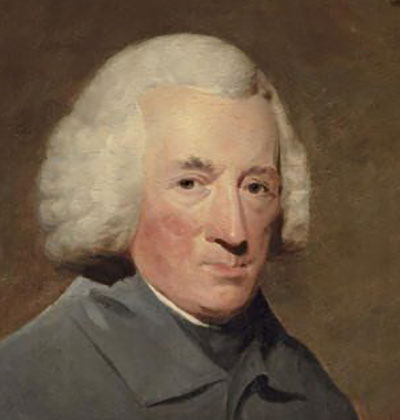
“All our salvation consists in the manifestation of the nature, life, and spirit of Jesus Christ in our inward new man.” — William Law, The Spirit of Prayer
Life
William Law was born in 1686 in King’s Cliffe, Northamptonshire, England. His father, Thomas Law, kept a small shop in the village. In 1705 William entered Emmanuel College, Cambridge, as a sizar, a student who received financial help in return for doing certain duties. In 1711 he was elected a fellow of the college and ordained a priest in the Church of England (Encyclopaedia Britannica).
In 1714 Queen Anne died and George I of Hanover came to the throne. The new regime required all clergy to swear an oath of allegiance. Law refused. His conscience would not allow him to renounce his loyalty to the Stuart line. This decision cost him his fellowship and any prospect of church preferment and placed him among the “Nonjurors” — those who would not take the oath. He did not compromise (Encyclopaedia Britannica).
After losing his post at Cambridge, Law turned to writing and private teaching. Around 1727 he moved into the home of the Gibbon family in Putney, London, as tutor to the young Edward Gibbon — father of the future historian. The historian later recalled that Law became a “much-respected friend and spiritual director” of the household (Encyclopaedia Britannica).
During his years in the Gibbon home Law wrote his two major early works: A Practical Treatise upon Christian Perfection (1726) and A Serious Call to a Devout and Holy Life (1728). The Serious Call had an immediate and wide influence (Encyclopaedia Britannica).
Around 1734 Law encountered the writings of the German mystic Jakob Böhme through the physician George Cheyne. This meeting marked a turning point. From then on his work shifted from moral exhortation to the mysteries of the inner life (Harvard Theological Review).
By about 1740 Law had returned to his native King’s Cliffe to live. Two women later joined him there: Elizabeth Hutcheson, the widow of a friend, and Hester Gibbon, the sister of his former pupil. For more than twenty years they lived together in a quiet rhythm of worship, Scripture reading, writing, and practical charity. They used much of their income to support the poor and to run schools in the village (Encyclopaedia Britannica).
In these years at King’s Cliffe Law wrote his deepest works: The Spirit of Prayer (1749–1750) and The Spirit of Love (1752–1754). These late books show the strong influence of Böhme, yet Law did more than repeat him. He took Böhme’s insights and wove them into his own experience of Christ indwelling the believer (CCEL).
William Law died in King’s Cliffe on April 9, 1761, aged seventy‑five.
Timeline
- 1686 — Born in King’s Cliffe, Northamptonshire
- 1705 — Enters Emmanuel College, Cambridge
- 1711 — Elected fellow of Emmanuel; ordained in the Church of England
- 1714 — Refuses the oath of allegiance to George I; loses fellowship; becomes a Nonjuror
- c. 1727 — Begins work as tutor in the Gibbon household in Putney
- 1726 — Publishes A Practical Treatise upon Christian Perfection
- 1728 — Publishes A Serious Call to a Devout and Holy Life
- c. 1734 — Encounters Jakob Böhme’s writings; his spiritual direction changes
- c. 1740 — Settles in King’s Cliffe with Mrs. Hutcheson and Hester Gibbon
- 1749–1750 — Publishes the two parts of The Spirit of Prayer
- 1752 — Publishes The Way to Divine Knowledge
- 1752–1754 — Publishes the two parts of The Spirit of Love
- 1761 — Dies at King’s Cliffe on April 9
Teaching
Early: The Serious Call
Law’s early books speak bluntly: your whole life — not just your formal times of prayer — must belong to God.
“Devotion signifies a life given, or devoted to God. He therefore is the devout man, who lives no longer to his own will, or the way and spirit of the world, but to the sole will of God; who considers God in everything, who serves God in everything, who makes all the parts of his common life parts of piety, by doing everything in the name of God, and under such rules as are conformable to His glory.” — A Serious Call
This is not monastic withdrawal. It is about how you spend money, how you use time, how you treat your neighbour. These show what you really believe.
“If you will here stop and ask yourself why you are not as pious as the primitive Christians were, your own heart will tell you, that it is neither through ignorance, nor inability, but purely because you never thoroughly intended it.” — A Serious Call
The Serious Call struck the conscience of the eighteenth‑century English church like a hammer. Samuel Johnson later told his biographer Boswell that as a student at Oxford he picked up the book expecting something dull, “but I found Law quite an overmatch for me.” Johnson said this was the first time in his life he seriously thought about his own faith (Boswell, Life of Samuel Johnson).
John Wesley had a similar testimony. He wrote that Law’s Christian Perfection and Serious Call “convinced me more than ever of the absolute impossibility of being half a Christian. I determined, through His grace — the absolute necessity of which I was deeply sensible — to be all devoted to God, to give Him all my soul, my body, and my substance” (Wesley, A Plain Account of Christian Perfection).
George Whitefield, before leaving Gloucester for Oxford, was shown the second edition of the Serious Call by his bookseller friend Gabriel Harris. When he read that “the devout man… lives no longer to his own will, or the way and spirit of the world, but to the sole will of God,” those words lit a new fire within him (Religion & Liberty Online).
Later: The Indwelling Christ
After he began to read Böhme, Law turned from calling people to a devout life to asking where such a life comes from — the actual formation of Christ within the believer. In The Spirit of Prayer he writes:
“This holy Jesus… is already within thee, living, stirring, calling, knocking at the door of thy heart. And all that thou hast to do is to turn inwards, and attend to Him, who is the Light and Word and Spirit of God within thee; who has long been striving with thy soul.” — The Spirit of Prayer
Christ did not only die on the cross for you; He now dwells in you and waits to grow. On regeneration, Law says:
“When this seed of heaven in the soul, which is the bruiser of the serpent, does not lie still, in a state of death, but is suffered to arise and break forth with all its conquering powers; when it comes through all the powers of the soul, and has got such possession of them, that the whole soul turns itself wholly and solely to God, then it is that we are born again. Jesus Christ is then formed in us.” — The Spirit of Prayer
In The Grounds and Reasons of Christian Regeneration (1739) he sums up God’s nature in one word — love:
“For God is love, yea, all love, and so all love, that nothing but love can come from Him.” — The Grounds and Reasons of Christian Regeneration
In The Spirit of Prayer he distils everything into one sentence:
“There is but one salvation for all mankind, and for every man, that ever was, or ever shall be, and that is the life of God in the soul.” — The Spirit of Prayer
Salvation is not a ticket to heaven; it is God’s life actually working, growing, and transforming within a person.
Law’s late works clearly show Böhme’s influence. Yet he did not swallow Böhme’s dense cosmology. He took what was most central — that before all things God is love, that the fall came from turning away from this love, and that restoration lies in this love being rekindled in the soul — and brought these insights back onto the foundation of Scripture, in clear English (CCEL; PasstheWord).
Connection to the Lord’s Recovery
A Link in the Inner-Life Line
Brother Witness Lee, when speaking about the inner-life tradition in church history, places William Law as a key transmitter:
“There was a brother named William Law, an English scholar, who edited the books of the mystics. This has helped many people.” — Witness Lee, The Full Knowledge of the Word of God, ch. 4
Lee points out that Law’s work prepared the way for Andrew Murray, who “in a further way improved upon the writings of the mystics, bringing out the profound truths in simple words.” The line runs from Madame Guyon, Fénelon, and Brother Lawrence, through Law’s editing and interpreting, to Andrew Murray, then to Jessie Penn-Lewis, and from there into the broader inner-life current (Ministry Samples).
Murray himself valued Law so highly that he compiled an anthology of his writings under the title Wholly for God: The True Christian Life, introducing Law’s call to full consecration and inner life to a wider audience (Amazon – Wholly for God).
Indirect Influence on Watchman Nee
Brother Watchman Nee received the inner-life tradition largely through the missionary Margaret Barber. Through her he read Guyon, Fénelon, Brother Lawrence, Andrew Murray — and behind Murray stood William Law (Ministry Samples).
Themes that Law stresses in The Spirit of Prayer — Christ formed within, the heavenly seed growing in the soul, the outward man having to yield to the inward life — run along the same line as Nee’s messages in The Breaking of the Outer Man and the Release of the Spirit. Both men saw that the real issue is not outward improvement but the release of the inner life (Watchman Nee, The Breaking of the Outer Man and the Release of the Spirit).
When Paul writes in Galatians 1:15–16 that God “was pleased to reveal His Son in me” (Recovery Version), he names what Law was seeking in The Spirit of Prayer hundreds of years earlier. Nee and Lee, standing in the Lord’s recovery, receive and carry this same line further.
Significance
A Serious Call answers the “outside” question: faith cannot be locked up inside Sunday services. The book lit the fire in Wesley, Whitefield, and the wider evangelical revival. The Spirit of Prayer and The Spirit of Love answer the “inside” question: where does such a life come from? Not from willpower but from Christ actually formed within.
William Law stands as a bridge between the Catholic mystical tradition and the English‑speaking inner‑life stream. By editing and explaining the writings of Madame Guyon, Fénelon, and Brother Lawrence, he helped treasures forged within Roman Catholicism become food for Christians across the confessions. Andrew Murray took up his work; Jessie Penn-Lewis carried it further; Margaret Barber brought this line to China; Watchman Nee and Witness Lee built on this foundation.
Law’s call still stands whole today: your daily life must be devout — but the root of that devotion lies not in your resolve but in Christ’s life within you. The outer consecration and the inner life belong together; neither can be missing.