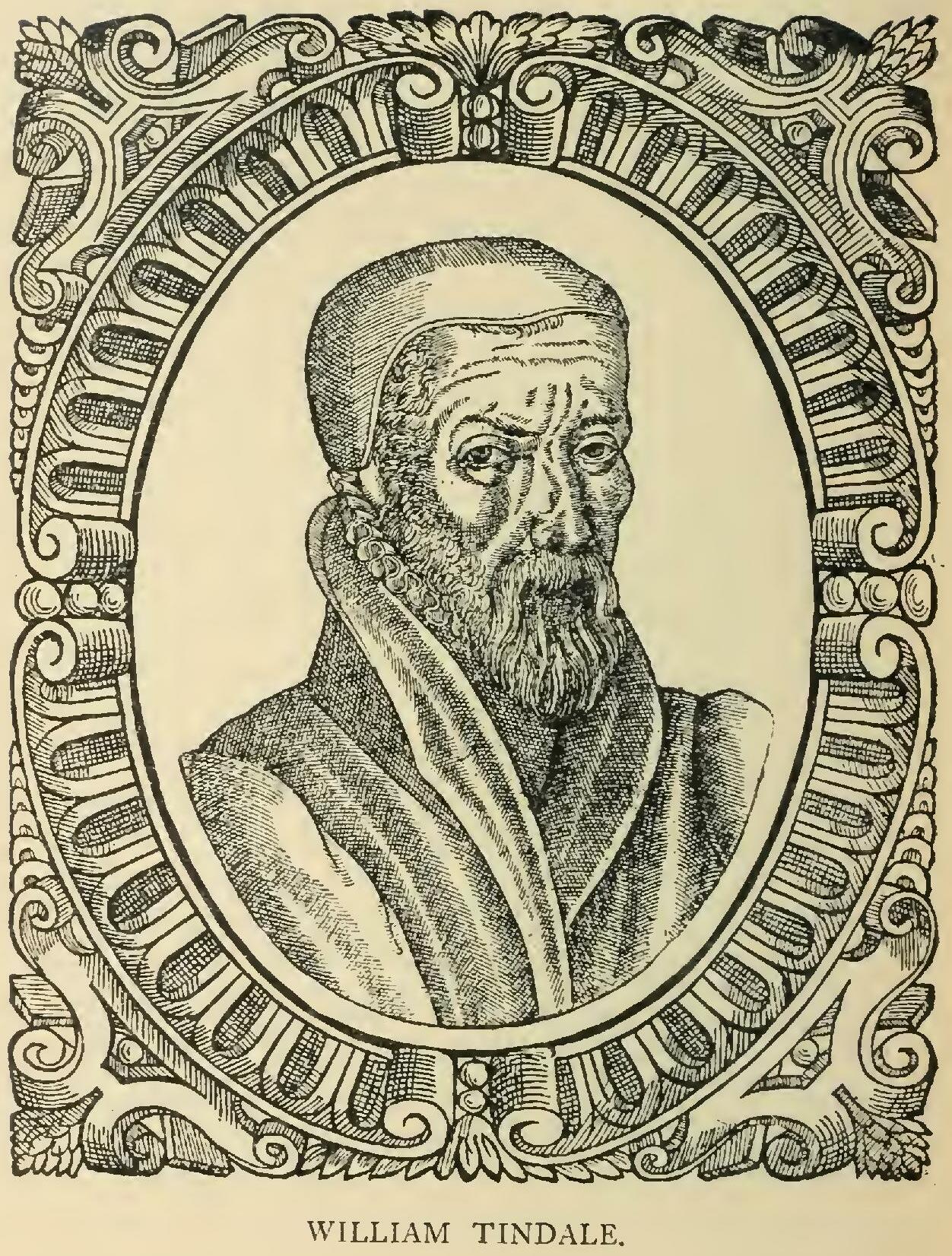
“If God spare my life, ere many years I will cause a boy that driveth the plough shall know more of the Scripture than thou dost.” — William Tyndale, c. 1521, John Foxe, Book of Martyrs
Life: One Man Against a World
William Tyndale was born around 1494 in Stinchcombe, Gloucestershire, England. He studied at Oxford, received his bachelor’s degree in 1512, was ordained as a priest that same year, and earned his master’s degree in 1515, before moving to Cambridge. There he encountered Erasmus’s Greek New Testament (1516) and Luther’s Reformation theology. A conviction took shape in his mind: if the common people of England could read the Scriptures in their own language, the ignorance and darkness of the institutional church would have nowhere to hide.
In 1521 he served as a tutor in the household of Sir John Walsh, and his debates with local clergy convinced him of a root cause: the biblical illiteracy of England’s clergy traced directly back to a Bible locked inside Latin. In 1523 he traveled to London and sought permission from Bishop Cuthbert Tunstall to undertake a translation. The refusal was absolute. It only hardened his resolve — he would go to the continent and do the work alone.
Tyndale left England in the spring of 1524 for the continent. He worked in Hamburg and possibly Wittenberg before arriving in Cologne, where in 1525 he began printing the New Testament. Midway through printing, authorities intervened and forced him to flee to Worms with his manuscripts. In 1526, the first New Testament translated directly from Greek into English was published in Worms and smuggled into England. The Bishop of London publicly burned multiple batches in the square of St. Paul’s Cathedral — but it was too late. Over sixteen thousand copies had already quietly spread among the people. (Wikipedia: William Tyndale)
In 1528 he published The Obedience of a Christian Man, arguing that Scripture’s authority supersedes all human tradition. In 1530 he completed the first English translation of the Pentateuch from the Hebrew. In 1534 he revised and published an improved New Testament.
In 1535, an Englishman named Henry Phillips posed as a friend, lured Tyndale out from under the protection of the Antwerp merchant Thomas Poyntz, and handed him over to imperial authorities. Tyndale was imprisoned in Vilvoorde Castle near Brussels and tried for Lutheran heresy. In October 1536 he was strangled and his body burned. His last prayer, called out toward the sky: “Lord, open the King of England’s eyes.” (World History Encyclopedia: William Tyndale)
God answered that prayer. Only three years later, Henry VIII authorized the Great Bible for distribution across England — and its backbone was Tyndale’s translation.
Timeline
- c. 1494 — Born in Stinchcombe, Gloucestershire, England
- 1512 — Bachelor’s degree from Oxford; ordained as priest
- 1515 — Master’s degree from Oxford
- 1517–1521 — Studied at Cambridge; encountered Erasmus’s Greek New Testament and Luther’s Reformation theology
- c. 1521 — Tutor in Sir John Walsh’s household; made his “plowboy” vow
- 1523 — Traveled to London and sought translation permission from Bishop Tunstall; refused
- 1524 — Left England for the continent; worked in Hamburg and possibly Wittenberg
- 1525 — Began printing the New Testament in Cologne; fled to Worms after authorities intervened
- 1526 — English New Testament published in Worms; smuggled into England
- 1528 — Published The Obedience of a Christian Man
- 1530 — Translated the Pentateuch from Hebrew into English
- 1534 — Published revised New Testament
- 1535 — Betrayed by Henry Phillips; arrested in Antwerp
- October 1536 — Strangled and burned at Vilvoorde
- 1539 — Henry VIII authorized the Great Bible, built largely on Tyndale’s translation
- 1611 — The King James Bible published; approximately 84% of its New Testament derives from Tyndale
Teaching: God’s Word Belongs to Everyone
One: Scripture Above All Human Authority
In The Obedience of a Christian Man (1528), Tyndale argued that God’s Word is the sole ultimate authority — no papal decree, episcopal statute, or church tradition stands above it. He wrote:
“It is impossible to preach Christ, except thou preach against antichrist; that is to say, them which with their false doctrine and violence of sword enforce to quench the true doctrine of Christ.” — William Tyndale, The Obedience of a Christian Man (1528), Wikiquote
This was no armchair theological proposition. The price he paid for this conviction was twelve years of exile, betrayal, and death.
The Obedience of a Christian Man directly inspired Henry VIII to break from Rome and declare the English church free from papal jurisdiction. The historical irony is sharp: the king who later ordered Tyndale’s arrest was the same man who read Tyndale’s book and declared, “This is a book for me and all kings to read.” (Wikipedia: The Obedience of a Christian Man)
Two: Congregation, Not Church
Tyndale translated the Greek ekklēsia as congregation rather than the Roman Catholic preference, church. This translation choice was not a technical matter — it was a theological declaration. The assembly is not a hierarchical institution holding exclusive authority; it is a community of believers gathered in Christ. This insight runs in full accord with the Reformation’s vision of the priesthood of all believers. (World History Encyclopedia)
Three: Justification by Faith, Not Works
Tyndale followed Luther in rendering the Bible’s message of salvation into language ordinary English people could grasp — faith before obedience, grace before works:
“If we believe the promises, with our hearts, and confess them with our mouths, we are safe.” — William Tyndale, The Obedience of a Christian Man, Banner of Truth
Four: Absolute Fidelity to God’s Word
Arrested and imprisoned, he continued translating. On the text of Scripture, his position was death before compromise:
“I call God to record against the day we shall appear before our Lord Jesus, that I never altered one syllable of God’s Word against my conscience, nor would do this day, if all that is in earth, whether it be honor, pleasure, or riches, might be given me.” — William Tyndale, Wikiquote
Connection to the Lord’s Recovery
Brother Witness Lee, in chapter three of The Pursuit of a Christian (“The Translation of the Bible”), explicitly names Tyndale’s place in this history:
“John Wycliffe was the first to translate the Latin Vulgate into English. Afterward William Tyndale and a few others also undertook the translation work.” — Brother Witness Lee, The Pursuit of a Christian, chapter 3, ministrysamples.org
Brother Lee places Tyndale within the unbroken river of Bible translation running from antiquity to the present, leading directly to the birth of the King James Version (1611) — and ultimately to his own work overseeing the Recovery Version. The entire spirit of the Recovery Version is Tyndale’s spirit continued: return to the original Greek and Hebrew, and give God’s people a translation that is both precise and deep.
First: Scripture above all human authority. Tyndale’s core conviction — that Scripture is the sole ultimate authority, and that no tradition, leader, or institution stands above it — aligns completely with the position held by Brother Watchman Nee and Brother Witness Lee. When Brother Nee led co-workers in Shanghai, he required every teaching to begin from Scripture and be confirmed by Scripture. When Brother Lee released the life-studies, he consistently grounded his exposition in original-language vocabulary and context, refusing to let tradition or authority substitute for direct investigation of the text itself.
Second: The nature of the church. Tyndale’s rendering of ekklēsia as “congregation” points to an assembly constituted by believers — not a tiered religious institution. The Lord’s Recovery’s understanding of the church — God’s people gathered in a locality, unattached to any denomination or human organization — moves in the same direction as Tyndale’s translation insight.
Significance: God’s Word Cannot Be Locked Away
Tyndale spent twelve years in exile translating a Bible he could not translate in his own country. His New Testament was burned in massive quantities — and he used the proceeds from book sales to print more. He was betrayed by a man he trusted as a friend — and he kept translating in prison. He was burned at the stake — and three years later his translation became the authorized Bible for all of England.
This is one of the rare events in church history that Paul’s words in Philippians 1:12 describe exactly: persecution only caused God’s Word to spread further.
For believers today — especially those living where the Bible is monopolized by some “authoritative interpretation” — Tyndale’s life is a declaration: God’s Word belongs to every believer, and no person or institution has the right to take it from their hands.
His final prayer was answered. The King of England’s eyes were opened after all.
“All Scripture is God-breathed and profitable for teaching, for conviction, for correction, for instruction in righteousness, That the man of God may be complete, fully equipped for every good work.” — 2 Timothy 3:16–17