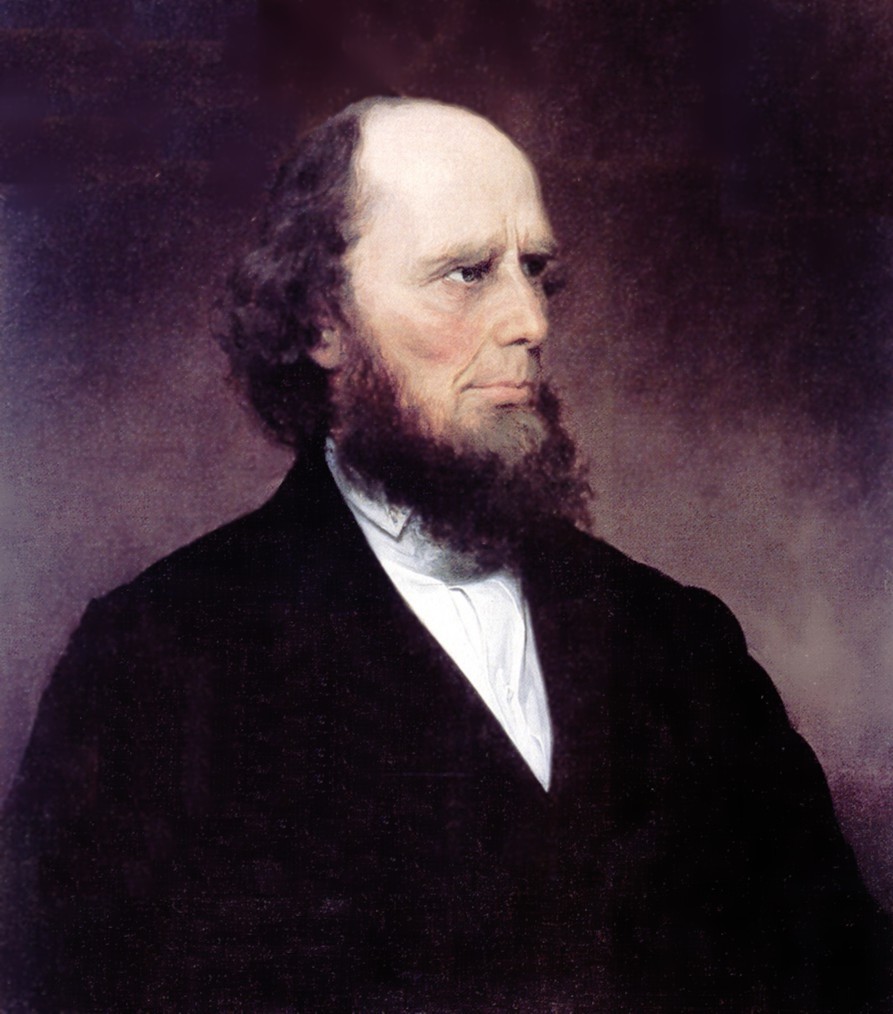
“A revival is not a miracle, nor dependent on a miracle, in any sense. It is a purely philosophical result of the right use of the constituted means — as much so as any other effect produced by the application of means.” — Charles Finney, Lectures on Revivals of Religion, Lecture I
Life
With that single sentence, Charles Finney redefined how the Protestant world thought about revival. Before him, revival was understood as a sovereign act of God — you prayed, waited, and hoped. After him, revival became something you could plan, organize, and execute. The implications — theological, practical, and cultural — are still reverberating two centuries later.
Charles Grandison Finney was born on August 29, 1792, in Warren, Connecticut. His family moved to upstate New York when he was two. He never attended college. Instead, he studied law as an apprentice under Judge Benjamin Wright in Adams, New York — and it was the legal profession, not the seminary, that shaped his mind. Reading Blackstone’s Commentaries on the Laws of England, he kept encountering references to Mosaic law and began studying the Bible to understand them. (Britannica)
On October 10, 1821, Finney went alone into the woods near Adams, determined to settle the question of his soul. He later wrote:
“It seemed as if I met the Lord Jesus Christ face to face… and I fell down at his feet and poured out my soul to Him.” — Memoirs of Charles G. Finney, Chapter II
That same evening, he experienced what he described as a baptism of the Holy Spirit:
“The Holy Spirit descended upon me in a manner that seemed to go through me, body and soul… it seemed like waves… of liquid love.” — Memoirs of Charles G. Finney, Chapter II
The next morning, a client came to his law office for a case. Finney told him: “I have a retainer from the Lord Jesus Christ to plead His cause, and I cannot plead yours.” He never practiced law again. (Memoirs, Chapter III)
Licensed to preach in December 1823 by the St. Lawrence Presbytery, Finney launched into an itinerant ministry across upstate New York’s “Burned-over District” — a term he popularized for a region so thoroughly evangelized that it had been, as it were, burned over by revival fire. His methods were unconventional from the start: he used colloquial language instead of theological jargon, addressed sinners by name in prayer, allowed women to pray aloud in mixed assemblies, and invented the “anxious bench” — a designated seat at the front for those under conviction. These “new measures” scandalized the Calvinist establishment. (Wikipedia)
The Rochester Revival of 1830–1831 was Finney’s greatest triumph. The entire city was affected: shopkeepers closed businesses to attend meetings, taverns shut down, crime rates dropped. (Christian History Institute)
In 1832, Finney moved to New York City, ministering at Chatham Street Chapel and then the Broadway Tabernacle — built for him in 1834–1835 and described as the largest Protestant house of worship in the country. In 1835, he accepted a professorship in systematic theology at the newly founded Oberlin Collegiate Institute in Ohio, on the condition that the school admit Black students and guarantee free speech. He served as president of Oberlin from 1851 to 1866. (Britannica)
Finney was a fierce abolitionist. He denounced slavery from the pulpit as a “great national sin” and refused communion to slaveholders. Oberlin under his leadership became a station on the Underground Railroad. Faculty and students actively resisted the Fugitive Slave Act of 1850. (Wikipedia)
He died on August 16, 1875, in Oberlin, Ohio, two weeks before his eighty-third birthday.
Timeline
- 1792 — Born August 29, Warren, Connecticut
- 1794 — Family moves to upstate New York
- c. 1818 — Begins studying law under Judge Benjamin Wright in Adams, NY
- 1821 — Conversion on October 10 in the woods near Adams; baptism of the Holy Spirit that evening
- 1823 — Licensed to preach by the St. Lawrence Presbytery
- 1824 — Commissioned as missionary; marries Lydia Root Andrews
- 1825–1832 — Itinerant revival ministry across the Burned-over District
- 1827 — New Lebanon Conference: clergy examine Finney’s “new measures”
- 1830–1831 — Rochester Revival — his greatest evangelistic achievement
- 1832 — Moves to New York City; ministers at Chatham Street Chapel
- 1834–1835 — Broadway Tabernacle built for his ministry; Lectures on Revivals of Religion published
- 1835 — Accepts professorship at Oberlin Collegiate Institute
- 1837 — Old School–New School Presbyterian split; Finney leaves Presbyterianism for Congregationalism
- 1846 — Lectures on Systematic Theology published (Vol. 1)
- 1847 — First wife Lydia dies; Systematic Theology Vol. 2 published
- 1848 — Marries Elizabeth Ford Atkinson
- 1851–1866 — Serves as president of Oberlin College
- 1850s — Two evangelistic journeys to England
- 1863/1864 — Elizabeth dies
- 1865 — Marries Rebecca Allen Rayl
- 1868 — Begins writing his Memoirs
- 1875 — Dies August 16 in Oberlin, Ohio
Teaching
Revival as Method
Finney’s most consequential idea was also his most controversial: revival is not a sovereign miracle from heaven but the predictable result of applying the right means. “There is nothing in religion beyond the ordinary powers of nature,” he wrote. A crop comes from sowing seed in prepared soil; a revival comes from preaching truth to prepared hearts. (CCEL, Lectures on Revivals, Lecture I)
This was a direct challenge to the prevailing Calvinist view — that revival comes when and where God sovereignly pleases, and human agency is secondary. Finney inverted the equation: human agency is primary. If ministers use the right methods, revival will come. If revival does not come, the methods were wrong — or the ministers were faithless.
His “new measures” followed logically from this premise: the anxious bench (forerunner of the modern altar call), protracted meetings (daily services lasting weeks), public prayer for sinners by name, and women praying in mixed assemblies. These practices horrified the Calvinist establishment. Nathan Beman and Lyman Beecher convened the New Lebanon Conference in 1827 to examine Finney’s methods; the conference failed to achieve unity among the participants but clarified the differences. (Wikipedia: New Lebanon Conference)
Human Ability and Moral Government
Finney’s revivalism rested on a deeper theological foundation: his conviction that human beings possess the inherent ability to choose or reject God. He rejected total depravity, original sin (“an anti-scriptural and nonsensical dogma”), and the imputation of Christ’s righteousness. He defined regeneration as “the sinner changing his ultimate choice… from selfishness to love” — a natural human capacity, not a supernatural divine gift. (Modern Reformation)
His atonement theology followed the same logic: Christ’s death was not penal substitution (Christ bearing the penalty of sin in the sinner’s place) but a demonstration of God’s moral government — designed to uphold the authority of God’s law and motivate sinners toward repentance. (Modern Reformation)
B.B. Warfield of Princeton, in his Studies in Perfectionism, delivered the sharpest Reformed verdict:
“It is quite clear that what Finney gives us is less a theology than a system of morals. God might be eliminated from it entirely without essentially changing its character.” — B.B. Warfield, Studies in Perfectionism
Perfectionism and the Second Blessing
Finney taught that believers could attain “entire sanctification” — a state of complete consecration to God — through a second decisive experience of the Holy Spirit, subsequent to conversion. This was not sinless perfection (he acknowledged the possibility of relapse) but a radical reorientation of the will. He developed this doctrine alongside Oberlin president Asa Mahan, forming what became known as “Oberlin Perfectionism.” (Wikipedia)
This teaching — a distinct baptism of the Spirit after conversion that brings holiness and power — flowed directly into the Holiness movement of the late nineteenth century and, from there, into Pentecostalism. Every altar call, every crusade, every “decision for Christ” in modern evangelicalism carries Finney’s fingerprints.
Social Reform
Finney refused to separate conversion from social action. His revivals produced not only converts but abolitionists, temperance advocates, and prison reformers. He denied communion to slaveholders. He made Oberlin one of the first American colleges to admit Black students (1835) and the first to regularly admit women (1837). For Finney, genuine conversion necessarily produced a changed life — and a changed life necessarily confronted social injustice. (Christian History Institute)
Connection to the Lord’s Recovery
Brother Watchman Nee read Finney’s works during his formative spiritual years. He was influenced in part by the Wesleyan-holiness tradition and was an extensive reader of Western Christian writers. (Wikipedia: Watchman Nee)
Brother Witness Lee listed Finney among the significant evangelists the Lord raised up in the nineteenth century:
“Besides the great teachers among the Brethren, there were evangelists like C. H. Spurgeon, Charles Finney, D. L. Moody, and R. A. Torrey who were outside the Brethren.” — Brother Witness Lee, “The Fading of Britain”
As with Spurgeon, the classification is telling: Brother Lee categorized Finney as an “evangelist,” not a teacher of the inner life or a builder of the church. Finney’s contribution was in gospel proclamation and revival, not in the deeper matters of the Spirit’s indwelling work or the building of the Body of Christ. The recovery inherited from Finney not his theology (which departs substantially from the recovery’s Reformed-rooted soteriology) but his burden for the Spirit’s power and his refusal to accept a dead, formal Christianity.
Significance
Finney is one of the most consequential — and most contested — figures in the history of Protestant Christianity. He did not merely lead revivals; he changed how the Western church thinks about revival, conversion, and the relationship between divine sovereignty and human agency.
His strengths are real. He broke the grip of a fatalistic Calvinism that told sinners to wait passively for God to convert them. He insisted that the gospel demands a response — now, not later. He refused to separate faith from justice, and his abolition work gave moral credibility to his preaching. His personal courage was extraordinary: he confronted both theological opponents and slaveholders without flinching.
His weaknesses are equally real. His theology of human ability veers into Pelagianism — the ancient heresy that humans can choose God without prior grace. His denial of original sin, penal substitution, and imputed righteousness places him outside the boundaries of historic Reformed orthodoxy. John Williamson Nevin argued that the anxious bench fostered spurious conversions by redirecting focus from genuine repentance to physical action. (Banner of Truth)
Michael Horton’s assessment is severe but not without basis: “Finney is not merely an Arminian, but a Pelagian. He is not only an enemy of evangelical Protestantism, but of historic Christianity of the broadest sort.” (Modern Reformation) Whether or not one accepts that verdict, Finney forces every Christian to confront a question that will not go away: what is the relationship between the Spirit’s sovereignty and human responsibility? Finney gave an answer that tilted too far toward the human side. But the dead formalism he fought against — the religion that uses God’s sovereignty as an excuse for spiritual passivity — was a real disease, and his fire burned it where it stood.
The challenge for today’s believer is to hold both truths: God is sovereign and human response matters. Revival is God’s work and requires human cooperation. The Spirit moves as He wills — and He has chosen to move through broken, willing vessels who cry out and act. Finney got the balance wrong. But he got the urgency right.
“God has found it necessary to take advantage of the excitability there is in mankind, to produce powerful excitements among them, before he can lead them to obey.” — Charles Finney, Lectures on Revivals of Religion, Lecture I