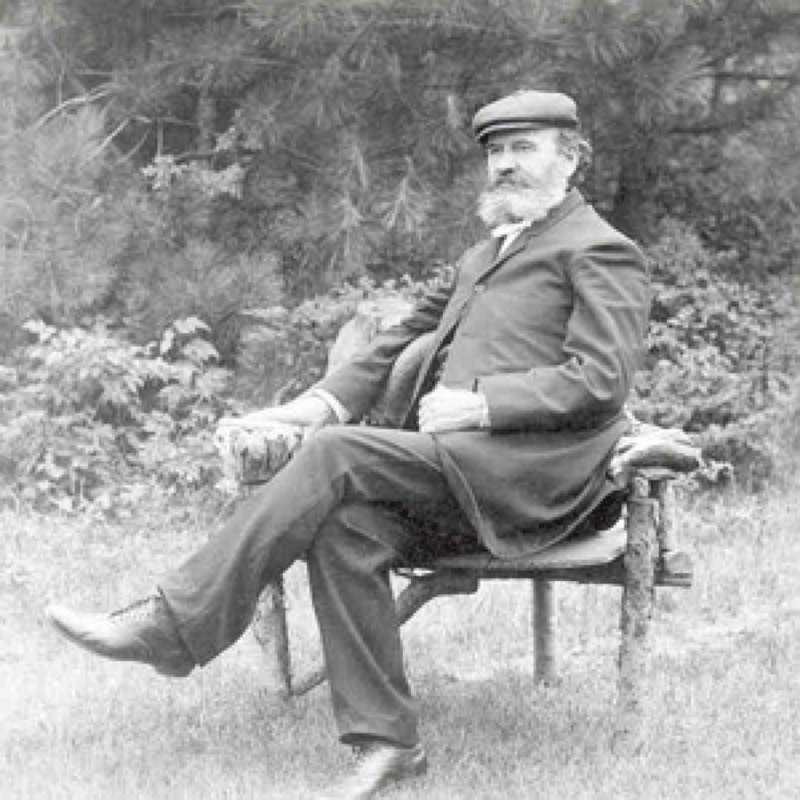
“Once it was the blessing, now it is the Lord; once it was the feeling, now it is His Word; once His gifts I wanted, now the Giver own; once I sought for healing, now Himself alone.” — A.B. Simpson, hymn Himself, ca. 1891, (Hymnary.org)
Life
This hymn captures the deepest turning point in the life of Albert Benjamin Simpson (1843–1919). He went from a pastor chasing blessings to a man pursuing Christ alone. The shift was not a theological adjustment in his head but a real crisis and breakthrough in his life — one that redefined his ministry, his faith, and everything about him.
Simpson was born on December 15, 1843, in Bayview, Prince Edward Island, Canada, and grew up in a strict Scottish Calvinist Presbyterian home. In 1859, at sixteen, he was converted at a revival led by the evangelist Henry Grattan Guinness. (Wikipedia) He entered Knox College at the University of Toronto to study theology, graduated in 1865, and was ordained as a minister in the Canada Presbyterian Church. At just twenty-one years old, he was called to pastor Knox Presbyterian Church in Hamilton, Ontario.
In December 1873, Simpson moved to Chestnut Street Presbyterian Church in Louisville, Kentucky — the largest Presbyterian congregation in Louisville. There, tension grew between his burden for broader evangelism and the conservatism of the congregation. He longed to build a “tabernacle” open to ordinary people, but the church would not follow.
In 1880, Simpson took a position at Thirteenth Street Presbyterian Church in New York City. But ministry in New York brought a deeper crisis: in August 1881, he experienced a divine healing of heart disease that radically altered his theological direction. That October, he received believer’s baptism — an act tantamount to a break within Presbyterianism — and promptly left the denomination to begin independent gospel work among immigrants and neglected people in New York. (Wikipedia)
In 1882, he launched The Gospel in All Lands — described as the first illustrated missionary magazine. That same year, he began informal training courses in New York that later grew into the Missionary Training Institute (later Nyack College). In 1887, at Old Orchard Beach, Maine, he founded two organizations: The Christian Alliance (for domestic work) and The Evangelical Missionary Alliance (for overseas missions). In 1897, the two merged into the Christian and Missionary Alliance (C&MA). (Wikipedia)
On October 29, 1919, Simpson died in Nyack, New York. The C&MA he left behind now operates in eighty-eight countries with approximately 6.7 million members and 24,000 churches. (Wikipedia: C&MA)
Timeline
- 1843 — Born December 15 in Bayview, Prince Edward Island, Canada
- 1859 — Converted at a Guinness revival meeting
- 1865 — Graduated from Knox College; ordained as Presbyterian minister; began pastoring in Hamilton
- 1873 — Moved to Chestnut Street Presbyterian Church, Louisville, Kentucky
- 1880 — Moved to Thirteenth Street Presbyterian Church, New York City
- 1881 — Experienced divine healing in August; baptized in October; left Presbyterianism and began independent gospel work
- 1882 — Founded The Gospel in All Lands magazine; began missionary training courses
- 1885 — Published The Gospel of Healing
- 1887 — Founded The Christian Alliance and The Evangelical Missionary Alliance at Old Orchard Beach
- ca. 1891 — Wrote the hymn Himself
- 1895 — Published The Holy Spirit, or Power From on High
- 1897 — Two alliances merged into the C&MA
- 1900 — Published The Apostolic Church
- 1910 — Published The Cross of Christ
- 1919 — Died October 29 in Nyack, New York
Teaching
The Fourfold Gospel: Christ as Savior, Sanctifier, Healer, and Coming King
Simpson’s most influential theological framework was the “Fourfold Gospel,” which first took shape around 1887 in his New York preaching and was published as a book in 1890. (Internet Archive) Four aspects form the C&MA emblem — the cross, the laver, the oil cruet, and the crown — representing Christ as Savior (redemption on the cross), Sanctifier (cleansing through the Holy Spirit), Healer (restoration of the body), and Coming King (the hope of His return). (GotQuestions.org)
This framework was not a product of systematic theology but a summary of Simpson’s own experience. He encountered different aspects of Christ through conversion, a breakthrough in sanctification, bodily healing, and the hope of the Lord’s return — then integrated these experiences into a Christ-centered gospel formulation.
From Blessing to the Lord Himself: The Heart of the Deeper Life
What set Simpson apart in his view of sanctification was that he fit neatly into neither Wesley’s perfectionism (which held that sin can be eradicated in this life) nor the Keswick suppression model (which held that sin can only be suppressed). Scholars have described his position as “broadly within the Keswick tradition, but departing from traditional Keswick teaching on progressive sanctification and rejecting the suppression theory.” (Wikipedia) His approach was not to fight sin but to be filled with Christ Himself — when Christ fills a person, sin becomes a conquered enemy.
This is exactly what his most famous hymn, Himself, expresses:
“Once it was the blessing, now it is the Lord … Christ, all in all, and forever Christ alone — Christ only let me sing.” — (Hymnary.org)
Another hymn, I Am Crucified with Christ, included in the Recovery Version hymnal, is similarly grounded in Galatians 2:20, applying the reality of co-death and co-life with Christ to sanctification, healing, and the entire Christian life. (Hymnal.net #482)
Missions: “The Regions Beyond”
Simpson was a pioneer of modern faith missions — sending missionaries not through denominational budgets but through prayer and voluntary giving. One of his purposes in founding the C&MA was to bring the gospel to “the regions beyond.” His missionary magazine, The Gospel in All Lands, was the first missionary publication to use photographs, bringing the needs of distant lands vividly before Western believers.
“Prayer is the mighty engine that is to move the missionary work.” — A.B. Simpson, (QuoteFancy)
Among the missionaries he sent, the most significant was Robert A. Jaffray, dispatched to Wuzhou, Guangxi, China, in 1897. Jaffray led C&MA work in South China for thirty-five years, founded the Wuzhou Bible School (later relocated to Hong Kong as the Alliance Bible Seminary), and in 1929 established the Chinese Foreign Missionary Union to send Chinese believers as missionaries to Indonesia, Thailand, and the Philippines. (Wikipedia: Robert A. Jaffray)
Relationship with the Charismatic Movement: “Seek Not, Forbid Not”
Simpson’s stance toward the early Pentecostal movement was nuanced. He profoundly influenced early Pentecostalism — many Pentecostal leaders trained at his Nyack Missionary Training Institute. But when the Pentecostal movement began insisting that tongues were the sole evidence of Spirit-baptism, Simpson publicly dissented. His position has been summarized as “seek not, forbid not” — he did not encourage pursuing tongues as evidence, but neither did he prohibit tongues as a gift. (Wikipedia)
His private journals later revealed that he had privately sought the gift of tongues. He never spoke in tongues, but he did experience what he described as “a baptism of holy laughter” — an immersion of the Spirit accompanied by prolonged laughter. This tension between public caution and private openness makes Simpson a far more complex figure than most realize.
Connection to the Lord’s Recovery
In available research, no record has been found of Brother Watchman Nee or Brother Witness Lee directly quoting or mentioning Simpson. The primary influences on Brother Nee came from the Brethren movement, the Keswick movement, and individuals such as Margaret E. Barber, D.M. Panton, Jessie Penn-Lewis, and T. Austin-Sparks. (Wikipedia: Watchman Nee)
Yet there are striking theological parallels:
First, “from blessing to the Lord Himself” and the central message of the Recovery. Simpson’s hymn Himself — “Once it was the blessing, now it is the Lord” — aligns perfectly with the lifelong emphasis of Brother Watchman Nee and Brother Witness Lee: the Christian pursuit is not gifts, experiences, or doctrines but Christ Himself. Though this hymn is not in the Recovery Version hymnal, its spirit runs through the entire ministry of the Recovery.
Second, I Am Crucified with Christ was included in the Recovery Version hymnal. This hymn, grounded in Galatians 2:20 (both words and music by Simpson), appears on Hymnal.net (#482), indicating that the Recovery has selectively received Simpson’s contribution, at least at the level of hymnody. (Hymnal.net)
Third, a similar direction in sanctification. Simpson rejected both Wesley’s eradication theory and Keswick’s suppression theory, choosing instead the path of being filled with Christ rather than fighting sin. This closely parallels the Recovery ministry’s approach of experiencing Christ as life rather than striving to overcome sin — though the Recovery ministry goes further along this trajectory (emphasizing the life-giving Spirit, the mingled spirit, and the union of the divine Spirit with the human spirit), the starting point is the same.
Significance
Simpson is hard to pin down with a single label. He was a Presbyterian minister who left Presbyterianism. He was a deeper-life teacher who founded a denomination. He opposed the excesses of Pentecostalism yet privately desired the gift of tongues. He taught divine healing yet wrestled deeply in that very area. He wrote over 120 hymns, and the best of them have outlasted any of his books.
His deepest legacy to the church is not the Fourfold Gospel framework (though it shaped millions) but the insight of that hymn: once it was the blessing, now it is the Lord. This is a movement from the periphery to the center — from pursuing what God gives to pursuing God Himself. That movement is real and necessary in every age and every church tradition.
“The moment anything we want becomes more important to us than God, it is an idol.” — A.B. Simpson, (QuoteFancy)