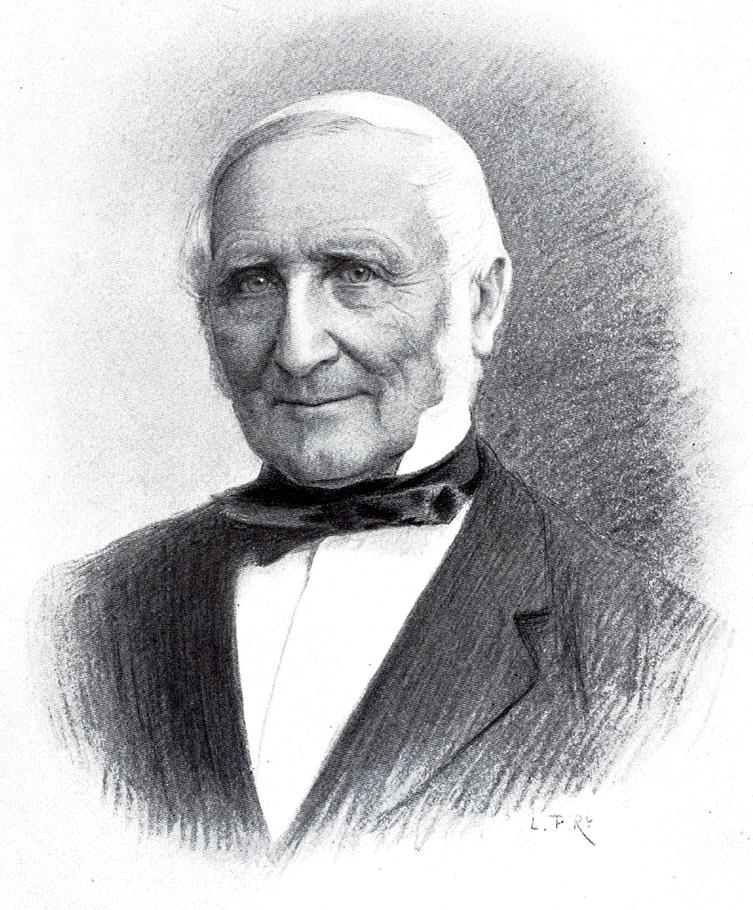
“The historical character of the Fourth Gospel has become to me more and more profoundly credible.” — Frédéric Louis Godet, Commentary on the Gospel of John
Life
Frédéric Louis Godet (1812–1900) is not a household name — even in theological circles, he is often overshadowed by the apostles on whom he commented. Yet his commentaries remain in use more than a hundred and sixty years after publication, while many of his contemporaries have long been forgotten. The reason is straightforward: in an era when liberal theology was sweeping across Europe, Godet chose a difficult path — he did not reject scholarship, but neither did he sell out the faith.
Godet was born on October 25, 1812, in Neuchâtel, Switzerland. His father, Paul-Henri Godet, was a lawyer who died during Frédéric’s early childhood; his mother, Eusébie Gallot, was a pastor’s daughter who founded a girls’ school and devoted herself fully to her son’s education. (Wikipedia)
After completing his early studies in Neuchâtel, Godet went to the Universities of Berlin and Bonn to study theology. In Berlin, he encountered the most important group of theologians of his era — Hengstenberg, Tholuck, Neander, and Schleiermacher. Among them, Neander exerted the greatest influence on him. At the same time, the spiritual influence of Prussian Lutheran pastor Otto von Gerlach and the Pietist leader Baron von Kottwitz kept Godet’s scholarship grounded in piety. (Wikipedia) (Logos)
Between 1836 and 1838, Godet served as pastor in two small parishes. In 1838, he received an extraordinary appointment: he became the tutor of the Crown Prince of Prussia (later Emperor Frederick III), serving in the Berlin court until 1844. (Wikipedia) In 1844, he married Caroline Vautravers and returned to Neuchâtel, first serving as a deacon in the church at Val-de-Ruz. In 1850, he was appointed professor of theology at the University of Neuchâtel, teaching New Testament criticism and exegesis, and later Old Testament introduction as well. He simultaneously served as pastor of a church in Neuchâtel until 1866.
In 1873, Godet helped establish the Free Evangelical Church of Neuchâtel (Église évangélique libre) and served as professor in its theological seminary. This move reflected his dissatisfaction with the state church system and his commitment to the purity of the gospel. (Encyclopædia Britannica, 1911 edition) After his retirement in 1887, his son Georges succeeded him as professor.
Godet died on October 29, 1900, in Neuchâtel, at the age of eighty-eight. He had received honorary doctorates from the Universities of Basel and Edinburgh. (Wikipedia)
Timeline
- 1812 — Born October 25 in Neuchâtel, Switzerland
- c. early 1830s — Went to the Universities of Berlin and Bonn to study theology
- 1836–1838 — Served as pastor in two small parishes
- 1838–1844 — Served as tutor to the Crown Prince of Prussia in Berlin
- 1844 — Married Caroline Vautravers
- 1850 — Appointed professor of theology at the University of Neuchâtel
- 1864–1865 — Published Commentary on the Gospel of John (Commentaire sur l’Évangile de Saint Jean), first edition
- 1871 — Published Commentary on the Gospel of Luke
- 1873 — Helped establish the Free Evangelical Church of Neuchâtel
- 1879–1880 — Published Commentary on the Epistle to the Romans
- 1881 — Published Lectures in Defence of the Christian Faith
- 1886–1887 — Published Commentary on First Corinthians
- 1887 — Retired; his son Georges succeeded him as professor
- 1893–1898 — Published Introduction to the New Testament
- 1900 — Died October 29 in Neuchâtel
Teaching
Refusing to Choose between Scholarship and Faith
Godet occupied a unique position in the nineteenth-century European theological landscape: he refused to choose between academic rigor and gospel faith. In an era when German liberal theology (represented by Baur and the Tübingen School) denied the apostolic authorship of New Testament books, Godet used the same scholarly methods — textual criticism, historical investigation, linguistic analysis — to defend apostolic authorship and the historical reliability of the gospel. (Wikipedia)
His method was to present the interpretations of various scholars, refute those he considered incorrect one by one, and then state his own reading with the reasons behind it. Logos Bible Software described it this way: “His exegesis is both expository and theological… He is scholarly in breadth, acquainted with the commentators that preceded him. Many of their views are cited and refuted in order to present the author’s own correct interpretation.” (Logos)
The 1911 edition of the Encyclopædia Britannica called his commentaries “the most noteworthy commentaries in the French language that have appeared in recent years.” (Encyclopædia Britannica)
The Historicity of the Gospel of John
In his Commentary on the Gospel of John, Godet devoted extensive discussion to defending the apostle John’s authorship of the Fourth Gospel and its historical reliability. In an era when an increasing number of scholars regarded the Gospel of John as a second-century theological composition, Godet maintained that its author was the apostle who had personally experienced the life, death, and resurrection of Jesus. He pointed to the precise geographical details and historical settings in the text — details that only an eyewitness could have written. (Google Books)
Between Strict Orthodoxy and Liberalism
Godet’s theological position was not simply that of a “conservative.” J.N. Darby wrote a lengthy essay, Evangelical Protestantism and the Biblical Studies of Mr. Godet, criticizing Godet for regarding the Bible as “a narrative of revelation” rather than revelation itself, and for treating the Gospels as compilations of “reminiscences” and “recollections” rather than records entirely guided by the Holy Spirit. (Stem Publishing) This indicates that while Godet defended the authority of Scripture, he was not an inerrantist in the Brethren sense — he acknowledged the human element in the biblical text while maintaining its divine authority.
On Christology, Godet held a form of kenotic Christology, the view that Christ voluntarily set aside certain divine attributes at the incarnation. This position later influenced the Free Evangelical Church tradition. (Academia.edu)
He also did not hold the Calvinist position on predestination — Arminian theologians have cited his works. (Wikipedia) On the whole, Godet was a mediating figure: he did not belong to the German liberal camp, nor was he entirely in the Anglo-American evangelical camp, but walked a path between the two — putting scholarship in the service of faith and exegesis in the service of the church.
Connection to the Lord’s Recovery
Brother Witness Lee, in chapter two of The World Situation and God’s Move, “The Fading of Britain,” listed Godet as one of the outstanding Bible expositors in church history:
“W.H. Griffith Thomas and Godet are two of the expositors.” — Brother Witness Lee, “The Fading of Britain”
(Note: Brother Lee grouped Godet under Britain’s spiritual output. Although Godet was Swiss, the English editions of his commentaries were published by T. & T. Clark of Edinburgh and circulated widely in the English-speaking world.)
As one of the most important evangelical New Testament scholarly works of the nineteenth century, Godet’s commentaries were very likely among the reference sources for the Recovery Version Bible footnotes — though this would require a systematic comparison of the footnote texts to confirm.
Godet’s exegetical method — neither credulously accepting liberal criticism nor avoiding scholarly discussion, but establishing the meaning of the text through solid work in the original languages and a comprehensive biblical vision — aligns with the spirit of the Recovery Version Bible footnotes: taking the original text seriously, unfolding the message of the Bible with Christ as the center, while remaining free from any single academic trend.
Significance
Godet’s place in church history is that of a witness who held his balance between two extremes. Nineteenth-century European theology was splitting apart: on one side, increasingly radical liberal criticism — denying miracles, denying apostolic authorship, reducing the Bible to a human religious document; on the other, a conservative backlash that rejected scholarly methods altogether. Godet walked a third path: he used the tools of scholarship without being bound by its presuppositions. He took the questions of the critical scholars seriously, then used the same methods to arrive at different answers.
His commentaries remain in use today not because they are “conservative” — there are many conservative commentaries — but because they are honest. Godet did not dodge difficult questions, did not gloss over troubling details in the text, and did not substitute doctrinal assumptions for exegesis. He let the text speak for itself — then told you what he heard, and why.
For believers today, Godet’s example reminds us of one thing: faithfulness to the Bible does not mean fear of scholarship. You can study the original languages seriously, examine historical backgrounds, listen to the views of different scholars — and still find that this book is trustworthy, and this Christ is real. Scholarship is not the enemy of faith. Laziness and fear are.
“His exegesis is both expository and theological.” — (Logos Bible Software)