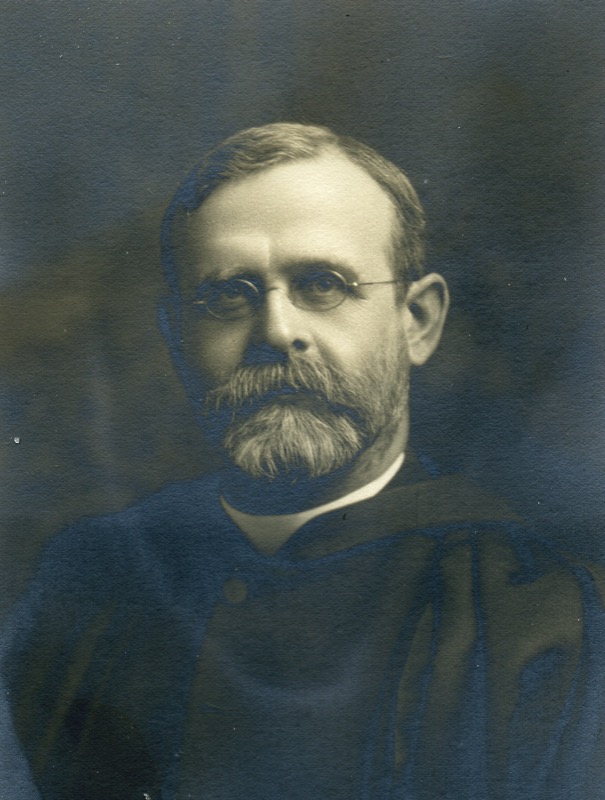
“The relationship of Christianity to Christ is so close and indissoluble that our view of the Person of Christ determines our view of Christianity.” — W.H. Griffith Thomas, Christianity Is Christ
Life
William Henry Griffith Thomas (1861–1924) defies easy classification. He was an ordained Anglican clergyman who carried a deep burden for non-denominational Bible teaching. He was the head of an Oxford college, yet his lifelong concern was not academic prestige but whether ordinary believers could understand the Bible. He was a systematic theologian who wrote the least systematic-sounding sentence imaginable: “Christianity is Christ.”
He was born on January 2, 1861, in Oswestry, Shropshire, England. His father, William Thomas, a draper, died during his childhood. (Wikipedia) He studied theology at King’s College London (1882–1885), then entered Christ Church, Oxford, receiving his Doctor of Divinity degree from Oxford in 1895. He was ordained as an Anglican clergyman in 1885. (Theopedia)
In 1905, Griffith Thomas became Principal of Wycliffe Hall, Oxford — one of the most important evangelical training institutions within the Church of England. He “personally undertook the greater part of the teaching” and has been described as “one of the most distinguished Principals of Wycliffe Hall,” commemorated to this day by a bronze bust in the college dining hall. (Wikipedia: Wycliffe Hall)
In 1910, he left Oxford and moved to Toronto, Canada, where he served as Professor of Old Testament Literature and Exegesis at Wycliffe College (sharing its name with the Oxford institution but a separate school) until 1919. (Theopedia)
In 1919, Griffith Thomas moved to Philadelphia, devoting himself to conference speaking and writing. In the summer of 1920, he traveled with Charles G. Trumbull to Japan and China to survey mission fields. In January 1921, he delivered a talk titled “Modernism in China” at the Presbyterian Social Union in Philadelphia, criticizing liberal tendencies among missionaries in China. (Wikipedia)
In 1924, Griffith Thomas co-founded the Evangelical Theological College — later renamed Dallas Theological Seminary — together with Lewis Sperry Chafer. He was to serve as its first professor of systematic theology, but he never saw opening day. On June 2, 1924, Griffith Thomas died at the age of sixty-three. Dallas Theological Seminary later established the W.H. Griffith Thomas Memorial Lectureship in his honor. (Wikipedia: Dallas Theological Seminary) (Wikipedia: Chafer)
Timeline
- 1861 — Born January 2 in Oswestry, Shropshire, England
- 1882–1885 — Studied theology at King’s College London
- 1885 — Ordained as an Anglican clergyman
- 1895 — Received Doctor of Divinity degree (D.D.) from Oxford
- c. 1909 — Published Christianity Is Christ
- 1905–1910 — Served as Principal of Wycliffe Hall, Oxford
- 1910–1919 — Professor of Old Testament at Wycliffe College, Toronto
- 1911 — Published Methods of Bible Study
- 1913 — Published The Holy Spirit of God, the L.P. Stone Lectures at Princeton
- 1919 — Moved to Philadelphia for conference and writing ministry
- 1920 — Traveled to Japan and China to survey mission fields
- 1921 — Delivered the “Modernism in China” address
- 1924 — Co-founded Evangelical Theological College (later Dallas Theological Seminary) with Chafer; died June 2
- 1930 — Posthumous publication of The Principles of Theology
Teaching
Christianity Is Christ
Griffith Thomas’s most representative contribution is the argument he made in Christianity Is Christ. (Internet Archive) His central thesis: Christianity differs from every other religion in that it cannot be separated from its Founder.
“A man may be a faithful Muslim without caring anything about the personality of Muhammad.”
Christianity is different. Remove the Person of Christ — His life, His death, His resurrection, His ascension — and nothing remains. “Christianity is neither more nor less than a relationship with Christ.”
This was no slogan. Griffith Thomas devoted an entire book to demonstrating that Christianity’s historical origin is in Christ, its doctrinal foundation is in Christ, its ethical standard is in Christ, its spiritual experience is in Christ — take away this Person and everything collapses.
The Doctrine of the Holy Spirit
In 1913, Griffith Thomas delivered the L.P. Stone Lectures at Princeton Theological Seminary on the subject of the Holy Spirit. These lectures were later published as The Holy Spirit of God. (Internet Archive) In his preface he identified a problem: the doctrine of the Holy Spirit had long been neglected in systematic theology — compared with Christology and ecclesiology, pneumatology remained a “neglected” field.
“The Holy Spirit is the sole guarantee that religion shall be a personal fellowship with God.”
“The historical revelation of God given in the Person of Christ is mediated and made real to the soul by the Holy Spirit.”
He positioned the Spirit as the “Mediator” of Christ’s revelation — Christ is the revelation in history; the Spirit is the One who makes that revelation personal and real. This framework — Christ as the objective, the Spirit as the subjective — was later adopted by many evangelical theologians.
The Threefold Definition of Faith
Griffith Thomas offered a clear threefold definition of faith: faith begins with conviction of the mind (based on sufficient evidence), continues in confidence of the heart, and is completed in commitment of the will. This “mind, heart, will” framework of faith was later cited by Alister McGrath in Dawkins’ God. (Wikipedia)
A Systematic Statement of Anglican Evangelicalism
His posthumous work The Principles of Theology (published 1930) is a systematic exposition of the Thirty-Nine Articles of the Church of England — five hundred and forty pages that remain one of the most representative works of Anglican evangelical systematic theology. (Internet Archive)
Connection to the Lord’s Recovery
Existing research has found no record of Brother Watchman Nee or Brother Witness Lee directly citing Griffith Thomas. The primary Western influences on Brother Nee came from the Brethren tradition (J.N. Darby, George Müller), the inner-life tradition (Madame Guyon, Andrew Murray), and the Higher Life movement (Jessie Penn-Lewis). Griffith Thomas does not appear on any known list of influences. (WatchmanNee.org)
Yet his central thesis — “Christianity is Christ” — resonates deeply with the Lord’s recovery. Brother Witness Lee emphasized throughout his ministry that Christ is not merely the founder or example of Christianity — He is the content, the reality, and the everything of the Christian life. The Recovery Version note on Colossians 1:15–18 defines Christ as “the Firstborn of all creation” and “the Head of the church” — Christ is not an accessory to Christianity; He is Christianity itself. What Griffith Thomas argued in the language of systematic theology, the ministry of the recovery lives out in the language of experiencing Christ.
His pneumatological framework — the Spirit as the One who makes Christ’s historical revelation personal and real — also aligns with the direction of the recovery’s ministry. Brother Witness Lee taught in The Economy of God that the Spirit is the “transmission” of the processed Triune God reaching the human spirit — precisely what Griffith Thomas called the “Mediator of historical revelation.” The recovery’s ministry goes further, extending the Spirit’s work from “mediating revelation” to “dispensing the Triune God into man as life.”
Significance
Griffith Thomas is the kind of figure church history tends to skip over — he lacked the pulpit drama of Spurgeon, the evangelistic scale of D.L. Moody, and the movement-defining controversy of J.N. Darby. But he accomplished something quiet and lasting: he wrote the most systematic statement of faith for Anglican evangelicalism, he laid the founding vision of Dallas Theological Seminary, and he gave early twentieth-century apologetics its most concise declaration — Christianity is Christ.
He died at sixty-three, before the seminary he helped create ever held a class. But his writings — especially Christianity Is Christ and The Holy Spirit of God — are still read. The question he asked remains the most fundamental one: “What do you think of Christ?” Your answer to that question determines your answer to everything else about Christianity.
“Christianity is neither more nor less than a relationship with Christ.” — W.H. Griffith Thomas, Christianity Is Christ