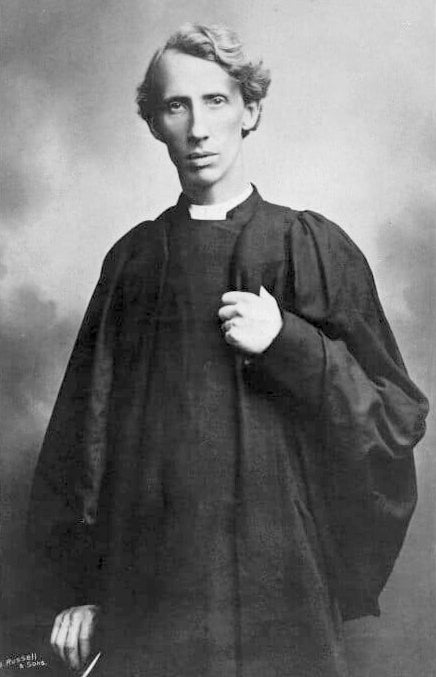
“For two years my Bible had been a closed book; two years of sorrow and suffering. A strange, alluring materialism was in the air… I put those books away in a cupboard and turned the key, and they stayed there for seven years. I bought a new Bible and began to read it with an open mind… that Bible found me.” — G. Campbell Morgan, (Sharper Iron)
Life
Those words came from a man who would become known as the “Prince of Expositors.” George Campbell Morgan (1863–1945) never attended seminary, held no formal degree, and at twenty-five was rejected by the Methodist ordination board — the examiners noting he “showed no promise whatsoever.” (Preceptaustin.org) His father sent a telegram of six words: “Rejected on earth, accepted in heaven.”
Morgan was born on December 9, 1863, in Tetbury, Gloucestershire, England. His father George Morgan had belonged to the strict Plymouth Brethren before leaving to become a Baptist minister. (Wikipedia) At thirteen Morgan preached his first sermon at the Monmouth Methodist Chapel — influenced by D.L. Moody’s 1873 visit to England. By fifteen he was preaching regularly in village chapels and was known as the “boy preacher.” (The Church in Toledo)
Between 1883 and 1888 he taught at the Jewish Collegiate School in Birmingham. It was during this period that he experienced a profound crisis of faith. The materialism of Darwin, Huxley, Spencer, and Tyndall was sweeping through intellectual circles, and Morgan was drawn in and shaken. He locked his Bible in a cabinet and did not open it for two years. Then he bought a new Bible and read it again with an empty heart — the Bible found him. From that moment he set the course of his life: “Since then, I have lived for one purpose — to preach the teachings of the Book that found me.” (GotQuestions.org)
After his rejection by the Methodists in 1888, Morgan was ordained as a Congregationalist minister in 1890 and pastored in Stone, Rugeley, Birmingham, and London. In 1896, D.L. Moody invited him to America to lecture at the Moody Bible Institute — the first of his fifty-four Atlantic crossings. (The Church in Toledo) After Moody’s death in 1899, Morgan took over as director of the Northfield Bible Conference, a post he held for five years.
In October 1904 Morgan became pastor of Westminster Chapel in London. The chapel was then called “the white elephant of Congregationalism” — it was declining. Morgan revived it: the two thousand five hundred seats were regularly filled, and the Friday evening Bible study drew fifteen hundred to seventeen hundred people. (Preceptaustin.org) He served there until around 1917.
From 1919 to 1932 Morgan toured across America, preaching in nearly every state. He taught at the Bible Institute of Los Angeles (BIOLA) and Gordon College in Boston, and pastored at the Philadelphia Tabernacle Presbyterian Church (1929–1932). (Wells of Grace)
In 1933, at nearly seventy, Morgan returned to Westminster Chapel for a second pastorate. In 1939 he invited Martyn Lloyd-Jones to serve as associate pastor. Despite their theological differences — Morgan leaned Arminian, Lloyd-Jones was a Calvinist — they deeply appreciated each other. In 1943 Morgan retired and Lloyd-Jones succeeded him as senior pastor. (MLJ Trust) At Morgan’s memorial service, Lloyd-Jones called him “God’s gift to His church.” (Preceptaustin.org)
Morgan died in London on May 16, 1945, at the age of eighty-one. Over his lifetime he preached more than twenty-three thousand sermons and published approximately seventy to eighty books.
Timeline
- 1863 — Born December 9 in Tetbury, Gloucestershire, England
- 1876 — Preached his first sermon at age thirteen at the Monmouth Methodist Chapel
- 1881 — Graduated from the Douglas School in Cheltenham
- 1883–1888 — Taught at the Jewish Collegiate School in Birmingham; experienced a crisis of faith
- 1886 — Left teaching to enter full-time ministry; married his cousin Nancy
- 1888 — Rejected by the Methodist ordination board
- 1890 — Ordained as a Congregationalist minister
- 1896 — Invited by D.L. Moody for his first visit to America; began transatlantic ministry
- 1899 — Succeeded Moody as director of the Northfield Bible Conference
- 1902 — Received an honorary Doctor of Divinity from Chicago Theological Seminary
- 1903 — Published The Crises of the Christ
- 1904–1917 — First pastorate at Westminster Chapel
- 1907–1911 — Published The Analyzed Bible (multi-volume)
- 1911–1914 — Also served as president of Cheshunt College, Cambridge
- 1919–1932 — Itinerant preaching and teaching across America
- 1933–1943 — Second pastorate at Westminster Chapel
- 1939 — Invited Martyn Lloyd-Jones as associate pastor
- 1943 — Retired; Lloyd-Jones succeeded him
- 1945 — Died May 16 in London
Teaching
Expository Method: Read Forty or Fifty Times Before Speaking
Morgan’s expository method rested on one discipline: before beginning to analyze a passage, read it through forty to fifty times, allowing the overall structure and central message to emerge on their own. His steps were: (1) survey — read repeatedly, grasp the whole; (2) condense — identify the main statements and arguments; (3) expand — see how each part develops the central message; (4) dissect — examine individual words and images in their context. Only after completing these four steps did he consult commentaries to verify his conclusions. (Heavenly Secret)
When asked the secret of his preaching success, his answer was always the same: “I always tell them the same thing — work, hard work, work.” (Preceptaustin.org)
The Whole Bible Is One Message
Morgan’s The Analyzed Bible and The Living Messages of the Books of the Bible series embodied his core conviction: the whole Bible is one unified message. His approach was “bird’s-eye” — first grasp the outline and governing purpose of each book, then analyze the parts. His posthumous works An Exposition of the Whole Bible (published 1959) and The Unfolding Message of the Bible (published 1961) represent the fullest expression of this vision.
In 1943 he made a statement revealing his position: “I am absolutely convinced that all the promises made to Israel find, are finding, and will find their complete fulfillment in the church.” (Wikipedia)
Christ-Centered
All of Morgan’s exposition pointed to Christ. His The Crises of the Christ (1903) examined the decisive moments in Jesus’ life — birth, baptism, the wilderness temptation, the mount of transfiguration, the cross, the resurrection — each one a revelation of Christ’s person and work. (Archive.org)
He had a personal motto: “The world needs to see a Person. Am I helping the world to see Him?” (Enjoying the Journey)
Facing Liberalism
Morgan contributed the essay The Purposes of the Incarnation to The Fundamentals, standing alongside conservative theologians such as B.B. Warfield and James Orr. (Wikipedia: The Fundamentals) But his apologetic style was not combative — it was constructive: he did not make a career of attacking liberalism but responded by positively unfolding the message of the Bible itself. His own life proved the point — during his crisis of faith he returned to the Bible not through argument but by reading the Book itself again.
Connection to the Lord’s Recovery
Existing research has found no record of Brother Watchman Nee or Brother Witness Lee directly citing Morgan. But one indirect connection is worth noting: the young T. Austin-Sparks was part of a Bible study group led by Morgan — and Austin-Sparks later became one of the figures who profoundly influenced Brother Watchman Nee. (Igreja Batista Renovada Cristã) Morgan’s emphasis on the overall structure of the Bible and its Christ-centered message may have indirectly influenced the ministry of the recovery through Austin-Sparks.
Churches in the Lord’s recovery are not unfamiliar with Morgan. The website of the church in Toledo, Ohio, carries a full biography of Morgan, (The Church in Toledo) indicating that believers in the recovery consider Morgan’s Bible teaching worthy of recommendation.
Theologically, Morgan and the ministry of the recovery share a core direction: the Bible is one unified message, and its center is Christ. Morgan used a “bird’s-eye” method to grasp the center of each book and point it toward Christ; Brother Witness Lee’s The Basic Revelation in the Holy Scriptures and the footnotes of the Recovery Version likewise unfold the entire Bible with Christ as its center. The two share a deep similarity in method and spirit.
Significance
Morgan’s life carries two layers of significance for believers today.
The first is his expository legacy. In an age when preaching grows increasingly shallow and topical, Morgan insisted on one thing: let the Bible speak for itself. Not using Scripture to prove preconceived ideas, but reading the text again and again until its structure and message become self-evident. His method — read forty times before speaking — requires no seminary degree; any believer willing to invest the time can practice it.
The second is his faith experience. In his early twenties he went through deep doubt, locked his Bible in a cabinet, and walked into the fog of materialism. His way out was not through argument, not through someone else convincing him, but through reading that Book again for himself — and discovering that he was not reading the Bible; the Bible was reading him. “That Bible found me.”
This experience is a comfort to any believer passing through any kind of spiritual crisis: you do not need to find faith to believe the Bible — the Bible itself will find you. You only need to open it.
“Holiness is not the inability to sin, but the ability not to sin.” — G. Campbell Morgan, (GotQuestions.org)