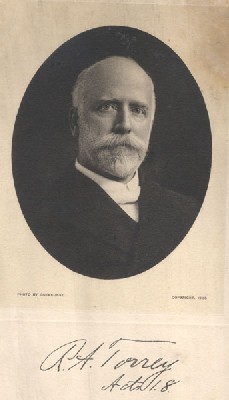
“Any man who is in Christian work who has not received the baptism with the Holy Spirit ought to stop his work right where it is and not go on with it until he has been clothed with power from on high.” — R.A. Torrey, The Baptism with the Holy Spirit
Life
These words came from a man who once did not believe in God. Reuben Archer Torrey (1856–1928) entered Yale at fifteen as an agnostic and a drunkard. During his junior year, life became an unbearable burden; one night he rose from his bed and told God that if God would give him relief, he would preach the gospel. (Wholesome Words) During his time at Yale Divinity School, he sank even deeper into skepticism. He later recalled: “I was the leader in the seminary of the New Theology and destructive criticism camp.” (Moody Media) But in the end, God brought him back from darkness into light through his study of the evidences of Christianity. (Wholesome Words)
In 1878, Torrey graduated from Yale Divinity School and was ordained as a Congregationalist minister. From 1882 to 1883, he studied at the University of Leipzig in Germany (under Old Testament scholar Franz Delitzsch) and the University of Erlangen (under New Testament scholar Theodor Zahn) — it was in Germany that he saw firsthand the hollow foundation of liberal theology and returned decisively to a conservative, orthodox position. (Wikipedia)
In 1889, D.L. Moody personally recruited Torrey to serve as the first superintendent of the Chicago Evangelization Society’s Bible Institute (later renamed Moody Bible Institute). When Moody first heard about Torrey, he said: “You make my mouth water for him.” (Moody Bible Institute Archives) Torrey served at Moody Bible Institute for nearly twenty years (1889–1908), also pastoring the Chicago Avenue Church (now Moody Memorial Church) from 1894 to 1906. He laid the foundation for the school’s curriculum — combining theological instruction with practical Christian work (street evangelism, prison visitation, hospital ministry). This model later became the template for over two hundred Bible institutes worldwide. (Moody Media)
After Moody’s death in 1899, Torrey took up his evangelistic torch. From 1902 to 1906, he partnered with singer Charles McCallon Alexander on one of the largest global evangelistic tours in church history — traveling through Australia, New Zealand, India, China, Japan, Great Britain, and North America. In Australia and New Zealand alone, approximately twenty thousand people were recorded as converts; in Liverpool, England, the Tournament Hall, seating twelve thousand five hundred, was filled to capacity for nine consecutive weeks, and on the final day about thirty-five thousand were turned away. The London campaign (February to June 1905) brought over seventeen thousand converts. In total, approximately one hundred thousand people professed faith during these tours. (Wikipedia) (Wholesome Words)
In 1912, Torrey became dean of the Bible Institute of Los Angeles (BIOLA, now Biola University) and served as the first pastor of the Church of the Open Door (1915–1924). On October 26, 1928, Torrey passed away at his home in Asheville, North Carolina, at the age of seventy-two. (Wikipedia)
Timeline
- 1856 — Born January 28 in Hoboken, New Jersey
- 1871 — Entered Yale at age fifteen
- 1875 — Graduated from Yale (A.B.); converted during his college years
- 1878 — Graduated from Yale Divinity School (B.D.); ordained as a Congregationalist minister
- 1878–1882 — Pastored in Garrettsville, Ohio
- 1879 — Married Clara Smith
- 1882–1883 — Studied at the University of Leipzig and the University of Erlangen in Germany
- 1883–1889 — Pastored in Minneapolis; served as city mission superintendent
- 1889 — Invited by D.L. Moody to serve as the first superintendent of the Chicago Bible Institute (Moody Bible Institute)
- 1893 — Published How to Bring Men to Christ
- 1895 — Published The Baptism with the Holy Spirit
- 1898 — Published What the Bible Teaches; daughter Elizabeth died of diphtheria
- 1900 — Published How to Pray
- 1902–1906 — Global evangelistic tour with Alexander; approximately one hundred thousand converts
- 1908 — Founded the Montrose Bible Conference
- 1910 — Published The Person and Work of the Holy Spirit; began co-editing The Fundamentals
- 1912–1924 — Served as dean of the Bible Institute of Los Angeles (BIOLA)
- 1913 — Published a critique of the tongues phenomenon in the Pentecostal movement
- 1915–1924 — Served as first pastor of the Church of the Open Door
- 1928 — Died October 26 in Asheville, North Carolina
Teaching
The Baptism with the Holy Spirit: Distinct from Regeneration, for Power in Service
Torrey’s most central teaching throughout his life was that the baptism with the Holy Spirit is an experience distinct from regeneration, available to every believer, with the purpose of receiving power for service.
“The baptism with the Holy Spirit is a work of the Holy Spirit separate and distinct from His regenerating work. One who has been regenerated by the Spirit is one thing; one who has been baptized with the Spirit is another thing, a further thing.” — R.A. Torrey, The Baptism with the Holy Spirit
“The baptism with the Holy Spirit is not for the purpose of cleansing from sin, but for the purpose of empowering for service.” — R.A. Torrey, (quoted by Craig T. Owens)
This teaching profoundly influenced both the Holiness movement and the Pentecostal movement. The difference: Pentecostals regarded tongues as the necessary evidence of Spirit baptism; Torrey rejected this. He maintained that the manner in which the Spirit’s power manifests depends on God’s calling for each individual — the Spirit distributes gifts according to His own sovereignty, and no single gift serves as a universal sign. (Christian History Institute)
The Holy Spirit Is a Person, Not an Influence
Torrey repeatedly emphasized that the Holy Spirit is a divine Person, not a vague force:
“If we think of the Holy Spirit merely as a divine influence or power, our thought will be, ‘How can I get more of the Holy Spirit?’ But if we think of the Holy Spirit as a divine Person, our thought will be, ‘How can the Holy Spirit get more of me?’” — R.A. Torrey, The Person and Work of the Holy Spirit
This distinction — “my getting more of the Holy Spirit” versus “the Holy Spirit getting more of me” — is the most penetrating line in Torrey’s pneumatology.
Prayer and Revival
Torrey regarded prayer as the one indispensable human element in revival:
“Every great awakening in the history of the Church from the days of the apostles to the present time has been the result of prayer. There have been revivals without much preaching, there have been revivals with absolutely no organization, but there has never been a true revival without much prayer.” — R.A. Torrey, The Place of Prayer in Evangelism
“Many churches are praying for a revival, but they don’t really want a revival … If they knew what a real revival meant — how many believers would have their hearts searched and judged — the real cry of the church would be: ‘Oh, God, don’t send us a revival.’” — R.A. Torrey, How to Pray
Biblical Inerrancy and The Fundamentals
From 1910 to 1915, Torrey served as one of the editors of The Fundamentals: A Testimony to the Truth. This twelve-volume, ninety-essay collection was funded by oil magnates Lyman and Milton Stewart and sent free of charge to tens of thousands of pastors, missionaries, and church leaders, defending biblical inerrancy, the virgin birth, substitutionary atonement, bodily resurrection, and the historicity of miracles. (Wikipedia: The Fundamentals) Torrey personally contributed articles on the place of prayer in evangelism and methods of personal evangelism. (Blue Letter Bible)
Personal Evangelism
Torrey was a master of personal evangelism — one-on-one soul work. His method was to place the Bible directly in the inquirer’s hands, have them read a selected passage, and then ask leading questions about the text until the person understood the truth. He did this everywhere — “on the street, on trolley cars, on buses, on trains, and on boats.” Some church historians have argued that since the apostles, no one has done more to advance the practice of personal evangelism than Torrey. (Wholesome Words)
Connection to the Lord’s Recovery
Brother Watchman Nee’s Shanghai Gospel Bookroom published a Chinese translation of Torrey’s How to Bring Men to Christ, listed under “general information” books — indicating that Brother Nee considered Torrey’s personal evangelism practice valuable enough to translate and publish. (WatchmanNee.org)
Brother Witness Lee mentioned Torrey in at least three places. He listed Torrey alongside Charles Spurgeon, Charles Finney, and D.L. Moody, calling them “evangelists” raised up by God in the previous century:
“Besides the great teachers in the Brethren, there were evangelists like Spurgeon, Finney, Moody, and Torrey, who were not in the Brethren.” — Brother Witness Lee, “The Fading of Britain”
Brother Witness Lee also read Torrey’s How to Bring Men to Christ in his youth. He recalled that Torrey provided Scripture passages for dealing with different types of people — a method that was helpful at the time, but Brother Lee later discovered that merely matching verses to categories was not sufficient for the various situations encountered in actual gospel preaching; a deeper knowledge of the entire Bible was needed. (Ministry Samples: “Preaching the Gospel by Speaking the Word”)
The core connection with the Recovery lies in the teaching on the Holy Spirit. Torrey insisted that the baptism with the Holy Spirit is an experience distinct from regeneration, given for the purpose of receiving power. The ministry of the Recovery also emphasizes that believers need to be filled with the Holy Spirit — but the Recovery goes further: the Spirit does not merely grant power; the Spirit Himself is the ultimate consummation of the processed Triune God (1 Cor. 15:45), dwelling in the believer’s spirit (Rom. 8:16) as the supply of life, not merely the power for service. Torrey’s contribution on the “power” side is clear, but the dimensions of “life” and “building up the Body” received their full development only in the ministry of the Recovery.
Significance
Torrey’s life is the story of a scholar turned evangelist, a skeptic turned defender of the faith. At Yale he led the liberal camp; at Leipzig he touched the hollow core of liberalism with his own hands; then he spent the rest of his life doing one thing: bringing people to Christ through the power of the Holy Spirit.
His legacy has two sides. One is practical: he established the curricular model of Moody Bible Institute, training generation after generation of preachers and missionaries; the Fundamentals he co-edited became a cornerstone of twentieth-century Christian apologetics; his methods of personal evangelism remain widely used today. The other is spiritual: throughout his life he called believers to receive the baptism with the Holy Spirit — not to remain in the experience of regeneration alone, but to enter into the reality of the Spirit’s power.
His limitations deserve honest acknowledgment as well. His understanding of the Holy Spirit concentrated on the “power” dimension — receiving power to preach the gospel and to serve — and entered less into the deeper aspects of the Spirit as life and as the Spirit who builds up the Body. His insistence on faith healing led to personal tragedy — in 1898 he lost his daughter because he refused to use the available diphtheria antitoxin treatment. (Veracity) His relationship with the “Fundamentalist movement” that later rose in his name is also complex — he would have been uneasy with the narrowness and combativeness that movement eventually took on.
But the question he asked still cuts to the heart: Have you received the power of the Holy Spirit? If not, he said, you should stop all your work until you have been clothed with power from on high. That call, regardless of how theological frameworks shift, remains true.
“We are getting more and more dependent upon men, machinery, and methods, and less and less dependent upon God.” — R.A. Torrey, The Place of Prayer in Evangelism